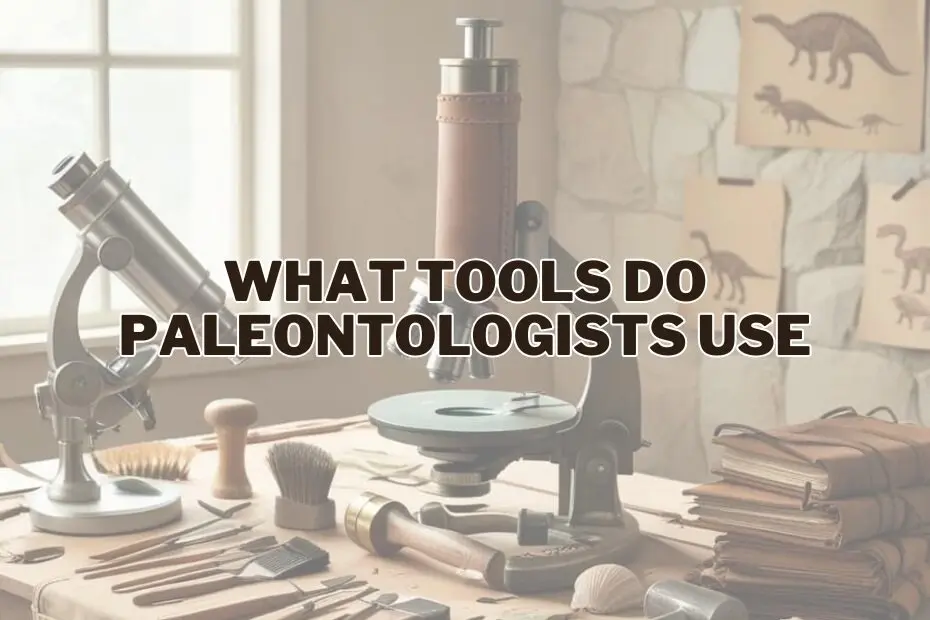
The pursuit of understanding prehistoric life on Earth is far more complex than simply wandering into the field and pulling ancient bones from the ground. Paleontology is a meticulous, highly disciplined science that bridges geology, biology, and history. Uncovering secrets that have been buried for millions of years requires not only deep scientific knowledge but also a highly specialized array of tools.
From the rugged terrain of remote desert badlands to the sterile environments of university laboratories, the equipment paleontologists use must balance raw power with extreme delicacy. Every fossil recovery operation is a race against time, weather, and natural erosion. To successfully extract a fragile specimen without destroying its scientific value, field researchers rely on a curated toolkit.
These instruments range from heavy-duty earth-moving equipment to high-tech spatial positioning devices and micro-precision dental tools. Together, they allow scientists to reconstruct ancient ecosystems, trace evolutionary pathways, and preserve the delicate remains of long-extinct organisms.
1. The Rock Hammer
The rock hammer stands as the universal symbol of field geology and paleontology. It is the first tool unholstered when a scientist steps onto an outcrop. Designed specifically for geological fieldwork, this tool features a dual-purpose head. One side consists of a flat, blunt face engineered for striking chisels or shattering dense rock, while the opposite side features a pointed pick or a flat chisel-edge designed for splitting stratified rock layers.
Using a rock hammer is an art form that requires patience and experience. Paleontologists do not simply smash rocks indiscriminately; instead, they analyze the natural bedding planes of sedimentary formations. By striking the rock at precise angles, they can split layers cleanly to reveal the fossilized impressions of ancient leaves, insects, or shells hidden within. A single misplaced blow can shatter a priceless specimen, making hand-eye coordination and an understanding of rock mechanics absolutely vital.
2. The Chisel
When a fossil is located within a hard rock matrix, a rock hammer alone is often too blunt an instrument to safely extract it. This is where the chisel becomes indispensable. Handheld steel chisels allow field researchers to focus the kinetic energy of a hammer blow onto a highly specific point, allowing for the controlled removal of surrounding rock.
Chisels come in various shapes and sizes, from broad-faced chisels used to split large slabs of shale to fine, pointed chisels designed for close-quarters work around a delicate specimen. By positioning the chisel along natural fractures or slightly away from the fossil itself, paleontologists can gently pry open rock layers. This minimizes the risk of micro-fractures propagating through the fossil bone, preserving its structural integrity during the initial extraction phase.
3. The Brush
Once a fossil is exposed to the elements, the process of cleaning and visualization begins immediately. The brush is the primary tool used to clear away loose sediment, dust, and weathered debris that obscure the fine details of the find. Without constant brushing, small fragments of bone can easily be lost or overlooked in the surrounding dirt.
Paleontologists carry an assortment of brushes into the field. Large, soft-bristled brushes, such as paintbrushes, are used to sweep away bulk dust from flat surfaces. Conversely, smaller, stiff-bristled utility brushes are employed to clean out deep crevices and reveal the exact boundaries of the fossil. Because fossilized bone can be incredibly soft and crumbly, selecting the right brush and applying the correct amount of pressure is a delicate task that prevents the accidental erosion of fragile surfaces.
4. The Trowel
For excavations in softer sediments, such as clay, sand, or loose soil, heavy hammers and chisels are set aside in favor of the trowel. A favorite among both archaeologists and paleontologists, the hand trowel allows for highly controlled, layer-by-layer digging.
Unlike a standard shovel, which moves large volumes of dirt indiscriminately, a trowel is used to scrape away thin layers of soil. This systematic approach ensures that if a fossil is buried just beneath the surface, the researcher will feel or see it before causing any significant damage. The flat edge of the trowel is also excellent for keeping the walls and floors of an excavation pit clean and level, which is critical for documenting the precise geological layer in which a fossil is found.
5. The Sifter
Not all fossils are large bones or massive teeth. Some of the most scientifically valuable discoveries are microfossils—tiny teeth, scales, seeds, and small bone fragments that provide crucial clues about the ancient climate and food webs. To find these miniature treasures, paleontologists use sifters.
By shoveling loose dirt and sediment into a wire mesh sifter and gently shaking it, researchers can separate fine dust and soil from larger debris. This process, often combined with water in a method known as screen-washing, leaves behind a concentrated mixture of gravel and microfossils. Sifting ensures that even the smallest pieces of the ecological puzzle are recovered and brought back to the laboratory for analysis.
6. The Pickaxe
When field teams encounter highly consolidated sediments or need to remove a substantial amount of barren rock—known as overburden—to reach a fossil-bearing layer, they require more physical leverage. In these demanding scenarios, the pickaxe is the tool of choice.
Featuring a heavy, double-sided head with a pointed pick and a wide mattock blade, the pickaxe is built for heavy labor. It is used to break through tough, sun-baked clay, dense sandstone, or heavily rooted topsoil. While the pickaxe is a blunt instrument, its proper application saves valuable time and physical energy during the early phases of a dig, clearing the path for the delicate hand tools that will be used closer to the fossil bed.
7. The Field Notebook
Science is defined by documentation, and in paleontology, a discovery is only as good as the data recorded alongside it. The field notebook is a constant companion for any researcher. In it, paleontologists record detailed observations about the sedimentology, stratigraphy, weather conditions, and associated finds at an excavation site.
These notebooks are often made with waterproof paper to withstand harsh field environments. Researchers use them to sketch the positioning of bones in situ, write down initial hypotheses, and log specimen numbers. If a fossil’s context—such as the specific rock layer it came from—is lost, its scientific value drops dramatically. The field notebook preserves this context for future generations of scientists.
8. The Measuring Tape
To reconstruct how an animal died and was buried, scientists must map the exact spatial relationships of the bones. The measuring tape is used to establish grids over excavation sites and take precise measurements of each fossil’s dimensions and depth.
By measuring the distance between different skeletal elements, paleontologists can determine if a skeleton was washed away and scattered by an ancient river current or if it remained intact after death. These measurements also assist in the creation of accurate site maps, which are essential for publication and further academic study.
9. The GPS Unit
In the vast expanses of modern field sites, finding a single fossil locality again without digital assistance can be nearly impossible. Modern paleontologists rely heavily on GPS (Global Positioning System) units to record the precise geographic coordinates of their discoveries.
A GPS unit allows research teams to map the distribution of fossil sites across a wide landscape, correlating different finds over miles of terrain. It also ensures that future expeditions can navigate back to the exact spot of a previous discovery to conduct follow-up excavations, making it an indispensable tool for long-term regional studies.
10. The Hand Lens
To the untrained eye, a small fragment of fossilized bone can look identical to a common pebble. To make quick, accurate identifications in the field, paleontologists use a hand lens—a compact, high-powered magnifying glass worn around the neck.
By holding the hand lens close to the eye and bringing the specimen into focus, researchers can examine the microscopic structure of the material. Fossilized bone typically exhibits a distinct, porous honeycomb structure (known as cancellous bone) that distinguishes it from ordinary stone. The hand lens also allows scientists to inspect tiny fossil details, such as the serrations on a predatory dinosaur’s tooth or the delicate segments of an ancient trilobite.
11. Plaster Bandages
Once a fossil is fully exposed, it is often too fragile to be lifted and transported on its own. To protect these ancient remains during the bumpy journey back to the laboratory, paleontologists use a technique called jacketing, which relies on plaster bandages.
The process involves covering the exposed fossil with a protective barrier, such as wet toilet paper or aluminum foil, to prevent the plaster from sticking directly to the specimen. Next, bandages soaked in wet plaster are wrapped tightly around the fossil and the surrounding rock matrix. Once dry, the plaster hardens into a rigid, form-fitting shell. This protective jacket cushions the fossil against vibrations and impacts, ensuring it arrives at the preparation lab in one piece.
12. The Awl
As excavations draw closer to the delicate surface of a fossil, the tools must become increasingly precise. The awl is a slender, handheld tool with a sharp, pointed metal tip. It is used to gently flake away thin layers of rock and hardened clay immediately adjacent to the specimen.
The awl is particularly useful for working in tight spaces where larger tools cannot fit. By carefully applying pressure, a paleontologist can pop small flakes of rock away from the fossil bone, slowly revealing its shape without scratching the delicate mineralized tissue beneath.
13. The Dental Pick
Perhaps the most famous of the precision tools, the dental pick is a staple of both field excavation and laboratory preparation. Featuring fine, curved tips of various shapes, dental picks allow for incredibly detailed cleaning work.
In the field, they are used to clean out the tiny crevices of teeth, skull bones, and other delicate structures. In the lab, prep technicians spend hundreds of hours under microscopes using dental picks to scrape away the remaining rock matrix grain by grain. The level of control provided by a dental pick is unmatched, making it essential for preserving the finest details of prehistoric anatomy.
14. The Shovel
Before any delicate excavation can take place, the barren layers of earth covering the fossil-bearing strata must be removed. The shovel is the primary tool for this heavy work, allowing teams to clear away large volumes of topsoil, sand, and loose gravel quickly.
While a shovel is not used directly on the fossils themselves, it is critical for maintaining a clean, safe workspace. Clearing away loose debris prevents cave-ins and keeps the active excavation area free of clutter, allowing researchers to focus on the precise work of extracting the specimens below.
15. The Compass
A compass is a vital instrument for understanding the geological orientation of a fossil deposit. Paleontologists use it to measure the "strike and dip" of rock layers—the tilt and direction of the sedimentary beds.
This geological data helps scientists understand the tectonic forces that have acted on the region since the fossil was buried. Additionally, recording the orientation of long bones (such as leg bones) with a compass can reveal the direction of ancient water currents that deposited the carcass, providing key insights into the prehistoric environment.
Frequently Asked Questions
What are the most common tools used by paleontologists?
The most common tools in a paleontologist’s field kit include rock hammers, chisels, soft brushes, hand trowels, and plaster bandages. These tools allow researchers to transition smoothly from heavy excavation to delicate preservation work.
Why do paleontologists use a GPS unit in their work?
GPS units are critical for mapping. They allow researchers to record the exact geographic coordinates of a fossil find, which helps correlate discoveries across vast distances and ensures that future teams can locate the site for further study.
How do plaster bandages help in paleontology?
Plaster bandages are used to create a rigid, protective shell around fragile fossils before they are lifted from the ground. This process, known as jacketing, prevents the fossil from breaking during transport from the field to the laboratory.
What is the role of a field notebook in paleontology?
A field notebook is used to document the geological context of a fossil discovery. Researchers use it to record sediment types, map coordinates, stratigraphic layers, and site sketches, preserving vital data that is essential for scientific analysis.
Why is a brush necessary for fossil excavation?
Brushes are used to remove loose dust and debris from the surface of a fossil. This allows paleontologists to clearly see the boundaries of the specimen and avoid damaging delicate structures with heavier digging tools.