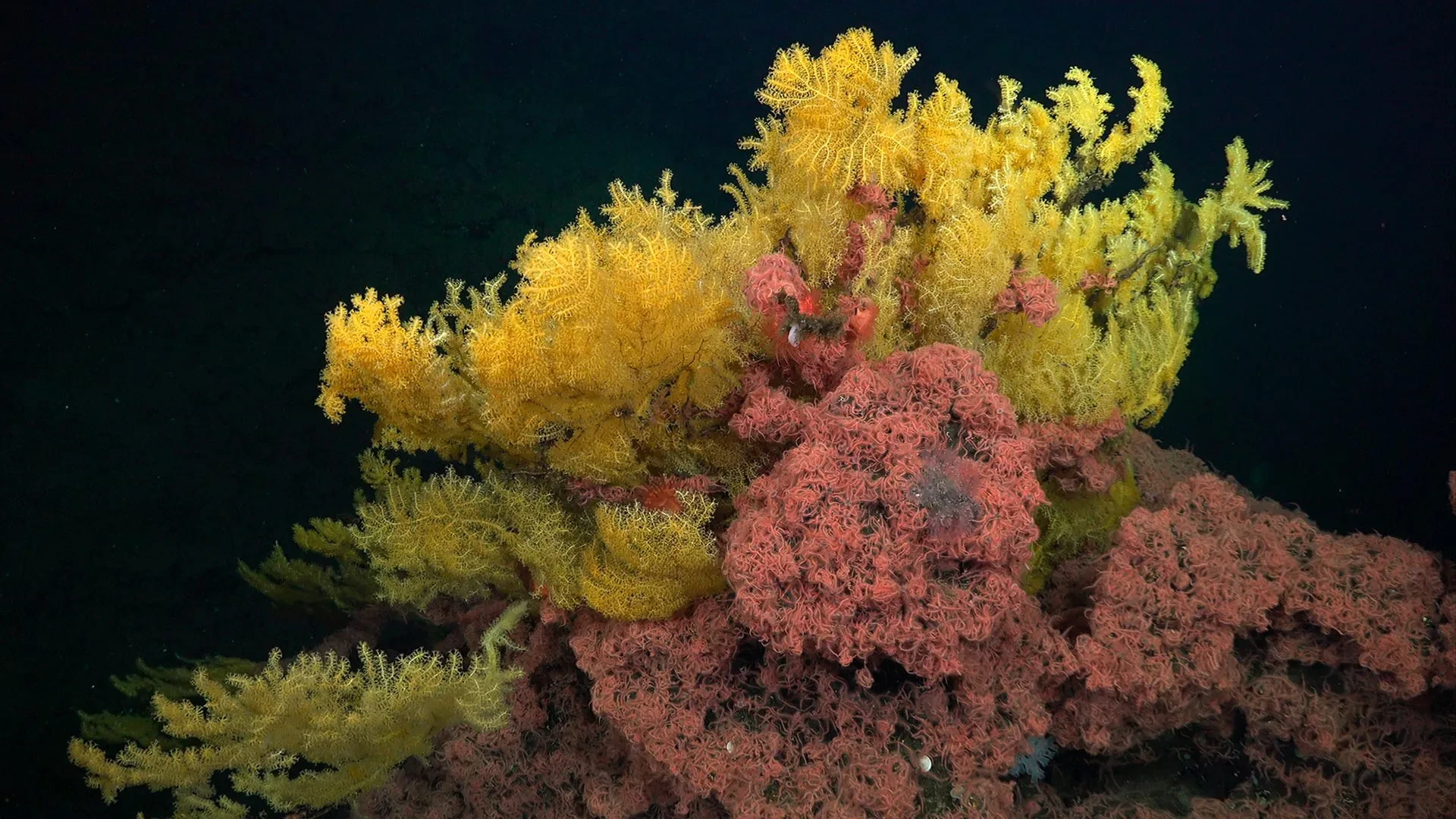
The striking organism, which features a bright yellow coloration and a branching, tree-like physical structure, was discovered inhabiting the deep Pacific Ocean at depths ranging between 360 and 529 meters below the surface. Captured in stunning detail during expeditions to rugged seamounts, the discovery underscores just how much of the Earth’s deep-sea environment remains poorly understood, despite covering roughly two-thirds of the planet’s surface.
The comprehensive findings detailing this unique specimen and its complex genetic lineage have been officially published in the open-access scientific journal ZooKeys, shedding new light on the rich and largely hidden biodiversity thriving within Costa Rica’s deep-sea ecosystems.
Exploring the Deep Pacific
Individual colonies of this newly discovered coral can grow to impressive heights, with some specimens stretching more than a meter tall from the rocky seafloor. Researchers collected the physical samples necessary for the study using SuBastian, an advanced remotely operated vehicle (ROV). These recovery operations took place during marine scientific expeditions conducted in 2019 and 2023 aboard the advanced research vessels Falkor and Falkor (too), both of which are operated and maintained by the Schmidt Ocean Institute.
The targeted expeditions focused heavily on exploring a series of underwater seamounts located near Isla del Coco, as well as along Costa Rica’s expansive Pacific margin. These submerged mountain ranges are known to harbor unique hydrodynamic conditions and mineral-rich substrates that frequently support dense assemblages of deep-water marine invertebrates, creating isolated biological hotspots in the pitch-black environment of the bathypelagic and mesopelagic zones.
A Golden Coral Among Fields of Stars
During the submersible dives, researchers noted that the vibrant coral was especially abundant on rocky outcrops where the surrounding terrain was heavily populated by brittle stars. These echinoderms coated nearly every available square inch of the substrate, creating a dense, shimmering carpet of movement and texture.
Against this glittering, star-like backdrop, the bright yellow branches of the newly discovered coral appeared to rise from the dark seafloor like glowing, arboreal sentinels. This unusual and visually arresting scene directly inspired the scientific nomenclature chosen by the research team.
The new genus for the organism was designated as Laurinque. The name is derived from "Laurinquë," which translates to "golden tree" in Quenya, an artificial Elvish language created by author J.R.R. Tolkien for his legendary mythos, including The Lord of the Rings and The Silmarillion. The researchers selected this specific linguistic root because of the coral’s vivid, sun-like yellow hue and its complex, tree-like branching architecture.
Furthermore, the species name chosen for the organism is elenya, which means "stellar" or "of the stars" in Quenya. This particular designation honors the dense populations of brittle stars that carpeted the seafloor and surrounded the coral colonies during the observations. Together, the genus and species names combine to reflect what the scientists described as an almost mystical, Tolkien-inspired landscape situated deep on the ocean floor.
DNA Reveals a New Coral Family
While the physical appearance of the coral provided immediate inspiration for its name, determining its precise placement on the evolutionary family tree proved to be a vastly more complicated scientific undertaking than initially anticipated.
When the research team first approached the classification of the specimen, they sequenced three standard genes that are commonly utilized by marine biologists to identify and classify corals. However, instead of pointing toward a unified taxonomic group or a single familiar family, each of the three sequenced genes suggested a completely different and unrelated family lineage.
Because these initial genetic results were unusually inconsistent and contradictory, the scientists pivoted to a more advanced molecular technique known as phylogenomics. This sophisticated method involves comparing hundreds of genes simultaneously rather than relying on just a few markers. The broader, highly detailed genetic analysis finally succeeded in clarifying the coral’s true evolutionary position.
The comprehensive phylogenomic data conclusively demonstrated that the species does not belong to any previously recognized coral family. Instead, it represents a distinct, isolated evolutionary lineage. While scientists found that it is most closely related to the family Eunicellidae, its underlying genetics and internal anatomy diverge enough to firmly justify the creation of an entirely new family, which has been named Laurinqueidae. Alongside this new family, researchers established the new genus Laurinque specifically to house the species.
Dr. Odalisca Breedy of the Universidad de Costa Rica, who served as the lead researcher on the study, reflected on the lengthy and surprising path to classifying the specimen.
"I saw the octocoral garden for the first time in 2019 and I was impressed by the beauty of the landscape, which inspired, later the elvish name of the taxa," Dr. Breedy said. "I thought the species could belong to a known family and genera, but after the preliminar morphological analysis I realised that it was something very different that I could not match with the known taxa."
Dr. Breedy noted that subsequent fieldwork yielded more data and specimens to solve the mystery. "In 2023 we collected more samples and thanks to the exhaustive molecular analyses made by my colleagues, Cathy McFadden, Catalina Murillo and Andrea Quattrini, we were able to determine the taxonomic placement of the stunning species, in one of the most enigmatic sites."
Costa Rica’s Deep Sea Still Holds Surprises
Dr. Breedy led the successful investigation alongside an international team of expert collaborators spanning multiple academic and research institutions. Financial and logistical support for the scientific expeditions was provided by the Schmidt Ocean Institute, alongside a crucial research grant awarded by the National Geographic Society.
The discovery of the family Laurinqueidae joins a rapidly growing catalog of previously undocumented marine species discovered during recent surveys of Costa Rica’s underwater seamounts. Each expedition continues to reveal animals that challenge existing taxonomies and expand our fundamental understanding of marine biology.
Beyond their sheer novelty and aesthetic beauty, deep-sea coral gardens like the one discovered off Costa Rica are widely recognized by marine scientists as vulnerable marine ecosystems. The complex, three-dimensional physical structures provided by these large octocorals create vital habitats, shelter, and breeding grounds for a wide variety of other deep-sea organisms. This makes them crucial centers of biodiversity in remote environments that researchers are only just beginning to explore, map, and understand.