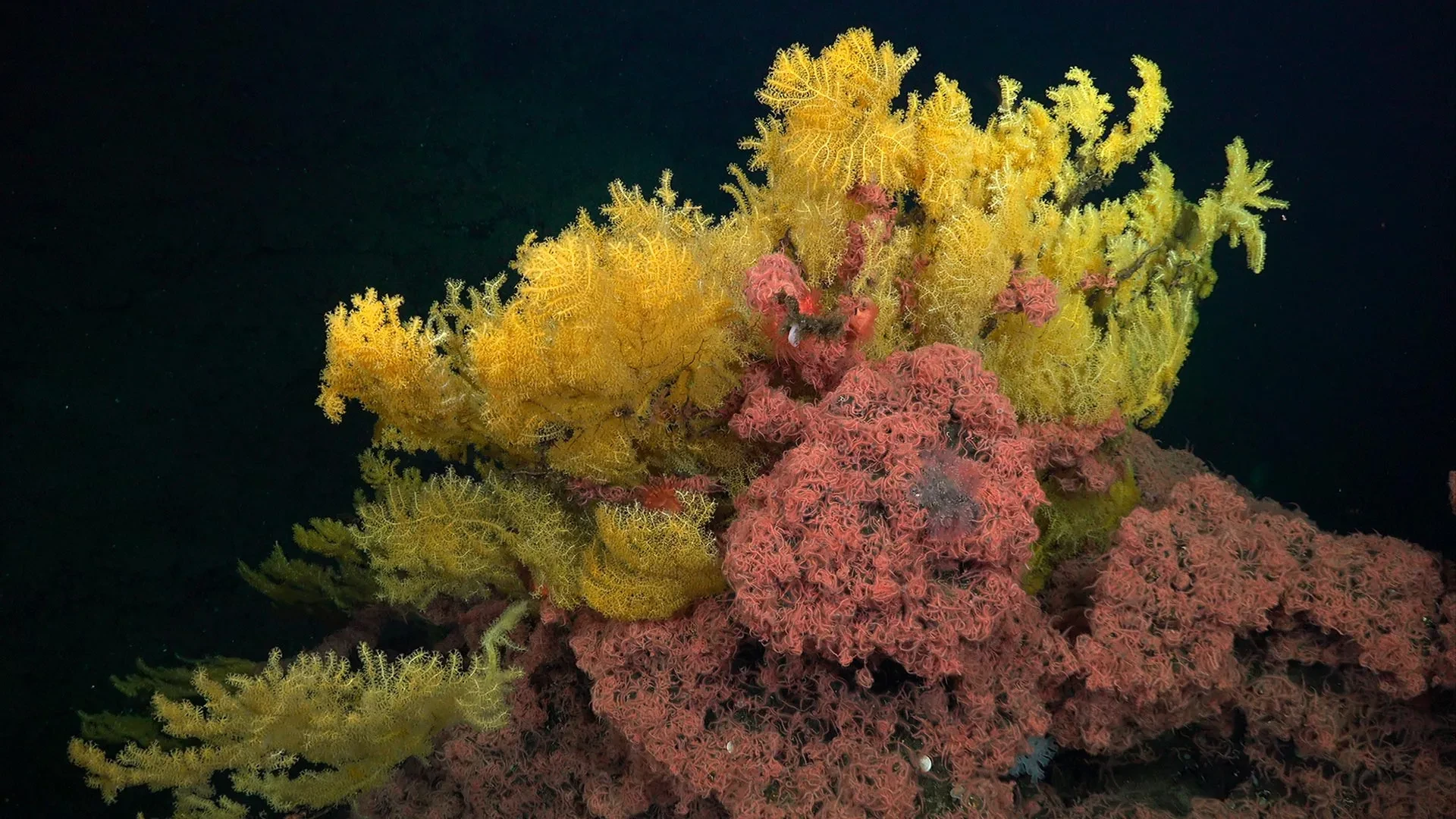
The striking organism, characterized by a bright yellow coloration and a branching, tree-like physical structure, was discovered dwelling in the twilight zone of the Pacific Ocean, between 360 and 529 meters below the surface. The monumental findings have been formally documented and published in the open-access scientific journal ZooKeys, offering marine biologists a rare glimpse into the complex and largely hidden ecosystems that thrive along deep-sea seamounts.
Some colonies of this extraordinary coral grow to impressive heights, stretching more than a meter tall from the rocky seafloor. Researchers successfully collected physical specimens of the organism using SuBastian, an advanced remotely operated vehicle (ROV). These operations took place during a series of deep-sea expeditions conducted in 2019 and 2023 aboard the prominent research vessels Falkor and Falkor (too). Both ships are owned and operated by the Schmidt Ocean Institute, a non-profit organization dedicated to advancing oceanographic research, technological innovation, and marine conservation. The expeditions specifically targeted rugged seamounts located near Isla del Coco and along Costa Rica’s expansive Pacific margin, a region rapidly emerging as a hotspot for deep-sea biodiversity and evolutionary novelty.
A Golden Coral Among Fields of Stars
During the exploratory dives, scientists noted that the newly discovered coral was especially abundant on steep rocky outcrops. On these elevated formations, dense populations of brittle stars—close relatives of starfish—carpeted nearly every available surface, creating a dynamic and visually arresting underwater scene. Against this shimmering, star-like backdrop, the vibrant yellow branches of the coral appeared to rise from the dark ocean floor like glowing trees surrounded by countless celestial bodies.
This unusual and captivating underwater landscape ultimately inspired the formal scientific nomenclature chosen by the research team. The new genus was named Laurinque, a term derived from "Laurinquë," which translates directly to "golden tree" in Quenya, the Elvish language meticulously constructed by legendary author J.R.R. Tolkien for his renowned literary works, including The Lord of the Rings and The Silmarillion. Researchers selected this evocative moniker as a direct tribute to the coral’s vivid, golden-yellow hue and its intricate, arboreal growth pattern.
Complementing the genus designation, the species was given the specific epithet elenya, which means "stellar" or "of the stars" in the same Elvish tongue. This choice honors the dense populations of brittle stars that persistently swarm and surround the coral colonies in their natural deep-sea habitat. Together, the genus and species names create a harmonious scientific identity that reflects what the researchers described as an almost mystical, fantasy-like landscape flourishing on the remote floor of the deep Pacific Ocean.
DNA Reveals a New Coral Family
While discovering a vibrant, tree-like organism in the deep sea is a thrilling achievement for marine biologists, determining precisely where the coral fit on the complex evolutionary family tree proved to be a significantly more complicated challenge than initially anticipated. When the research team first brought specimens back to the laboratory, they followed standard scientific protocols by sequencing three specific genes that are commonly utilized by taxonomists to identify and classify octocorals.
However, the initial genetic data produced confusing and contradictory signals. Instead of pointing toward a single, cohesive group of related organisms, each of the three tested genes suggested a completely different and seemingly unrelated coral family.
Because these preliminary results were unusually inconsistent and defied straightforward biological categorization, the researchers realized that standard single-gene barcoding would be insufficient. To resolve the mystery, they turned to phylogenomics—an advanced analytical method that compares hundreds of genes simultaneously across an organism’s genome. This much broader and more comprehensive genetic analysis finally pierced through the ambiguity, successfully clarifying the coral’s true evolutionary position and revealing its ancient lineage.
The detailed genomic results demonstrated conclusively that the species does not belong to any previously recognized coral family known to science. Instead, it represents a distinct evolutionary lineage that stands entirely on its own. While genetic and anatomical comparisons indicate that it is most closely related to the family Eunicellidae, its unique genetic markers and distinctive structural anatomy differ enough to justify the creation of an entirely new taxonomic family, which the researchers named Laurinqueidae. Furthermore, the team established the new genus Laurinque specifically to accommodate this single, extraordinary species.
Dr. Odalisca Breedy of the Universidad de Costa Rica, who served as the lead researcher on the scientific study, reflected on the multi-year journey of discovery.
"I saw the octocoral garden for the first time in 2019 and I was impressed by the beauty of the landscape, which inspired, later the elvish name of the taxa," Dr. Breedy said. "I thought the species could belong to a known family and genera, but after the preliminar morphological analysis I realised that it was something very different that I could not match with the known taxa."
"In 2023 we collected more samples and thanks to the exhaustive molecular analyses made by my colleagues, Cathy McFadden, Catalina Murillo and Andrea Quattrini, we were able to determine the taxonomic placement of the stunning species, in one of the most enigmatic sites," she added.
Costa Rica’s Deep Sea Still Holds Surprises
Dr. Breedy led the intricate research effort alongside a multidisciplinary, international team of collaborators. Financial and logistical backing for the expeditions was provided by the Schmidt Ocean Institute, alongside a dedicated research grant from the National Geographic Society, which has a long history of supporting deep-ocean exploration and conservation initiatives.
The identification of this golden coral joins a rapidly growing catalog of previously undocumented marine species discovered during recent scientific surveys of Costa Rica’s rugged underwater seamounts. These findings underscore a broader, sobering reality recognized by the global oceanographic community: an overwhelming majority of the deep ocean remains entirely unexplored, poorly mapped, and scientifically uncharacterized, despite the fact that marine environments cover roughly two-thirds of the Earth’s total surface area.
Marine scientists emphasize that deep-sea coral gardens like the one discovered off the coast of Costa Rica function as critical, highly vulnerable marine ecosystems. The complex, three-dimensional physical structures built by these corals provide essential shelter, breeding grounds, and foraging habitats for a wide variety of other deep-sea organisms, including fish, crustaceans, and echinoderms. Because they support such concentrated abundance in otherwise austere environments, these gardens serve as vital centers of biodiversity in the deep sea—highlighting the urgent need for continued scientific exploration and robust environmental protection in regions that humanity is only just beginning to understand.