When it comes to managing the Islamic Republic, the Trump administration finds itself confronting a decidedly dismal record of strategic setbacks. Despite months of intense aerial bombardments designed to wear down the nation’s military apparatus and economy, and despite sustained efforts to bend Tehran’s will at the negotiating table, U.S. policy objectives remain largely unfulfilled. Yet, even after seven months of frustrating roadblocks, officials in Washington believe they have finally turned a corner.
The U.S. government has implemented a fresh wave of aggressive economic sanctions while steadfastly maintaining its naval blockade along Iran’s southern coast, effectively throttling the country’s access to vital outside commerce. Based on these stringent containment measures, American officials have concluded that the Islamic Republic will soon either concede to U.S. demands or face total economic collapse. "We are going to economically asphyxiate this regime," declared Treasury Secretary Scott Bessent on September 1.
There is no denying that Washington has dealt significant, tangible damage to Iran over the course of the conflict. However, the Islamic Republic does not view its current trajectory as an unraveling of the state. In fact, Tehran increasingly believes that it is positioned to outlast and ultimately defeat the United States—and the rationale behind this confidence is not difficult to discern.
The Iranian government did not merely survive the initial onslaught of U.S. and Israeli airstrikes; it retaliated with ferocity, successfully damaging American military installations across the region and effectively obstructing commercial traffic through the vital Strait of Hormuz. While ordinary Iranian citizens are paying a heavy economic price due to wartime destruction and Washington’s financial cutoffs, a substantial portion of the population has rallied around the national flag. Many citizens appear to accept that profound hardship is a necessary sacrifice if Iran is to defend its sovereignty.
Consequently, Tehran has become notably emboldened. While Iranian officials may occasionally disagree on tactical implementations, they remain entirely unified in their overarching strategic ambitions: evicting U.S. military forces from the Persian Gulf once and for all, compelling Washington to dismantle its crippling sanctions regime, and forcing the United States to formally accept Iran’s status as a regional great power.
This ambitious agenda might sound excessively audacious given that Iran has been materially weakened by the war. Nevertheless, the Islamic Republic remains convinced that its primary goals are well within reach. Tehran calculates that its military forces can drive U.S. troops from the Persian Gulf by continuing to execute direct strikes on American bases and by leveraging pressure from Arab partner nations to encourage a U.S. withdrawal. Furthermore, Iranian strategists believe that by wreaking havoc on global energy markets, they can successfully force Washington to lift economic restrictions. In essence, Tehran’s theory of victory relies on the premise that it can endure the pain, inflict mounting costs on the United States, and ultimately break Washington’s resolve to maintain its containment policy.
Closing Ranks
No objective observer doubts that Iran has been severely battered by the ongoing war. Months of American and Israeli bombing campaigns have inflicted widespread damage on the country’s industrial base and critical infrastructure, causing unemployment to spike and pushing a growing number of Iranians into poverty. Washington’s aggressive sanctions and naval blockade have simultaneously fueled rampant inflation. Moreover, the U.S. and Israeli militaries can point to several tactical successes, most notably the targeted assassination of former Iranian Supreme Leader Ali Khamenei.
Strategically, however, the conflict has produced results contrary to Washington’s expectations. U.S. planners had anticipated that punishing aerial bombardments and sweeping efforts to degrade the Iranian economy would swiftly bring the Islamic Republic to its knees. Those expectations proved false. Washington also hoped that the assassination of Khamenei would trigger a massive anti-government uprising. That political scheme failed as well.
Instead of sparking a revolution, Khamenei’s death brought out the Islamic Republic’s most ardent supporters, who marched nightly through the nation’s major cities. They were eventually joined by citizens of diverse political backgrounds who rallied primarily in defense of their homeland. When the hostilities first commenced, neighboring Turkey made logistical plans to accommodate an anticipated influx of 70,000 Iranian refugees. Yet, very few people actually fled. As the war progressed, numerous Iranians living abroad actually returned home, including long-exiled cultural figures, journalists, and political personalities, such as the renowned singers Mohsen Namjoo and Bijan Mortazavi.
This sudden surge in nationalism should not be misconstrued as an enthusiastic endorsement of the ruling clerical establishment. Many Iranians remain deeply dissatisfied with their domestic leadership. However, public anger directed at the government has been largely subsumed by a far more powerful wave of resentment toward Washington. Previously, a significant majority of Iranians were skeptical of the official narrative that the United States was bent on their country’s destruction; many actively hoped that Tehran would pursue a diplomatic rapprochement with Washington.
That perspective shifted dramatically following the direct bombing of Iranian population centers and repeated threats from U.S. President Donald Trump vowing to annihilate the nation’s civilization—including statements suggesting he might "blow the entire nation up" and drive it "into hell with no chance of survival." Today, Iranians across the entire political spectrum genuinely believe that the United States intends to obliterate their country, or at least force it into total capitulation.
This profound psychological shift became apparent during extensive conversations conducted with Iranians of diverse ideologies, beginning when Washington first launched airstrikes against Iran in June 2025 and continuing through the present day to track evolving political sentiment. The vast majority of respondents expressed deep distress and anger toward their own government following the violent crackdowns that occurred in response to the mass protests of January. Yet, public opinions shifted drastically as the war dragged on and as Trump escalated his aggressive rhetoric.
"We believed so much in the American promise," Ali, a 45-year-old long-time dissident who has spent years imprisoned for political activism, explained. "Yet with this war and everything that Trump and his administration have said and done, it’s obvious the Americans sold us a false bill of goods. They want nothing but Iran’s total submission, and that’s not acceptable to us."
Mahsa, a writer and artist in her 30s, expressed similar disillusionment. "Everything we believed the United States stood for, freedom and respect and democracy, I now see as lies," she noted. "As angry as I’ve been at our state over the years, this is our homeland, and no outside country has the right to kill our leaders and drop bombs on our children and attempt to destroy us."
It is little wonder, then, that Khamenei’s funeral procession in July drew millions of mourners despite the active conflict. During the event, participants distributed red flags symbolizing a collective desire for retribution. Shortly thereafter, Iran launched attacks against commercial vessels navigating the Strait of Hormuz, effectively shattering the precarious cease-fire that had been brokered with the United States just three months prior.
Many U.S. officials appear to operate under the assumption that stiff economic pressure will ultimately force a shift in public opinion—that if the population suffers enough, ordinary Iranians will decide to overthrow their government, or that the regime, fearing for its own survival, will yield to American demands. However, analysts note this strategy relies on flawed assumptions. Iran has spent the past decade and a half deliberately engineering an economy specifically tailored to withstand American economic warfare. Iranian authorities have forged robust trading partnerships with neighboring nations and achieved near self-sufficiency in agricultural production.
Consequently, even though the Iranian economy is undeniably hurting and inflation remains high, cities and towns across the country have avoided critical shortages of essential goods and services. "It’s incredible how well-run everything has been inside of the country," said Hamid Reza, an engineer who frequently travels between Isfahan and Tehran for professional reasons. "Things are expensive, but there have been no shortages whatsoever across the country. Everything has been managed internally with a lot of care."
This resilience does not mean that ordinary Iranians feel optimistic about their collective future. Citizens remain deeply anxious and yearn for a return to stability and economic relief. Crucially, however, they do not view the U.S.-Israeli military campaign as a liberating force. Instead, they perceive it as gratuitous foreign aggression. The resulting surge in nationalism has successfully blurred traditional political lines and significantly reduced the likelihood of a domestic uprising, thereby inadvertently strengthening the ruling regime.
Pain and Gain
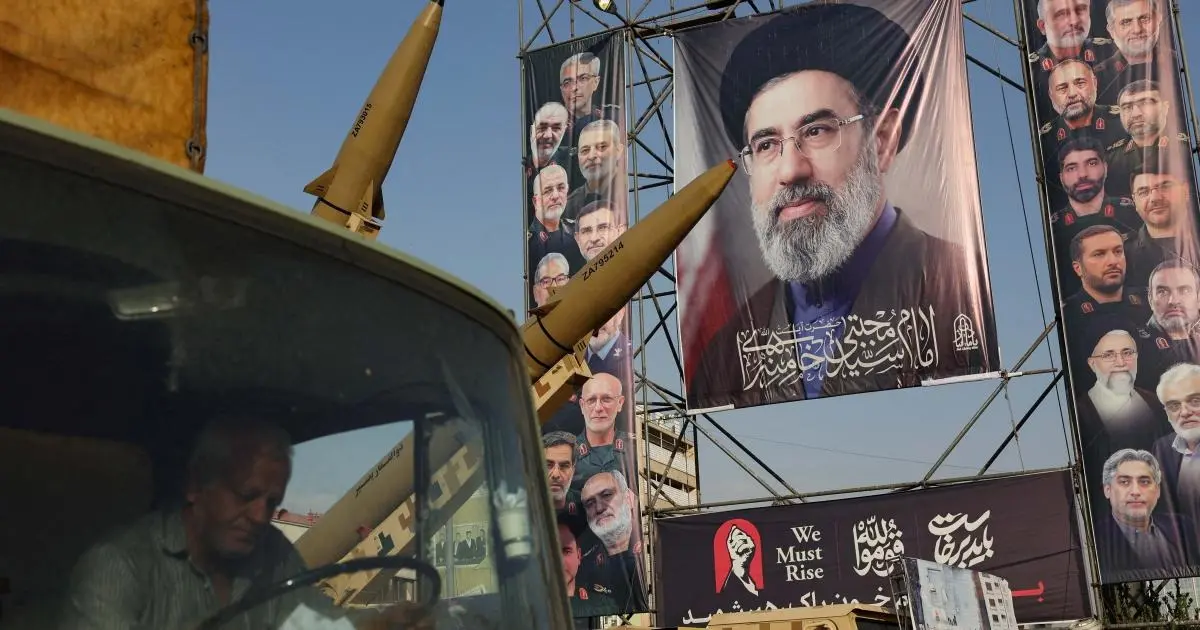
Mirroring the sentiment of its populace, the Iranian government has adopted a markedly more hostile posture toward Washington since the outbreak of hostilities. The nation’s new supreme leader, Mojtaba Khamenei, has quietly installed trusted loyalists into key government roles—operating largely from a secure location—with many of these hard-line figures maintaining deep ties to the Islamic Revolutionary Guard Corps.
Key officials, such as National Security Adviser Mohsen Rezaei and Hossein Taeb, commander of the country’s primary domestic paramilitary forces, firmly believe that deterring future military strikes requires a decisive, aggressive response to any provocation. They remain deeply skeptical of Washington’s diplomatic overtures, pointing out that the United States has twice launched military attacks against Iran while supposedly engaged in negotiations, and subsequently walked away from the memorandum of understanding signed in June. Consequently, they argue that Washington cannot be trusted, suspecting that any renewed U.S. interest in diplomacy merely masks preparations for subsequent military strikes, much like the patterns observed in June 2025 and February 2026.
Conversely, Iran’s relative moderates maintain a somewhat different perspective. This political faction, which includes Iranian President Masoud Pezeshkian, Parliament Speaker Mohammad Bagher Ghalibaf, former President Hasan Rouhani, and former Foreign Minister Mohammad Javad Zarif, has consistently argued that Tehran should continue exploring diplomatic avenues to resolve the conflict. Both Pezeshkian and Ghalibaf have publicly emphasized the severe economic hardships confronting ordinary working-class families.
Yet, the ideological distance between these moderate figures and the regime’s hard-line leadership is narrower than it might appear. As one regional analyst familiar with these political dynamics observed, "No one is saying Iran should surrender." While moderates view economic relief as an urgent priority, their proposed solution is to force Washington to fully implement the memorandum of understanding agreed upon in June.
From Tehran’s perspective, that diplomatic agreement committed the United States to unfreezing all sovereign Iranian assets, lifting all economic sanctions, permanently halting military strikes against the country, and paying reparations—in exchange for little more than a cease-fire and the resumption of commercial shipping through the Strait of Hormuz, over which Iran would retain the right to levy fees. Since the end of summer, senior figures like Rezaei and Ghalibaf have maintained that any future diplomacy must begin with the United States formally honoring that memorandum. According to analysts following recent United Nations meetings in New York, these officials believe that President Trump is not yet prepared for genuine negotiations, concluding that he will only return to the deal if he is forced to recognize Iran’s strategic resilience, which requires increasing the military and economic costs of the conflict for Washington.
As a result, Iran’s tactical behavior is expected to remain unrestrained and disproportionate. Should full-scale warfare resume, Tehran plans to project power across the broader region rather than restricting operations to its immediate geographic vicinity. The dominant consensus within Tehran is that caution and predictability will only invite intensified U.S. pressure while failing to advance its primary military objectives: compelling Washington to withdraw all military forces from the Persian Gulf and forcing international recognition of Iranian primacy.
Repeated Iranian drone and missile strikes targeting American military installations and logistical facilities in Jordan, Syria, and across the Persian Gulf are explicitly designed to achieve this objective. To a measurable degree, these tactics have already succeeded. The sustained threat has inflicted serious damage on several U.S. military assets, forcing the United States to relocate critical operational and logistical resources to Israel and Jordan, while increasingly relying on distant bases in the central Indian Ocean. The persistent danger of Iranian retaliation even prompted Washington to temporarily withdraw its strategic B-1 bombers from a base in the United Kingdom.
Simultaneously, Tehran has sought to pressure Washington’s Gulf Arab partners into expelling American military forces from their territories. To advance this goal, Iranian officials have openly declared that regional peace and security depend entirely on removing the U.S. military footprint, punctuating this message by striking neighboring states suspected of facilitating the American war effort. While it remains unlikely that Iran will completely eradicate the U.S. military presence in the Gulf, these actions have successfully caused regional governments to question the reliability of the American security umbrella, potentially paving the way for a reduced U.S. footprint.
Even if Iran ultimately fails to permanently expel the U.S. military from its neighborhood, it believes it can successfully coerce Washington into some form of economic accommodation by inflicting sufficient financial pain on global markets. To achieve this, Tehran has worked to drive up international prices for oil, natural gas, diesel, and jet fuel by targeting strategic energy infrastructure across the Gulf. Notable incidents include strikes on Qatar’s Ras Laffan gas field—executed in retaliation for an Israeli attack on Iran’s South Pars gas field—and attacks targeting oil facilities at the United Arab Emirates’ Fujairah port.
In addition to striking energy facilities, Iran has targeted commercial tankers transporting oil and liquefied natural gas while attempting to consolidate its sovereign control over the strategic Strait of Hormuz. Although Washington has mounted a vigorous defense of the waterway, successfully escorting numerous tankers through the maritime chokepoint, these protective operations require massive naval resources that the United States cannot indefinitely sustain at the current scale.
Iran’s regional allies and partner networks have also amplified these pressures. Iraqi militias backed by Tehran have launched attacks against a vital oil pipeline transporting Saudi crude to Red Sea export terminals, a move projected to significantly curtail global oil supplies for months. Meanwhile, Houthi forces in Yemen have consistently targeted Saudi energy infrastructure. The Houthis have also captured extensive new territory and advanced toward the Bab el-Mandeb Strait, enabling them to threaten the Red Sea shipping corridor through which roughly 12 percent of global maritime trade passes. These coordinated operations demonstrate that despite facing setbacks in Lebanon and Syria, Iran’s regional network retains substantial operational capacity.
Steady as She Goes
The United States may operate under the assumption that its current strategy has successfully cornered Iran. However, Tehran strongly disagrees with that assessment. Iranian leadership does not view itself as being on the defensive or running out of strategic options. Instead, officials believe the nation has effectively cemented its status as a regional great power, pointing with pride to its military performance and the cultivation of newfound international respect. Policymakers in Tehran openly celebrated the enthusiastic diplomatic reception afforded to the Iranian delegation by member states during the September summits of the Shanghai Cooperation Organization and the BRICS economic consortium.
While Iran continues to grapple with monumental domestic and economic challenges—having yet to discover a reliable mechanism for translating wartime resilience into enduring peacetime prosperity—the nation stands prepared to continue fighting if circumstances demand it. The ruling establishment remains convinced that, as one senior Iranian analyst close to policymakers observed, the population is fully willing to endure ongoing economic pain and societal suffering if it ultimately secures a strategic victory. With the political elite coalescing around a unified long-term strategy, Tehran remains supremely confident that it can prevail simply by staying the course, rendering compromise unnecessary as it faces down Washington’s maximum pressure campaign.