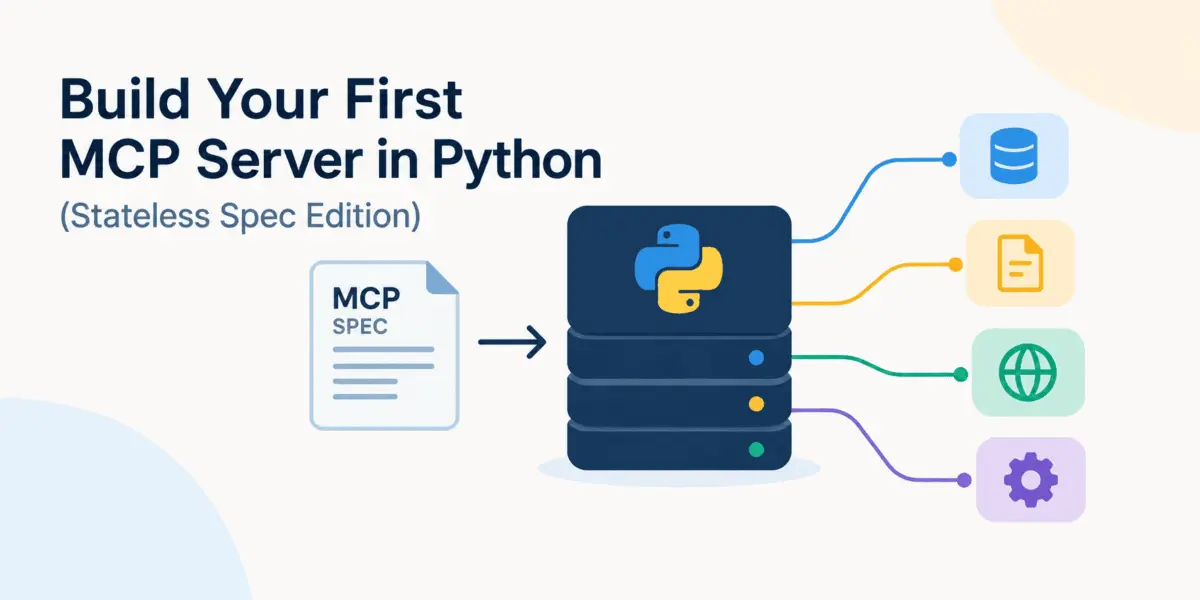
The developer ecosystem surrounding the Model Context Protocol (MCP) has entered a new phase following a foundational architecture update. The protocol core transitioned to a fully stateless model, eliminating the requirement for modern clients to establish explicit protocol sessions prior to transmitting requests. This structural evolution removes the historical reliance on session identifiers for ordinary requests, enabling development teams to scale MCP servers smoothly behind standard HTTP infrastructure without the overhead of sticky routing or specialized session management layers.
Concurrently, the official Python SDK has advanced its v2 release line into stable production status, introducing a high-level MCPServer application programming interface designed to streamline the exposure of tools, resources, and prompt templates. Rather than grappling with low-level protocol ceremonies, developers can now leverage standard Python type annotations and decorators to construct network-accessible AI context servers.
The significance of the protocol shift lies in its departure from older lifecycle designs. Previous iterations of the Model Context Protocol required clients to initialize handshake sequences that bound interactions to specific server instances via session identifiers. This stateful constraint frequently complicated multi-instance production deployments, requiring load balancers to maintain persistent connections to individual workers. Under the updated specification, every incoming request functions as a self-contained unit of execution. Client requests can freely cycle across different worker nodes within a server cluster without disrupting operational integrity or requiring protocol-level state preservation.
Industry observers note that this architectural transition aligns MCP more closely with traditional web application design patterns. While the underlying protocol core is now stateless, application-level state can still be maintained effectively through explicit handles, such as passing unique resource identifiers or token references within function arguments. By shifting the responsibility of state management from the transport protocol to the application logic, the protocol maintainers have simplified horizontal scaling for enterprise deployments.
The v2 Python SDK capitalizes on this stateless foundation by offering a streamlined developer experience. Using the MCPServer interface, engineers can define custom developer support knowledge bases, search tools, and resource endpoints using native Python constructs. Type hints automatically translate into structured input schemas, bypassing the need for manually written tool manifests or separate argument parsing layers.
Deploying these servers has similarly been optimized for modern Python deployment pipelines. Developers can execute applications in development modes equipped with inspection interfaces for local testing, or launch them over Streamable HTTP endpoints. Furthermore, because the SDK supports standard ASGI frameworks, MCP applications can integrate directly into existing web service architectures powered by frameworks like Starlette or FastAPI.
To verify connectivity across this new architecture, developers can pair modern Python clients directly with HTTP-accessible endpoints. The v2 client architecture accepts standard web URLs out of the box, automatically handling the negotiation of current protocol versions and streamlining the execution of remote tool calls. As organizations continue to integrate advanced language models with internal data repositories, the convergence of a stateless protocol core and an intuitive Python SDK is expected to accelerate the adoption of context protocol servers across enterprise engineering teams.