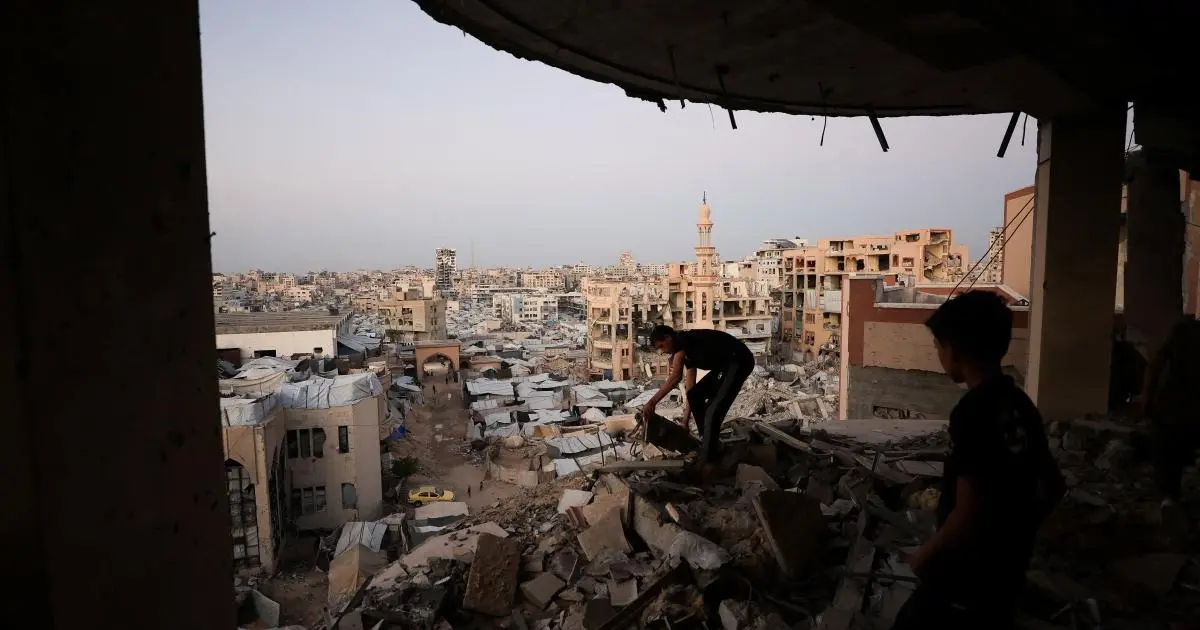
A year after the Trump administration successfully brokered an agreement to end the devastating war in Gaza, Palestinians across the battered coastal strip are still waiting for the promised "day after" to arrive. The October 2025 cease-fire plan successfully secured the release of the last remaining Israeli hostages and ostensibly brought major hostilities to a halt, but the reality on the ground tells a deeply troubling story. The Israeli military continues to strike targets throughout Gaza with alarming regularity, frequently killing civilians—including roughly 300 children over the course of the past year alone.
The original agreement also envisioned a carefully phased political and logistical process designed to jump-start the reconstruction of the heavily devastated territory. Earlier this year in January, Jared Kushner, U.S. President Donald Trump’s son-in-law and primary point person for the Middle East, made a public promise. He assured the international community that the restoration of core services and critical infrastructure—encompassing water and sewage systems, electrical grids, hospitals, and bakeries—would commence within 100 days.
Yet, nine months past that initial window, Gaza has witnessed zero meaningful reconstruction, no widespread restoration of basic services, and no reprieve from daily violence. Instead, the vast majority of the enclave’s inhabitants remain tightly packed into squalid, sprawling tent cities situated along a tiny and ever-shrinking strip of coastline. Plagued by persistent disease outbreaks and severe rodent infestations, these communities continue to endure extreme shortages of food, medicine, clean water, and access to basic sanitation facilities.
While Gazans may no longer be suffering under the acute grip of widespread famine as they were in prior years, the overall humanitarian situation remains thoroughly catastrophic and fundamentally unsustainable. Observers warn that these intolerable conditions could easily spark a fresh explosion of violence. More critically, these circumstances are actively enabling an endgame that many hard-line Israeli leaders have long desired: the eventual eviction of Gaza’s more than two million Palestinian residents.
HELL ON EARTH
It is exceedingly difficult to overstate the true scale of death, destruction, and suffering inflicted on Gaza and its roughly 2.2 million inhabitants over the past three years. In the immediate aftermath of Hamas’s October 7, 2023, terrorist attacks against Israel, Israeli military and political leaders openly vowed to "flatten" the territory and turn it into a "city of tents," explicitly promising that Gaza would never return to what it once was.
They have systematically delivered on those threats. The 223,000 tons of explosives dropped on Gaza—an explosive power roughly equivalent to 15 times the atomic bomb dropped on Hiroshima—have killed more than 74,000 Palestinians, the vast majority of whom were civilians. This relentless assault, which has placed Israel on trial for genocide at the International Court of Justice, has wiped out approximately 92 percent of Gaza’s housing stock, 95 percent of its agricultural farmland, all 12 of its universities, and nearly half of its 36 hospitals, effectively destroying the institutional fabric that sustains human life.
Following such unprecedented devastation, last year’s cease-fire came as an undeniable relief. Under the first phase of the Trump administration’s Gaza plan, the warring parties agreed to an immediate halt to all military attacks, an exchange of hostages and prisoners, the restoration of basic services, and a massive, unhindered surge in humanitarian aid. Apart from Hamas fulfilling its obligation to release Israeli hostages, however, most of these foundational commitments have been only partially fulfilled.
Phase two, which was formally launched in January even though Israel had yet to satisfy its phase one obligations, envisioned the stabilization of Gaza through the deployment of an international peacekeeping force. It also called for the establishment of a Palestinian technocratic governing body known as the National Committee for the Administration of Gaza, coupled with the gradual disarmament of Hamas and a phased withdrawal of Israeli forces. These final steps were designed to serve as essential prerequisites for the long-term reconstruction of the Gaza Strip as outlined in phase three.
A full year after the cease-fire was formally announced, Israel continues to block the entry of the Palestinian governing and policing bodies that would allow Hamas to relinquish power and allow reconstruction to officially begin. Furthermore, Hamas and Israel remain sharply at loggerheads regarding the precise sequencing of the militant group’s disarmament relative to an eventual Israeli military withdrawal.
Although the availability of food has improved since the height of last year’s famine, Israel continues to heavily restrict humanitarian aid, permitting only a fraction of the daily 600 truckloads mandated by the cease-fire agreement to enter the territory. More than 90 percent of Gaza’s population remains internally displaced.
Compounding these challenges, the Israeli military has unilaterally expanded its physical control from just over half of Gaza’s territory to roughly 65 percent since the cease-fire was declared. Frequent airstrikes by the Israeli army have claimed the lives of more than 1,400 Palestinians during the cease-fire period alone. The fact that the death toll continues to climb during an official cessation of hostilities highlights the dystopian reality that has become Gaza’s new normal. As UN Middle East Envoy Sigrid Kaag bluntly described it, living conditions in Gaza represent "hell on earth with no prospect of significant change in sight."
Of course, Israel is not solely responsible for the persistence of these hellish conditions; Hamas also bears a significant share of the blame. The Hamas leadership spent months stubbornly resisting international calls for disarmament as required by the Trump plan, ultimately agreeing to terms only under intense pressure from Egypt and other regional mediators. At the same time, the Trump administration bears substantial responsibility for allowing the political process to stall. By affording Israel tremendous latitude and enforcing the terms of the cease-fire in a heavily lopsided manner, Washington has effectively permitted Israel to continue waging war in Gaza, albeit at a reduced scale.
Only a few months ago, a breakthrough finally appeared within reach. In late July, President Trump announced a major breakthrough regarding the implementation of the second phase of his Gaza plan. Following seven months of intense and fraught negotiations, Hamas and the international Board of Peace reached a tentative deal concerning the disarmament of the Palestinian militant group. This agreement theoretically paved the way for desperately needed recovery work and the introduction of new Palestinian governance and policing mechanisms.
The success of the plan depended entirely on a carefully crafted sequence of events: Hamas would disarm in parallel with an Israeli military withdrawal, a structural design meant to ensure steady progress and prevent either side from exercising a unilateral veto over the peace process.
The fact that Hamas—an organization founded on armed resistance—had agreed to any form of disarmament was entirely unprecedented and was rightly hailed by Trump as a historic achievement. Yet, Israeli Prime Minister Benjamin Netanyahu categorically rejected this road map. Netanyahu insisted that there could be no Israeli military withdrawal until Hamas was fully disarmed, while simultaneously maintaining that Israel must remain completely free to continue active military operations inside Gaza. In essence, Israel’s position demands that Hamas fulfill all of its phase two obligations before Israel meets any of its phase one commitments, rendering the entire framework unworkable.
Consequently, the process is once again deadlocked. Without progress on either Hamas’s disarmament or an Israeli withdrawal, the Palestinian governing committee—currently marooned in Cairo—and the newly trained police force remain locked out of Gaza, alongside any international stabilization force.
While the Trump administration and the Board of Peace have attempted to fudge the issue of sequencing since the summer by publicly endorsing the Israeli stance that Hamas must disarm first while privately assuring Hamas that the road map remains unchanged, this diplomatic hedging has proven deeply damaging. In international diplomacy, ambiguity invariably favors the stronger party. By refusing to condemn Israel’s near-daily cease-fire violations and effectively granting Tel Aviv a pass on phase one commitments, Washington’s hedging amounted to an explicit endorsement of the Israeli position, leaving Gaza’s reconstruction on indefinite hold.
GONE FOR GOOD
The broader dangers of this deepening impasse were highlighted by Nikolay Mladenov, the Bulgarian diplomat serving as high representative of Trump’s Board of Peace. In a September interview, Mladenov warned that the complete absence of meaningful progress in Gaza is actively foreclosing the future of the territory and destroying any remaining possibility of a two-state solution, with grave implications for the wider region.
"If we allow for Gaza to continue in the situation that we have now," Mladenov cautioned, "Gaza will be gone. It will be gone for good." He added that if the international community fails to properly address the plight of two million Palestinians living in horrific conditions, finding a credible path toward resolving the broader Israeli-Palestinian conflict will become impossible. Furthermore, he warned, these conditions are actively planting the seeds for a future military and security crisis.
What Mladenov left unsaid, however, is that Prime Minister Netanyahu appears entirely content with this perpetual stalemate. Having only reluctantly acceded to the 2025 cease-fire under intense U.S. pressure, Netanyahu has successfully managed to continue military operations in Gaza without incurring significant domestic political costs. The ongoing crisis fails to trigger meaningful outrage within Israel, and even Netanyahu’s main political rivals have felt compelled to dismiss the U.S.-backed road map. Meanwhile, international outrage over the ongoing carnage has largely subsided as foreign governments increasingly settle for a failing peace process rather than no process at all.
For Netanyahu, maintaining a steady baseline of low-level violence—just enough to prevent Gaza’s recovery and reconstruction, but not enough to spark a massive international outcry—has become a strategic goal in its own right. Much as he insisted on the implausible objective of "total victory" during the first two years of the war, he now insists on the equally unachievable goal of Hamas’s "total disarmament." While it is entirely plausible for Hamas to surrender heavy weaponry like rockets and missiles, demanding the surrender of every individual firearm while Israeli forces continue active operations in the territory is fundamentally unrealistic. This uncompromising stance successfully placates Netanyahu’s extremist coalition partners, justifies permanent military control over Gaza, and indefinitely stalls any political horizon for the Palestinians.
More crucially, keeping Gaza trapped in a political, military, and humanitarian limbo serves the long-term vision harbored by many Israeli hard-liners: rendering the territory so utterly uninhabitable that its residents are ultimately forced to leave. For Netanyahu and his far-right government, the severe immiseration of Gaza is not a byproduct of military operations, but a central pillar of their strategy.
Top Israeli officials, including Defense Minister Israel Katz, have repeatedly vowed to maintain an indefinite military presence in Gaza. Across the two-thirds of the territory now under direct Israeli control, the military has systematically erased virtually all traces of Palestinian life, razing thousands of structures, flattening entire neighborhoods and agricultural lands, and constructing permanent military bases and infrastructure.
Members of Netanyahu’s coalition have made little secret of their ultimate objective: removing Gaza’s population and facilitating the eventual settlement of the land by Israeli Jews. Israeli National Security Minister Itamar Ben-Gvir recently unveiled a detailed seven-year plan aimed at promoting the "voluntary emigration" of Palestinians, which includes the removal of 250,000 residents during the first year alone.
Ben-Gvir is far alone in articulating these goals. Katz has similarly called for facilitating the emigration of Gazans "by any means," asserting that there is no other viable long-term solution for the strip. Private remarks from Netanyahu himself, leaked from a 2025 meeting with lawmakers, revealed that the prime minister acknowledged Israel has been destroying increasing numbers of houses so that Palestinians "have nowhere to return," concluding that the obvious result will be residents choosing to emigrate.
While the Trump administration may not actively share this displacement goal, its hands-off approach and extreme tolerance for Israeli violations demonstrate a profound indifference to Palestinian suffering.
LOSING GAZA
The consequences of perpetuating this misery are severe. As Mladenov warned, maintaining the current trajectory will likely drive increasing numbers of Palestinians to flee the Gaza Strip while drastically escalating the risk of a return to full-scale regional war. In both scenarios, the heavy human and economic costs will be borne overwhelmingly by Palestinians, while the wider Middle East grows increasingly unstable and the international standing of both Israel and the United States continues to erode.
As daily life fails to improve and deadly Israeli strikes persist, the threshold for a major explosion draws closer. Hamas, though heavily degraded as a military force, has shown remarkable restraint and absorbed continuous blows, including targeted assassinations and regular airstrikes. That pragmatic restraint is unlikely to hold indefinitely.
For Washington, the continuation of this farcical peace process threatens to unravel one of Trump’s few tangible foreign policy initiatives while locking the region into a state of perpetual turmoil. At a time when separate conflicts have increasingly cast the United States as an unreliable security partner, failure in Gaza would firmly cement the perception of American diplomatic impotence.
SALVAGE JOB
Although Trump’s Gaza plan and the accompanying oversight mechanisms, such as the Board of Peace, are deeply flawed and heavily biased in Israel’s favor, they remain the only viable framework currently available to bring desperately needed relief to Gaza’s suffering population. However, rescuing the process requires a fundamental shift in approach.
First, the United States and its international partners must recognize that Israel’s strategic objectives in Gaza directly contradict those of the international community. While Washington and its allies seek long-term stabilization and reconstruction, the current Israeli government appears committed to making the territory uninhabitable.
Second, the immediate improvement of daily life for ordinary civilians in Gaza must be strictly insulated—if not entirely delinked—from the broader political process. The safety, survival, and basic dignity of more than two million people cannot continue to be held hostage to either Hamas’s intransigence or internal Israeli political machinations. Humanitarian well-being must never be weaponized as a bargaining chip to extract political or military concessions.
Finally, international mediators must enforce compliance with the October 2025 cease-fire terms uniformly. This means halting armed attacks from all sides, facilitating a massive and unconditional influx of humanitarian aid, and aggressively clearing debris to restore basic services as mandated in phase one. Furthermore, Hamas’s disarmament, the withdrawal of Israeli forces, the installation of the Palestinian technocratic administration, and the reconstruction of the territory must be pursued as parallel, synchronized tracks rather than sequential hurdles.
Implementing these necessary course corrections will undoubtedly face stiff resistance in Washington, given President Trump’s close alignment with Netanyahu. Yet, without decisive international action to compel compliance, Gaza faces a future of permanent destruction, ensuring that the legacy of the conflict will reverberate across generations of Israelis and Palestinians alike.