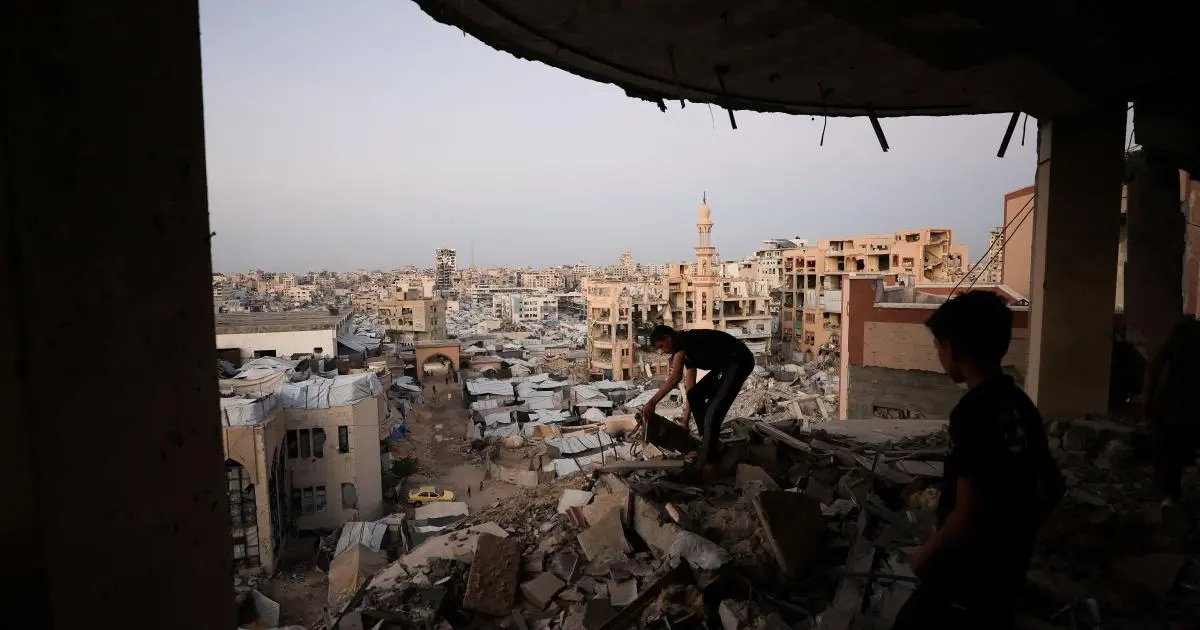
A year after the Trump administration successfully negotiated a high-profile agreement to end the devastating war in Gaza, Palestinians across the battered enclave are still waiting for the long-promised "day after" to materialize. The October 2025 cease-fire plan ultimately secured the release of the remaining Israeli hostages and brought an official halt to large-scale hostilities. However, the military reality on the ground tells a vastly different story. Israel continues to launch frequent, targeted strikes across the territory, frequently resulting in civilian casualties, including approximately 300 children killed over the past twelve months alone.
The original agreement had outlined a carefully structured, phased political process designed to facilitate the comprehensive reconstruction of the heavily devastated territory. Earlier this year in January, Jared Kushner—U.S. President Donald Trump’s son-in-law and key point person for Middle Eastern diplomacy—publicly promised that the systematic restoration of core civic services and vital infrastructure would commence within a strict 100-day window. This ambitious revitalization timeline was meant to cover essential facilities such as water and sewage networks, electricity grids, local hospitals, and bakeries.
Yet, nine months past that initial benchmark, Gaza has witnessed virtually no reconstruction, no meaningful restoration of basic public services, and no relief from daily violence. Instead, the overwhelming majority of the local population remains tightly packed into squalid, sprawling tent cities situated along a narrow and continually shrinking strip of coastline. These makeshift settlements are heavily plagued by widespread disease outbreaks and severe rodent infestations. Residents continue to endure extreme shortages of food, adequate medicine, clean drinking water, and access to basic sanitation facilities.
While Gazans may no longer be suffering under the acute grip of outright famine as they did during earlier phases of the conflict, the humanitarian situation remains thoroughly catastrophic and fundamentally unsustainable. International observers warn that these intolerable living conditions could easily spark another violent explosion. Furthermore, many analysts note that this manufactured deprivation is effectively enabling the ultimate endgame favored by numerous Israeli hard-liners: the eventual eviction and displacement of Gaza’s more than two million Palestinian residents.
The prevailing political status quo appears to heavily suit the current Israeli leadership. In a recent interview, Nikolay Mladenov, the Bulgarian diplomat serving as the high representative for President Trump’s Board of Peace—the international body overseeing the Gaza peace implementation—candidly pointed out where the primary obstacles to progress lie. Discussing compliance with established commitments, Mladenov gently noted that this is "where we are a little bit stuck right now." Kushner has similarly pointed to upcoming domestic political hurdles, attributing the paralysis in part to Israel’s contentious elections later this month, which he argues have left the government of Prime Minister Benjamin Netanyahu "a little irrational" regarding the management of Gaza.
Although electoral calculations are unquestionably playing a major role—with Netanyahu locked in a tight, politically existential reelection battle—the broader pattern of Israeli public statements and military actions points toward a much deeper and more alarming underlying strategy. Ultimately, the Netanyahu government’s operational approach appears to have far less to do with stabilizing the Gaza Strip or successfully disarming Hamas, and far more to do with rendering the entire territory utterly uninhabitable while systematically clearing out its indigenous population.
Whether or not the Trump administration actively shares this ultimate objective, its extraordinary diplomatic deference toward Netanyahu’s far-right government, coupled with a general indifference toward the daily suffering of ordinary Palestinians, is effectively facilitating just such an outcome. Unless the United States and its international partners are finally prepared to exert genuine pressure to force Israel into honoring its formal commitments, it may soon be only a matter of time before Gaza is lost permanently.
HELL ON EARTH
It remains difficult to overstate the staggering scale of death, physical destruction, and profound human suffering inflicted upon Gaza and its approximately 2.2 million inhabitants over the course of the past three years. In the immediate aftermath of the devastating October 7, 2023, terrorist attacks orchestrated by Hamas against Israel, Israeli political and military leaders explicitly vowed to completely "flatten" the territory and turn it into a "city of tents," publicly promising that "Gaza will never go back to what it was."
To a tragic extent, they have delivered on those threats. The estimated 223,000 tons of explosives dropped on the narrow strip—an explosive payload roughly equivalent to 15 times the power of the atomic bomb dropped on Hiroshima—have officially claimed the lives of more than 74,000 Palestinians. The vast majority of these casualties have been civilians, and the bombardment has reduced the vast majority of Gaza’s built environment to rubble. This sweeping military assault, which has left Israel facing serious allegations of genocide at the International Court of Justice, has wiped out an estimated 92 percent of the territory’s housing stock, 95 percent of its agricultural farmland, all 12 of its local universities, and nearly half of its 36 hospitals—effectively obliterating the foundational institutions required to sustain human life.
Following such unprecedented devastation, last year’s negotiated cease-fire was greeted with immense, undeniable relief. Under the initial phase of the Trump administration’s Gaza blueprint, the warring parties agreed to an immediate halt to military attacks, a comprehensive exchange of hostages and prisoners, the rapid restoration of vital basic services, and a massive, unhindered surge of humanitarian aid. However, aside from the initial release of Israeli hostages by Hamas, the vast majority of these reciprocal commitments have been fulfilled only partially, if at all.
Phase two of the framework, which was formally launched in January despite Israel’s failure to satisfy its prior obligations, envisioned the broader stabilization of the territory through the deployment of an international peacekeeping force. It also called for the establishment of a Palestinian technocratic governing body known as the National Committee for the Administration of Gaza, which was to be coupled with the gradual disarmament of Hamas and a phased withdrawal of Israeli military forces. These latter steps were established as essential prerequisites for the long-term physical and economic reconstruction of the Gaza Strip as detailed in phase three.
One full year after the initial cease-fire announcement, however, Israel continues to block the entry of the designated Palestinian administrative and policing bodies that would allow Hamas to formally relinquish local governance and enable large-scale reconstruction to begin. Meanwhile, Hamas and Israel remain deadlocked over the precise sequencing of the militant group’s disarmament relative to the timing of an Israeli military withdrawal.
Although the availability of food has improved relative to the height of last year’s famine, Israel continues to tightly restrict the flow of humanitarian assistance, permitting only a small fraction of the daily 600 truckloads mandated by the cease-fire agreement to cross into the territory. More than 90 percent of Gaza’s population remains internally displaced. Furthermore, in the time since the cease-fire was formally declared, the Israeli military has unilaterally expanded its physical control from just over half of the enclave to approximately 65 percent of its total land area.
Frequent Israeli airstrikes have continued to claim lives, killing more than 1,400 Palestinians even after the cease-fire took effect. The grim reality that the death toll continues to mount steadily during an active cease-fire serves as a stark testament to the dystopian normal that has settled over the strip. As United Nations Middle East Envoy Sigrid Kaag bluntly described the situation, living conditions in Gaza represent "hell on earth with no prospect of significant change in sight."
To be sure, Israel is not solely responsible for the perpetuation of these harrowing conditions; Hamas also bears a significant share of the blame. The leadership of Hamas spent months stubbornly resisting widespread international calls for its disarmament, a core requirement of the Trump plan, ultimately agreeing to the measure only under intense diplomatic pressure exerted by Egypt and other regional mediators. At the same time, the Trump administration must also shoulder substantial responsibility. By allowing the political process to stall indefinitely, granting Israel extraordinary latitude, and enforcing the terms of the cease-fire in a heavily lopsided manner, Washington has effectively permitted Israel to pursue a low-intensity continuation of the war.
Just a few months ago, it appeared that this intractable impasse might finally have been broken. In late July, President Trump triumphantly announced a major breakthrough regarding the implementation of the second phase of his Gaza initiative. Following seven months of exceptionally fraught and intense negotiations, Hamas and the Board of Peace successfully reached an accord concerning the phased disarmament of the militant faction. Theoretically, this development cleared the path for desperately needed recovery and reconstruction efforts, alongside the introduction of new Palestinian civilian governance and domestic policing mechanisms.
The overall success of this blueprint hinged upon a meticulously crafted sequence of events: Hamas was expected to disarm in direct parallel with a corresponding Israeli military withdrawal, a structural design specifically intended to ensure steady progress and prevent either side from exercising an effective veto over the peace process.
The fact that Hamas—an organization founded upon the premise of armed resistance—had formally agreed to any form of disarmament was unprecedented and rightly hailed by Trump as a historic achievement. Even so, Prime Minister Netanyahu categorically rejected this agreed-upon road map. He insisted that there could be no possibility of an Israeli military withdrawal until Hamas was fully and completely disarmed, while simultaneously maintaining that Israel reserved the absolute right to continue active military operations inside Gaza. In practical terms, Israel’s position demands that Hamas fulfill all of its phase two obligations before Israel has satisfied even its phase one requirements—an impossible stance that renders the entire diplomatic framework unworkable.
Consequently, the entire process is once again completely gridlocked. Without meaningful progress on either the disarmament of Hamas or the withdrawal of Israeli forces, the Palestinian technocratic governing committee—currently left marooned in Cairo—along with the newly formed police force remain unable to enter the Gaza Strip. The same prohibition applies to any international stabilization force.
While the Trump administration and the Board of Peace attempted to obfuscate this sequencing dilemma during the summer—publicly endorsing the hardline Israeli narrative that Hamas must disarm first, while privately reassuring Hamas and other regional stakeholders that the original road map remained intact—such diplomatic hedging ultimately favored the stronger party. Washington’s ambivalence functioned as an explicit endorsement of the Israeli position. Having already granted Israel an effective pass on most of its phase one obligations by repeatedly refusing to condemn near-daily cease-fire violations, the U.S. government was now quietly absolving Tel Aviv of its phase two responsibilities as well, leaving Gaza’s reconstruction suspended indefinitely.
GONE FOR GOOD
The inherent dangers of this persistent stalemate were articulated clearly by Mladenov during a September interview, where he warned that the total absence of meaningful progress in Gaza is actively foreclosing the territory’s future and severely damaging the viability of a two-state solution, with grave implications for the wider Middle East.
"If we allow for Gaza to continue in the situation that we have now," Mladenov cautioned, "Gaza will be gone. It will be gone for good." He added that if the international community fails to address the plight of the two million Palestinians living in these abysmal conditions, finding a credible path back to resolving the broader Israeli-Palestinian conflict will become impossible, while simultaneously planting the volatile seeds of an inevitable future military and security crisis.
What Mladenov left unsaid, however, is that Netanyahu appears thoroughly content with maintaining this exact state of diplomatic and military paralysis. The Israeli prime minister, who only reluctantly acceded to the 2025 Gaza cease-fire under intense external pressure, has successfully managed to sustain military pressure inside the enclave without incurring significant political or diplomatic costs at home. Ongoing military actions and the persistent humanitarian catastrophe fail to generate meaningful domestic outrage within Israel. Furthermore, even Netanyahu’s main political rivals in upcoming elections have felt compelled to distance themselves from or outright dismiss the U.S.-backed peace road map. Meanwhile, international outrage over the ongoing carnage has largely subsided, with many foreign governments opting to support a failing peace process rather than confronting the alternative of complete collapse.
For Netanyahu, maintaining violence at this carefully calibrated level—just enough to prevent any meaningful recovery or structural reconstruction of Gaza, yet remaining below the threshold required to trigger a major international crisis—has transformed into an end in itself. Much as he previously insisted on the unattainable objective of "total victory" during the first two years of the war, he now champions the equally unachievable goal of Hamas’s "total disarmament." While it is conceivable for Hamas to surrender heavy weaponry such as rockets, missiles, and mortars, expecting the group to relinquish every individual rifle or handgun while hostile foreign forces continue to occupy parts of the territory is entirely unrealistic. Nevertheless, Netanyahu’s uncompromising stance successfully placates his extremist coalition partners, justifies permanent military control over the enclave, and indefinitely preempts any future political accommodation with the Palestinians.
More crucially, keeping Gaza trapped in this multi-dimensional limbo—characterized by neither a genuine peace nor a return to full-scale warfare, limited short-term humanitarian relief alongside zero long-term reconstruction, and a population utterly consumed by daily survival yet devoid of hope—directly serves the broader ideological vision harbored by Israeli hard-liners. Their ultimate objective is to render Gaza so fundamentally uninhabitable that its residents are left with no choice but to flee.
For Netanyahu and his far-right ministers, the ongoing immiseration of the strip is not an unfortunate byproduct, but a central pillar of state strategy. Prominent Israeli officials, including Defense Minister Israel Katz, have repeatedly vowed to maintain an indefinite military presence in the territory without withdrawing. More tellingly, across the two-thirds of Gaza currently under direct military control, the Israel Defense Forces have systematically eradicated virtually all physical traces of Palestinian civilian life, razing thousands of structures, flattening entire neighborhoods and agricultural zones, and erecting permanent military infrastructure and outposts.
Members of Netanyahu’s governing coalition have made little secret of their ultimate ambitions regarding the removal of Gaza’s native population and the eventual establishment of civilian settlements by Israeli Jews. Israeli National Security Minister Itamar Ben-Gvir, among the most vocal proponents of Palestinian expulsion, recently unveiled a formal seven-year strategy aimed at encouraging the "voluntary emigration" of Palestinians from the territory, setting a target of relocating 250,000 residents during the first year alone.
Ben-Gvir is far from alone in expressing these sentiments openly. Katz has similarly called for facilitating the emigration of Gazans "by any means," asserting that "there is no real solution for Gaza in the end without this migration." Netanyahu himself has echoed these views behind closed doors, privately confirming to a group of lawmakers in 2025 that Israel has intentionally been "destroying more and more houses" in Gaza to ensure that displaced Palestinians "have nowhere to return." As Netanyahu reportedly observed, "The only obvious result will be Gazans choosing to emigrate outside of the strip."
While the Trump administration may not explicitly endorse such an outcome, its actions have done little to prevent it. Back in January 2025, President Trump floated a controversial proposal suggesting that the United States should "take control" of Gaza and "clean out" its population as part of a grandiose vision to transform the depopulated coastline into a "Riviera of the Middle East." Although Trump ultimately stepped back from that specific proposal following a massive global outcry, the administration’s persistent laissez-faire attitude toward ongoing Israeli violations suggests a high tolerance for prolonged Palestinian suffering.
LOSING GAZA
The long-term consequences of perpetuating this ongoing misery are profoundly grim. As Mladenov and other international diplomats have repeatedly warned, maintaining the current trajectory will likely yield two primary outcomes: driving increasing numbers of desperate Palestinians to abandon the Gaza Strip entirely, and dramatically elevating the statistical probability of a catastrophic violent escalation, including a potential return to full-scale regional warfare. In either scenario, the heaviest human costs will continue to be borne overwhelmingly by Palestinian civilians, even as wider regional stability deteriorates and the international standing of both Israel and the United States experiences further erosion.
As living conditions in Gaza fail to show any meaningful improvement while deadly military strikes persist, the risk of a renewed explosion grows exponentially. Hamas, though heavily degraded as a military force, has not been completely unseated and has thus far exhibited notable restraint, absorbing continuous blows including targeted assassinations and regular airstrikes. However, this pragmatic restraint is unlikely to hold indefinitely.
Netanyahu may calculate that keeping Israel on a perpetual war footing serves his domestic political survival, welcoming the prospect of a low-level forever war in Gaza. Yet a prolonged military occupation offers few tangible strategic benefits while steadily draining national resources, eroding public morale, deepening international isolation, and permanently foreclosing any possibility of normalizing diplomatic relations with additional Arab states. Similarly, while the fantasy of a mass Palestinian exodus may appeal to proponents of a "Greater Israel," it would cement Israel’s status as an international pariah and condemn generations of Israelis and Palestinians to an endless cycle of bloodshed.
For the United States, prolonged violence and an increasingly farcical peace process threaten to unravel one of the few tangible foreign policy achievements claimed by the Trump administration, locking the wider region into a state of perpetual instability. Against the backdrop of escalating tensions with Iran—which has often cast Washington in the light of an unreliable security partner and encouraged regional allies to seek alternative diplomatic arrangements—a definitive failure in Gaza would solidify perceptions of the United States as a declining global superpower.
SALVAGE JOB
There is little doubt that both the Trump administration’s original Gaza blueprint and the institutional mechanisms established to oversee it, such as the Board of Peace, suffer from profound structural flaws. The peace architecture is heavily skewed in Israel’s favor, demands no genuine accountability for past or ongoing atrocities, routinely denies Palestinian agency and self-determination, and conflicts with key tenets of international law, including the stipulations of the Geneva Conventions. Nevertheless, in the absolute absence of a more equitable and comprehensive peace initiative, the existing road map remains the single viable mechanism capable of delivering much-needed relief and recovery to the suffering population—provided it is enforced fairly.
Assuming the Trump administration genuinely desires to see its peace plan succeed, a practical path forward through the current impasse remains available. To achieve this, the United States and its international partners must immediately adopt three essential courses of action.
First, Washington must recognize that Israel’s strategic objectives in Gaza diverge sharply from—and in many critical ways directly contradict—the stated goals of the Trump administration and the broader international community. While international stakeholders remain focused on the long-term stabilization, rehabilitation, and governance of the strip, the current Israeli government appears intent on making continued human habitation impossible.
Second, improvements in the daily lives and basic survival of ordinary civilians in Gaza must be rigorously insulated from, and ideally delinked entirely within operational planning from, the broader political process. The safety, security, and fundamental dignity of more than two million non-combatants cannot continue to be held hostage either to the political recalcitrance of Hamas or to the internal electoral machinations of Israeli politics. The basic well-being of Palestinian civilians must never again be utilized as a geopolitical bargaining chip by Israel or the Board of Peace to extract military or political concessions.
Finally, the United States and international mediators must exert decisive pressure to ensure that both sides strictly adhere to their mutual obligations under the October 2025 cease-fire agreement, standing fully prepared to impose concrete diplomatic and economic consequences for noncompliance. This requires bringing an immediate halt to all unauthorized military attacks, permitting an unrestricted influx of unconditional humanitarian aid, restoring essential public services, clearing massive amounts of structural debris, and actively reviving local economies as mandated in the first phase of the Trump plan.
Furthermore, the disarmament of Hamas, the withdrawal of Israeli military forces, the installation of the new Palestinian technocratic administration, and the comprehensive physical reconstruction of the territory must be treated as parallel, interdependent tracks rather than sequential hurdles. They must be pursued simultaneously, exactly as outlined in the original Board of Peace road map, if the process is to have any realistic chance of succeeding. Crucially, to facilitate any of these steps, Washington and the Board must compel Israel to permit the entry of Palestinian administrative personnel and newly trained police forces into Gaza without further delay.
Implementing these necessary measures will undoubtedly prove politically difficult in Washington, particularly given President Trump’s close personal alignment with Netanyahu and the Israeli leader’s heavy reliance on extremist coalition partners. Yet there are simply no viable alternatives, regardless of the ultimate outcome of Israel’s domestic elections.
While many political observers have speculated that a potential Netanyahu electoral victory might finally grant him the political latitude to advance the Trump peace plan, the empirical record of the past three years strongly suggests otherwise. A renewed mandate for a radical coalition under Netanyahu is far more likely to be utilized over the next four years to finalize the destruction of viable Palestinian life in Gaza, alongside accelerating de facto annexation and settlement expansion in the West Bank.
President Trump would be well-advised to carefully consider whether it is strategically prudent to sacrifice a signature foreign policy initiative—one upon which he has staked considerable personal and political capital—to shield an Israeli government whose political tenure may already be drawing to a close. The profound human and geopolitical fallout resulting from the destruction of Gaza and the immense suffering of its people will resonate across the region for generations to come. Ultimately, only Israel and its primary diplomatic enabler in the Washington White House hold the power to determine whether the coming years will be defined by genuine rebuilding and healing, or by an endless cycle of perpetual violence and regional instability.