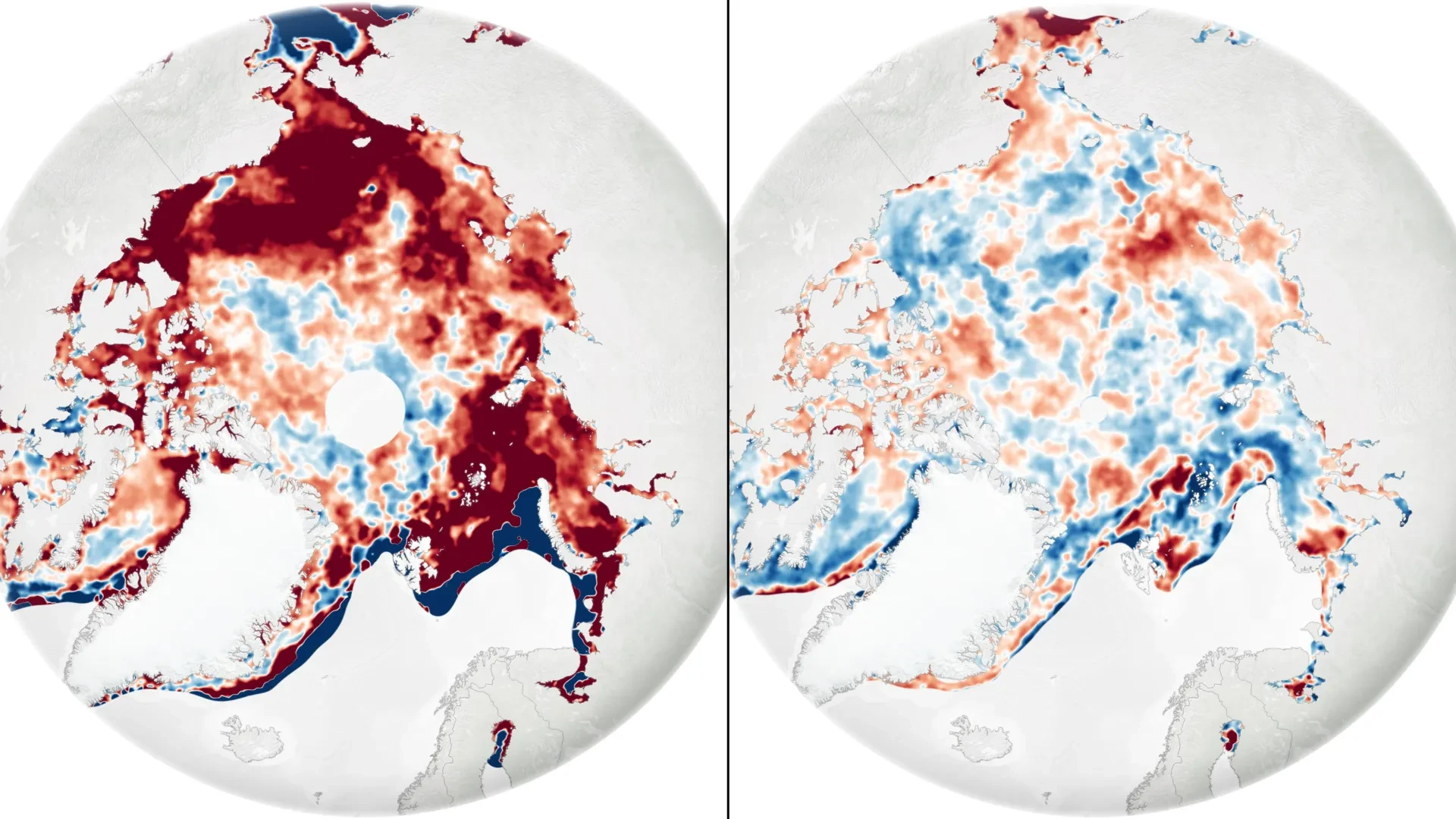
For the vast majority of the satellite observation era, the story of the Arctic has been one of relentless, compounding transformation. Year after year, data beamed down from orbit confirmed a troubling trajectory: the Arctic sea ice melt season was steadily growing longer, cutting deeper into both ends of the frigid polar calendar. Sea ice began its retreat earlier in the spring, delayed its triumphant return well into the deepening chill of autumn, and triggered cascading ecological and climatological consequences across the globe.
Around 2010, however, that long-running, predictable trend unexpectedly flattened.
According to a comprehensive new NASA-led study analyzing decades of continuous orbital monitoring, although the melt season has lengthened dramatically since modern satellite tracking began in the late 1970s, its average duration has experienced remarkably little change over the last decade and a half. While the overarching crisis of a warming Arctic remains entirely unabated, the stabilization of the melt season’s duration offers a fascinating, complex window into how a fundamentally altered polar ecosystem behaves when pushed into a new climatic state.
Arctic Melt Season Is About 40 Days Longer
To capture the broader historical scope of these shifts, the research team analyzed a robust archive of satellite observations spanning nearly half a century, from 1979 through 2023. By tracking the precise signatures of surface temperature, microwave emissions, and visual imagery, the scientists were able to pinpoint the exact moment each spring when melting commenced across the ice pack, as well as the critical transition point in the autumn when sea ice began to freeze anew.
The findings underscore the immense magnitude of the transformation that has already taken place. The researchers discovered that the Arctic sea ice melt season is now approximately 40 days longer than it was when the satellite record first began in 1979. That is more than a month of additional open water absorbing solar radiation, altering weather patterns, and disrupting marine ecosystems.
Yet, a closer look at the temporal distribution of those 40 days reveals a striking nuance. The vast majority of that increase accumulated during the decades leading up to approximately 2010. Since that milestone, the average length of the melt season has remained relatively steady. This plateau persists even though individual years continue to exhibit sharp, volatile fluctuations driven by localized weather anomalies and atmospheric variability.
Digging deeper into the mechanics of this extended timeline, the data revealed that the lengthening melt season was driven primarily by a delayed autumn freeze-up rather than a massive shift toward drastically earlier spring melting. As the climate warmed, the autumn window expanded, keeping waters open longer into the dark polar winter.
"Previously, there was more of this multiyear ice that didn’t melt away each summer," explained Linette Boisvert, a co-author on the new study and an ice scientist at NASA’s Goddard Space Flight Center in Greenbelt, Maryland. "Now that the ice is thinner and there’s less of it, there’s a lot more variability."
Even with this recent stabilization, the profound structural decline in sea ice thickness and overall geographic extent—a trend that accelerated dramatically during the 2000s—appears to have paused temporarily, prompting researchers to investigate the underlying physical mechanisms responsible for the shift.
Why the Earlier Rapid Change Slowed
To decipher why the rapid lengthening of the melt season stalled around 2010, the scientific team turned to the fundamental energy balance of the Arctic region. The Arctic energy balance represents the net difference between all incoming energy entering the system—principally from the Sun, the surrounding atmosphere, and warm ocean currents—and the infrared thermal energy escaping back out into the vacuum of space.
During the dramatic sea ice losses observed throughout the 2000s, a powerful feedback loop took hold. As shrinking ice cover exposed vast stretches of dark, open ocean water, the reflectivity of the polar cap plummeted. Bright, pristine sea ice acts as a natural mirror, reflecting the vast majority of incoming solar radiation harmlessly back into the atmosphere. In contrast, dark ocean water readily absorbs that solar energy, converting it into ambient heat.
That extra heat accumulated in the upper layers of the ocean, significantly delaying the autumn freeze-up and keeping the melt season dragging on for weeks longer than historical averages. During the height of that decade, maps tracking the phenomenon highlighted sprawling regions where the melt season lengthened by as much as five days every single year.
Concurrently, the physical composition of the Arctic ice pack was undergoing a radical internal transformation. The thick, rugged multiyear ice that once dominated the high latitudes was systematically replaced by younger, seasonal ice that forms and melts within a single annual cycle. Because thinner ice is structurally weaker and far easier to fracture, melt, or push around by ocean currents, the remaining cover became hyper-sensitive to short-term meteorological disruptions, including passing cloud cover, fierce storms, and shifting winds.
Cloud Changes May Be Playing a Larger Role
In the years following 2010, subtle yet consequential shifts in atmospheric circulation patterns and cloud formations altered the local microclimate, reducing the amount of direct sunlight reaching the surface across significant sectors of the Arctic Ocean.
This celestial and atmospheric modulation appears to have counterbalanced the system enough to hold the average melt season relatively steady over extended multi-year periods, even if individual years continue to diverge substantially from the mean.
Crucially, researchers emphasize that this stabilization does not imply that anthropogenic climate change has somehow stopped impacting the Arctic. The polar region continues to warm at an astonishing rate—roughly four times faster than the global average—and the sea ice that manages to survive the summer melt is significantly thinner, more fragmented, and more precarious than it was several decades ago.
Instead, the data suggests that the Arctic may have crossed a threshold into a new operational phase. In this contemporary regime, day-to-day and year-to-year atmospheric conditions exert a much more dominant and immediate influence over the lifespan of the sea ice.
"Melt season length is much more dependent on atmospheric effects," Boisvert noted. "They seem to be playing a bigger role because the ice is generally thinner and more vulnerable to begin with."
The Plateau Could Be Temporary
Despite the stabilization observed over the past decade and a half, the study’s authors offer a firm note of caution, warning that the current plateau should not be misinterpreted as a permanent recovery or a permanent halt to sea ice degradation.
A resilient reservoir of thick, multiyear Arctic sea ice still survives year-round, primarily locked in the high-stress convergence zones north of Greenland and sheltered within the intricate waterways of the Canadian Arctic Archipelago. However, this last bastion of ancient ice continues to feel the thermal pressure of a warming planet.
If that remaining thick ice continues to erode and thin out in the coming years, scientists warn that the Arctic could easily breach another tipping point, plunging the region back into a period of rapid sea ice decline. Should that vulnerability translate into widespread structural loss, the melt season could quickly resume its historic march toward a longer calendar span.
For now, these findings underscore the critical importance of maintaining continuous, high-resolution satellite monitoring programs to track the delicate thermodynamic balance governing how Arctic ice forms, melts, and reforms. Whether the recent stabilization represents a lasting structural pivot in the polar climate system or merely a deceptive pause before another wave of accelerated change remains one of the defining questions of modern Earth science.