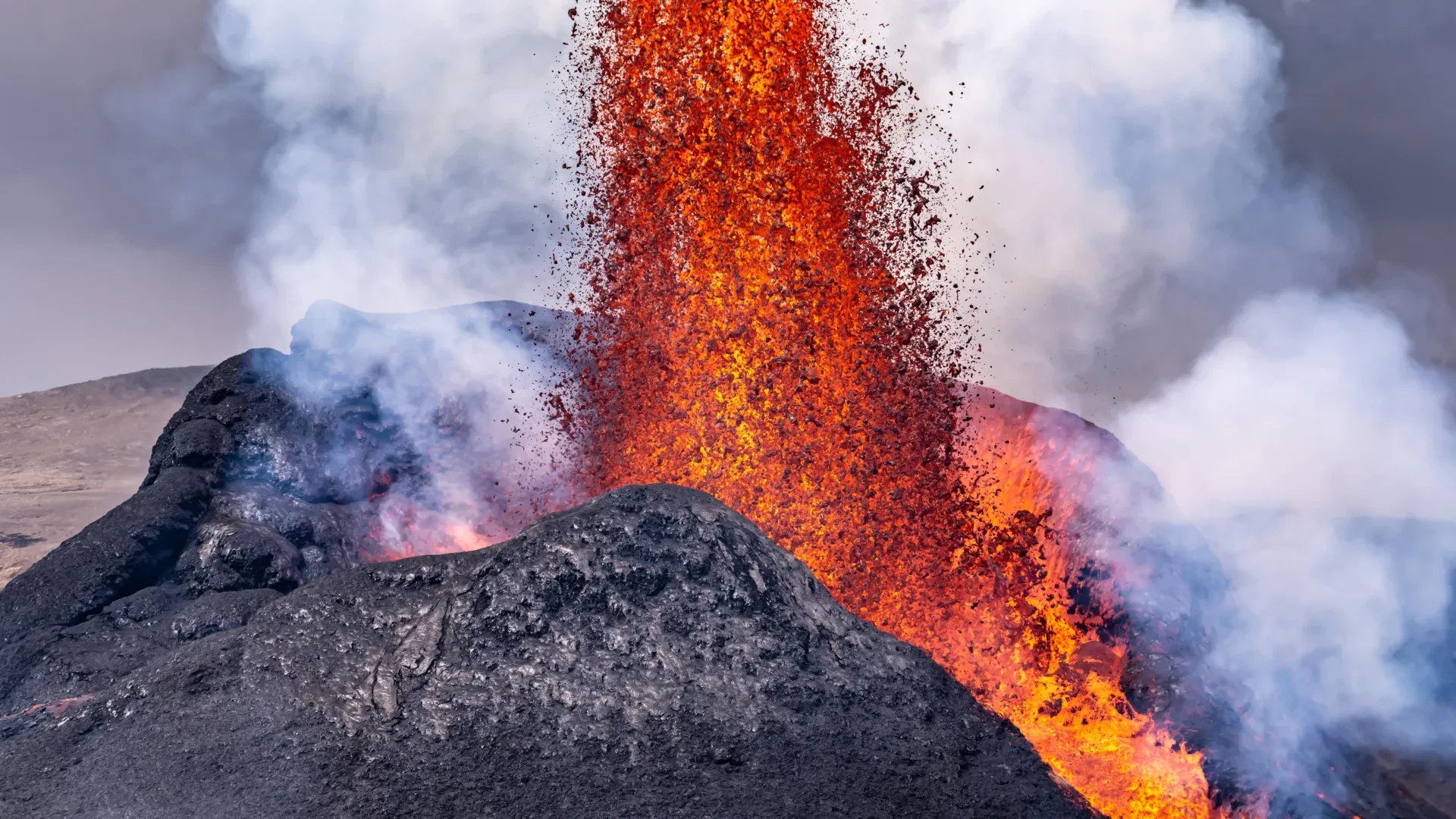
Geologists studying some of the oldest surviving volcanic rocks on Earth have uncovered compelling new evidence that water was actively influencing the planet’s interior and driving volcanic activity more than three billion years ago. The discovery offers a rare and revealing window into the dynamic nature of our planet during its infancy, suggesting that vital recycling systems were operating long before modern plate tectonics took hold.
The international research team, spearheaded by Adelaide University geochemist Dr. Eric Vandenburg, focused their investigation on ancient, exceptionally well-preserved rock formations located within Western Australia’s rugged Pilbara Craton. Through meticulous chemical analysis, the scientists determined that water had traveled far beneath the Earth’s surface billions of years ago before ultimately contributing to the formation of magma. This ancient magma fed volcanic systems that bore a striking resemblance to those found around the modern Pacific "Ring of Fire" today.
The findings, which were recently published in the prestigious scientific journal Nature Communications, indicate that Earth may have been actively exchanging and recycling water between its surface and its deep interior much earlier than scientists had previously realized. This revelation forces geologists to rethink the operational mechanics of the young planet, highlighting a world that functioned in ways vastly different from our modern environment, yet was surprisingly complex beneath its crust.
A Rare Look at the Young Earth
Dr. Vandenburg, a researcher within the School of Physics, Chemistry and Earth Sciences at Adelaide University, explained that the ancient rocks of the Pilbara Craton provide an extraordinary and unusual opportunity to investigate the extreme environmental conditions that prevailed on Earth billions of years ago. Because the geological record from this remote epoch is sparse and heavily weathered, these formations act as invaluable time capsules.
"These rocks formed more than three billion years ago, when Earth was a very different place," Dr. Vandenburg noted, emphasizing the sheer antiquity of the samples.
In the modern geological era, plate tectonics plays a fundamental and central role in moving water through the planet’s systems. At active subduction zones scattered across the globe, one tectonic plate sinks beneath another, forcibly carrying water from the oceans down toward the viscous mantle below. As this water-laden material descends into high-temperature and high-pressure environments, it helps lower the melting point of surrounding rocks, generating magma. This buoyant magma then rises toward the surface, fueling the explosive volcanic arcs that contribute significantly to the ongoing creation and growth of Earth’s continental landmasses.
However, scientists have long understood that the early Earth was a substantially hotter planet. Because of this intense thermal state, the lithospheric plates of the young Earth could not behave in the rigid, sliding manner characteristic of modern plate tectonics. Consequently, until now, it remained a major point of contention and uncertainty within the geological community whether surface water could have ever made that profound journey deep into the interior more than three billion years ago, and if so, through what exact mechanisms.
"What surprised us was finding evidence that large amounts of water had already made their way deep into the Earth’s interior and influenced the formation of volcanic rocks," Dr. Vandenburg said, highlighting the unexpected nature of the analytical results.
A Process Called "Dripduction"
To account for how water could be transported deep underground in the absence of modern subduction zones, the researchers point toward an alternative and unconventional geological mechanism that may have dominated the young planet. The team suggests a process they refer to as "dripduction."
In this hypothesized scenario, dense, water-rich portions of Earth’s cooler outer crust periodically became unstable, sagging downward and eventually collapsing gravitationally into the hotter, more fluid mantle below. This gravitational sinking action effectively dragged surface water along with the descending crustal material, funneling vital volatiles deep into the planetary interior.
As these dense sections of ancient crust descended further into the intense heat of the mantle, they released their trapped water. This liberated fluid altered the surrounding mantle composition and helped generate batches of magma. Over time, this magma rose buoyantly toward the surface, erupted through primitive volcanoes, and eventually cooled into the stable igneous rocks that have somehow managed to survive the destructive forces of plate tectonics, erosion, and metamorphism for over three billion years.
"The Earth wasn’t operating exactly as it does now, but it appears some of the key processes were already in place," Dr. Vandenburg observed. This suggests that while the architectural framework of our planet has evolved drastically, the underlying chemical interactions between the surface and the interior have deep historical roots.
When Did Earth Begin Recycling Its Surface?
The new discovery addresses one of the most enduring and fundamental questions in the field of geology: precisely how early did materials begin moving in a closed-loop cycle between Earth’s surface and its deep interior?
Pinpointing the exact timeline of when water first started traveling deep underground carries profound implications for multiple branches of Earth science. This deep-water recycling process profoundly affects global volcanic activity, dictates the pace and mechanics of continental growth, and governs the deep-Earth movement of chemical ingredients that are crucially important for the development and sustenance of life.
Furthermore, understanding these ancient mechanisms may help scientists construct more accurate models of how Earth’s earliest continents developed from a barren, molten-dominated landscape and how the planet gradually evolved over eons into the temperate, life-sustaining world we recognize today.
Chemical Clues From 3.1 Billion Years Ago
Rocks originating from this remote chapter of planetary history are exceptionally rare, which is precisely what makes the Pilbara Craton region of Western Australia so uniquely valuable to the scientific community. The region contains some of the oldest and best-preserved crustal fragments on Earth, offering researchers an unblemished geological archive of processes that transpired more than three millennia of millions of years ago.
By deploying advanced analytical techniques to study the delicate chemical signatures locked deep inside microscopic mineral grains within the rocks, the research team successfully reconstructed geological events dating back approximately 3.1 billion years. These geochemical markers served as proxy data, revealing the hidden history of fluid interactions that transpired long before the rise of complex multi-cellular life.
The results strongly indicate that Earth’s surface environment and its deep interior were interacting through active chemical exchange much earlier than previously recognized by mainstream geoscience. Rather than functioning as a relatively static, geologically sluggish body, the young Earth appears to have been remarkably dynamic, possessing the internal machinery required to recycle one of its most essential and ubiquitous substances: water.
The groundbreaking study was a collaborative international effort, involving researchers from Adelaide University, Monash University, the Geological Survey of Western Australia, Curtin University, the Australian National University, Cardiff University, and the GEOMAR Helmholtz Center for Ocean Research in Germany.