The Federal Aviation Administration is moving forward with a significant modernization of its remote pilot certification process, introducing a new format that will alter how prospective commercial drone operators are evaluated. Beginning October 26, 2026, the FAA will update its Unmanned Aircraft General-Small knowledge test, commonly known as the Part 107 test, to include dynamic, image-based questions that require applicants to interpret aviation charts directly within the digital testing environment.
According to the FAA’s August 2026 Airman Testing Community Advisory, the federal agency is collaborating closely with its official testing provider, PSI, to integrate these visual components seamlessly into the exam questions. While the underlying regulatory standards and operational rules governing small unmanned aircraft systems remain entirely unchanged, the way applicants demonstrate their comprehension of airspace and navigation is undergoing a notable evolution.
Under the updated framework, individuals pursuing their initial remote pilot certification will encounter exam questions featuring updated aviation chart images that do not appear in any existing printed testing supplements. This shift moves the testing methodology away from static, memorized figures and toward real-time spatial analysis and chart interpretation.
What Is Changing in the Exam Format?
For years, applicants studying for the Part 107 exam have relied heavily on traditional testing supplements containing familiar sectional charts and diagrams. Candidates could study specific figures in advance, memorizing key landmarks, airspace boundaries, and communication frequencies associated with standardized test questions. The upcoming October 26 update disrupts this reliance by introducing unfamiliar chart excerpts directly into the digital examination interface.

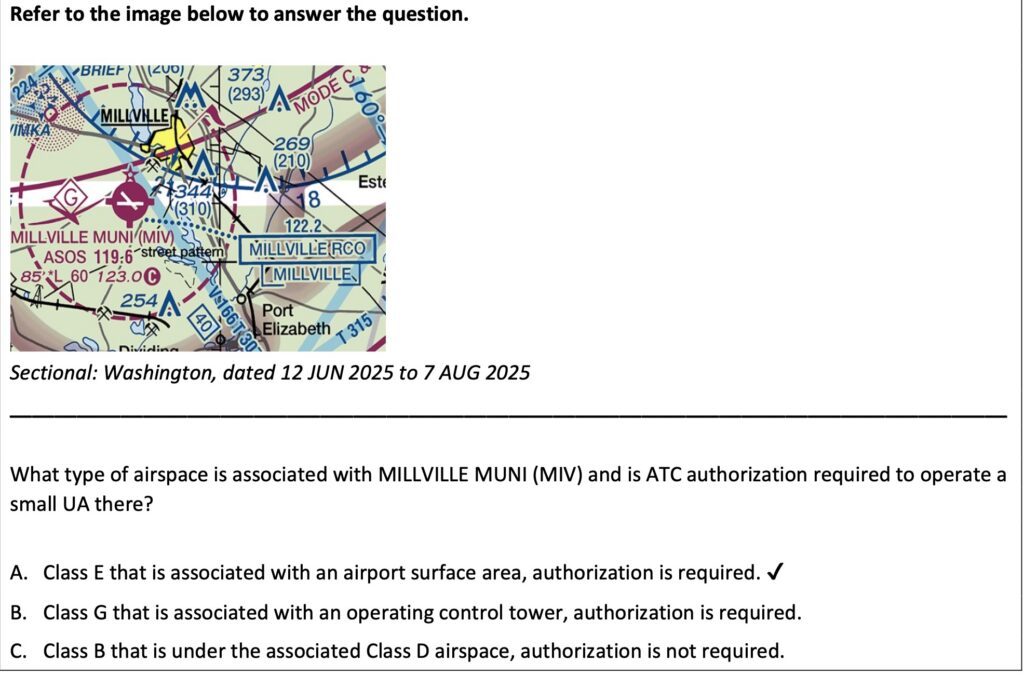
The FAA has outlined the nature of these new interactive inquiries within its recent advisory, providing sample questions to help the aviation community understand the scope of the modification. In one sample scenario, an applicant is tasked with inspecting a specific airspace surrounding an airport directly from an embedded visual graphic, requiring them to analyze whether proposed drone operations necessitate prior air traffic control authorization. Another sample question challenges test-takers to identify the correct airport communications frequency by interpreting the visual data presented on an updated chart excerpt rather than recalling a pre-printed figure from a manual.
This modernization effort means that future remote pilots must possess a deeper, more adaptable understanding of aeronautical charts. Rote memorization of legacy study materials will no longer suffice; candidates must be thoroughly prepared to interpret novel chart excerpts and apply aeronautical knowledge dynamically under test conditions.
Despite the introduction of these visual testing elements, the FAA has confirmed that printed testing supplements will not disappear immediately. The agency has not yet announced a definitive timeline for the complete removal of these traditional documents. Until a future transition phase is finalized and announced, applicants will continue to have access to the printed supplements during their examinations. Furthermore, the core regulations outlined in Part 107—such as altitude restrictions, visual line-of-sight requirements, and operational limitations over human beings—remain completely unaltered by this procedural update.
Industry Response and Preparation Resources
As the October 26 implementation date approaches, various aviation training organizations and independent educational providers have begun updating their curricula to help candidates navigate the transition. The FAA strongly recommends that all prospective applicants review the newly released sample questions through its official testing provider, PSI, to become thoroughly familiar with the updated digital exam format before sitting for their scheduled tests.
Independent training providers are also stepping up to assist the drone community. Organizations such as Fly107Prep have published detailed explanations regarding the October 2026 modifications, offering specialized study tools and resources designed specifically around aviation chart interpretation. These independent platforms are rolling out updated preparation materials, including free informational guides and companion mobile apps, aimed at bridging the gap between traditional study methods and the new image-based testing environment.
Aviation experts note that this update is part of a broader, long-term initiative by the FAA to modernize airman knowledge testing across multiple aviation sectors. By transitioning toward interactive, image-based assessments, the agency aims to ensure that newly certified remote pilots possess robust, practical competency in reading aeronautical data, ultimately enhancing safety within an increasingly crowded national airspace. For prospective commercial drone operators, the fundamental aeronautical knowledge required to fly safely remains the same, but the method by which that knowledge is verified has officially entered a new era.