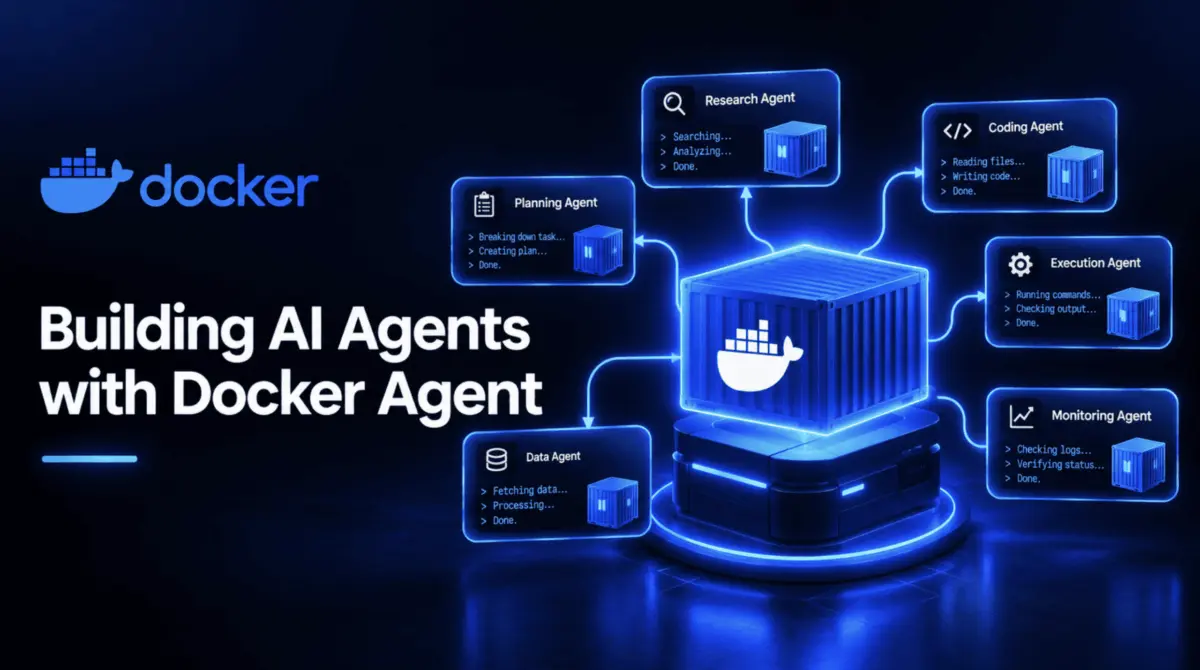
Docker, the company that revolutionized software deployment by popularizing the concept of containerization, is bringing its signature philosophy of packaging, versioning, and portability to the rapidly evolving world of artificial intelligence. With the introduction of Docker Agent, developers can now describe, run, and distribute AI agents using the same container registries and operational workflows that power modern cloud infrastructure.
The core premise behind Docker Agent is straightforward: package software once, run it anywhere, the exact same way every time. By applying this methodology to artificial intelligence, Docker aims to solve a growing fragmentation problem in the AI development ecosystem. Instead of writing custom code to wire together language models, prompts, and toolsets, developers can define AI agents using declarative configurations, manage them via a command-line interface plugin, and distribute them through standard Open Container Initiative registries.
The open-source project, licensed under the Apache 2.0 license and built by Docker Engineering, is installed and run simply as a command-line plugin. Early tagged releases of the Go-based project appeared in early 2026, and the tooling has since gained significant traction within the developer community, amassing thousands of GitHub stars and a high volume of commits.
This release does not mark Docker’s first foray into the artificial intelligence space. Throughout the previous year, the company laid the groundwork for agentic infrastructure. In July, Docker extended Docker Compose to native support for AI agents and models, followed by the introduction of Docker Model Runner as a mechanism for executing large language models locally without relying on external cloud application programming interface keys. Docker Agent represents the culmination of these efforts, bringing dedicated tooling specifically tailored for agentic workflows rather than relying solely on modifications to existing orchestration tools.
What distinguishes Docker Agent from other AI frameworks is its provider-agnostic, declarative design. Agents are defined using standard configuration formats such as YAML or HCL, meaning that building and deploying sophisticated agentic systems does not strictly require a traditional software engineering background. The tool integrates seamlessly with a broad array of leading model providers, including OpenAI, Anthropic, Google Gemini, Amazon Web Services Bedrock, Mistral, and xAI. Furthermore, developers can bypass cloud providers entirely by utilizing local models powered by Docker Model Runner.
Beyond single-model interactions, Docker Agent supports multi-agent orchestration, enabling teams of specialized agents to delegate tasks among themselves. Its tool ecosystem accommodates both built-in utilities—such as filesystem access, command-line execution, and reasoning helpers—and any Model Context Protocol server. These servers can operate locally, remotely, or in isolation inside dedicated Docker containers. Once an agent or a multi-agent team is fully constructed, it can be pushed to and pulled from any OCI-compliant registry, leveraging the exact same distribution pipelines already trusted by enterprise software teams.
Getting started with the tool requires a functional Docker installation and access to at least one language model. Users running recent versions of Docker Desktop find the plugin pre-installed, while others can install the binary via package managers like Homebrew or directly from the project’s repository releases. Configuration requires specifying an API key for a preferred cloud provider via environmental variables or opting for local execution through the model runner.
The foundational unit in Docker Agent is a single configuration file that outlines an agent’s designated model, descriptive metadata, specific behavioral instructions, and authorized toolsets. Developers can launch these configurations interactively through a terminal user interface for conversational tasks, or execute them non-interactively for automated scripting and continuous integration pipelines.
To handle more complex workflows, Docker Agent supports Model Context Protocol integrations, allowing agents to reach outside the local machine to perform tasks such as web searches or interacting with persistent memory databases. The recommended security pattern involves running these protocol servers inside isolated Docker containers rather than as uncontained local processes, preserving system security and environment cleanliness.
The true strength of the architecture emerges when configuring multi-agent teams. Rather than forcing a single general-purpose agent to handle every aspect of a complex project, developers can design cooperative teams where each member fulfills a narrow, specialized role. For instance, a common pattern involves a root coordinator agent that accepts user topics, delegates web information gathering to a dedicated research agent, and subsequently passes the compiled findings to a writing agent responsible for generating a polished final report.
A notable feature of this multi-agent architecture is its flexibility regarding underlying artificial intelligence models. Within a single multi-agent configuration, different team members can utilize models from entirely different providers, allowing engineering teams to select the most capable model for a specific sub-task rather than compromising on a single vendor ecosystem.
To ensure reliability before execution, Docker Agent configurations can be validated against established schema definitions. This programmatic validation step catches structural errors, invalid toolset types, or misconfigured references before runtime, ensuring that deployments behave as expected.
Once a multi-agent system is thoroughly tested and verified, packaging and sharing the agent follows standard container distribution workflows. Finished agents can be published to public or private OCI registries, allowing other developers to pull and execute them instantly without needing local configuration files. Furthermore, agents can reference external team members hosted in registries as sub-agents, blending locally maintained components with shared, version-controlled organizational assets.
When integrating external agents from a registry, developers can choose between referencing them via mutable tags or immutable content digests. While tags allow for automatic updates, referencing agents by their explicit cryptographic digests ensures strict reproducibility and eliminates runtime latency caused by remote registry lookups, keeping system behavior consistent and secure.
The introduction of Docker Agent shifts the paradigm of artificial intelligence development from writing brittle, imperative scripts to managing portable, declarative artifacts. By treating an agent’s entire operational identity—its underlying intelligence, behavioral instructions, tool access, and collaborative team structure—as a version-controlled entity, Docker provides the infrastructure needed to bring agentic applications reliably out of the experimental phase and into production environments.
Shittu Olumide is a software engineer and technical writer passionate about leveraging cutting-edge technologies to craft compelling narratives, with a keen eye for detail and a knack for simplifying complex concepts.