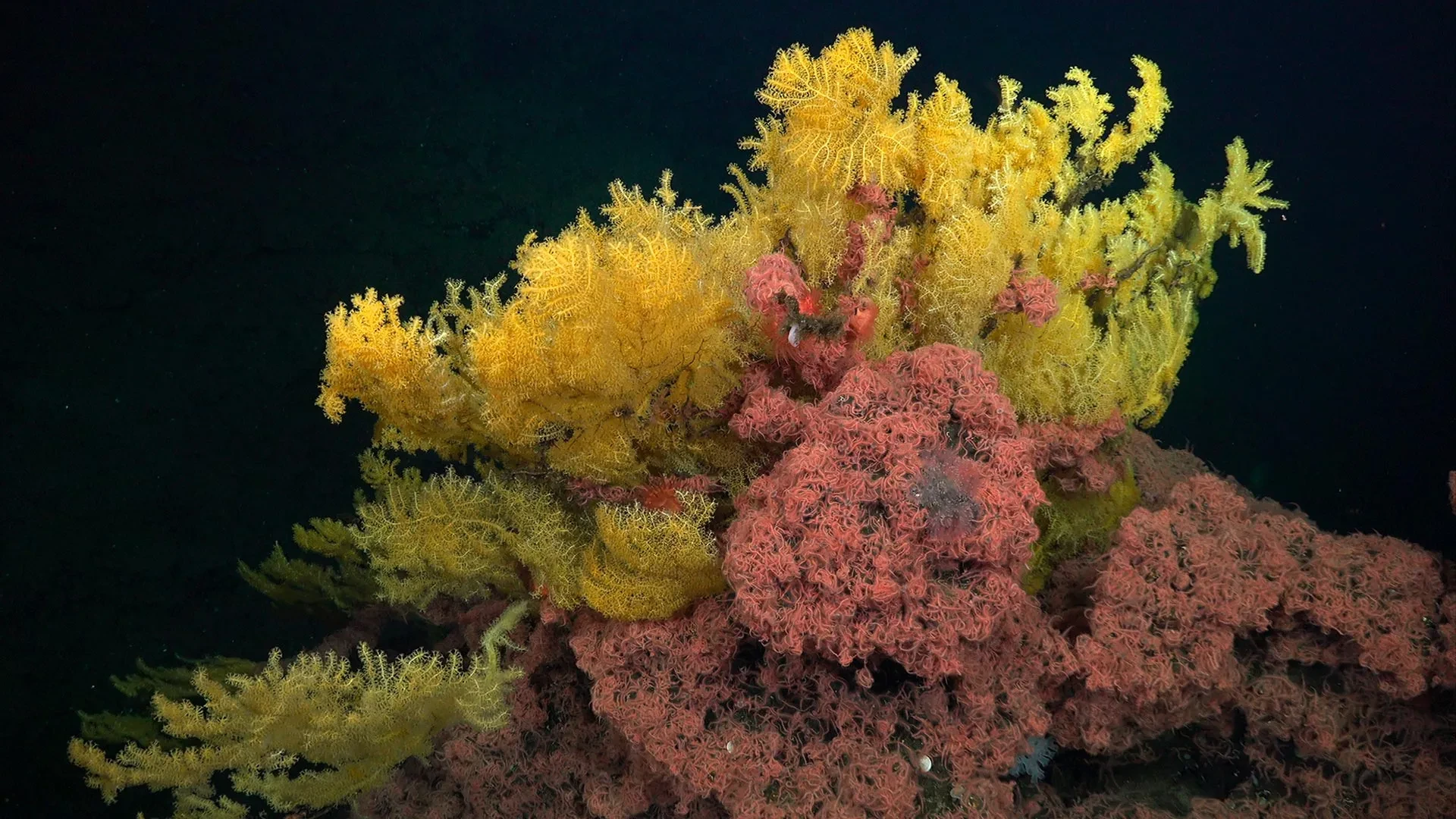
Deep beneath the surface of the Pacific Ocean, off the coast of Costa Rica, marine scientists surveying remote underwater mountains have made a remarkable and unexpected discovery: a brand-new species of coral that is so physically and genetically distinct from anything previously known to science that researchers were forced to establish an entirely new biological family to classify it.
The striking organism, characterized by a bright yellow color and a branching, tree-like architecture, was found thriving at depths ranging from 360 to 529 meters below the ocean’s surface. These towering colonies, some of which grow to heights exceeding one meter, were brought to light during comprehensive deep-sea surveys of seamounts located near Isla del Coco and along Costa Rica’s rugged Pacific margin. The detailed findings regarding this unique deep-sea dweller have now been officially documented and published in the open-access scientific journal ZooKeys.
The specimens were successfully collected during expeditions carried out in 2019 and 2023. These voyages were executed using the advanced, remotely operated vehicle SuBastian aboard the advanced research vessels Falkor and Falkor (too), both of which are owned and operated by the Schmidt Ocean Institute. The collaborative international research effort was led by Dr. Odalisca Breedy of the Universidad de Costa Rica, working alongside a dedicated team of co-authors and specialists including Cathy McFadden, Catalina Murillo, and Andrea Quattrini.
A Golden Coral Among Fields of Stars
During the deep-water explorations, researchers noted that the newfound coral was particularly abundant across rugged rocky outcrops. On these steep underwater formations, dense carpets of brittle stars blanketed nearly every available square inch of surface area. Against this shimmering, star-like backdrop of echinoderms, the vibrant yellow branches of the coral appeared to emerge directly from the dark seafloor, looking precisely like glowing arboreal giants surrounded by a canopy of distant stars.
This striking, almost ethereal underwater tableau directly inspired the scientific nomenclature chosen by the research team. The newly established genus has been named Laurinque, a term derived directly from "Laurinquë," which translates to "golden tree" in Quenya—the intricate Elvish language created by legendary philologist and author J.R.R. Tolkien for his seminal works, The Lord of the Rings and The Silmarillion. The scientists selected this specific name to honor the coral’s vivid, luminescent yellow hue and its stately, tree-like growth habit.
Meanwhile, the species has been designated with the specific epithet elenya, which translates to "stellar" or "of the stars" in the same Elvish tongue. This choice of name directly references the dense, shimmering populations of brittle stars that blanket the surrounding habitat, creating a visual effect that closely hugs the coral colonies. Together, the chosen genus and species names pay homage to what the researchers described as a remarkably mystical, Tolkien-esque landscape resting quietly on the deep ocean floor far beyond the reach of sunlight.
DNA Reveals a New Coral Family
While the physical appearance of the organism was striking from the moment it was encountered through the camera lenses of the SuBastian submersible, determining where the coral fit on the broader evolutionary family tree proved to be a significantly more complicated endeavor than the team initially anticipated.
In the early stages of the taxonomic classification process, scientists extracted and sequenced three standard genes that are commonly relied upon by marine biologists to identify and classify octocorals. However, the preliminary genetic data yielded unexpected and contradictory results. Instead of pointing cohesively toward a single established group, each of the three individual genes suggested a completely different and unrelated coral family, leaving researchers with a genetic puzzle that defied standard categorization.
Faced with these unusually inconsistent molecular indicators, the research team turned to a much more comprehensive approach known as phylogenomics. This advanced technique involves comparing hundreds of genes simultaneously, allowing scientists to cut through the noise of conflicting single-gene markers and resolve deeper evolutionary relationships. The broader, more intensive genetic analysis finally brought clarity to the coral’s true evolutionary position.
The comprehensive phylogenomic data conclusively demonstrated that the species does not belong to any previously recognized coral family documented by science. Instead, it represents an entirely distinct evolutionary lineage. While it shows a distant genetic relationship to the family Eunicellidae, both its intricate genetic makeup and its distinct internal and external anatomy differ substantially enough to fully justify the creation of a brand-new family, which researchers have named Laurinqueidae. To accommodate the unique organism, the team also established the new genus Laurinque specifically for the species.
Reflecting on the unexpected journey of discovery, Dr. Odalisca Breedy shared her perspective on the milestone find.
"I saw the octocoral garden for the first time in 2019 and I was impressed by the beauty of the landscape, which inspired, later the elvish name of the taxa," Dr. Breedy remarked. "I thought the species could belong to a known family and genera, but after the preliminar morphological analysis I realised that it was something very different that I could not match with the known taxa."
Dr. Breedy further noted the collaborative effort required to unravel the mystery: "In 2023 we collected more samples and thanks to the exhaustive molecular analyses made by my colleagues, Cathy McFadden, Catalina Murillo and Andrea Quattrini, we were able to determine the taxonomic placement of the stunning species, in one of the most enigmatic sites."
Costa Rica’s Deep Sea Still Holds Surprises
The successful identification of the Laurinqueidae family was made possible through an international collaborative effort spearheaded by Dr. Breedy. Financial and logistical support for the expeditions was provided by the Schmidt Ocean Institute, alongside a crucial research grant from the National Geographic Society, which helped facilitate the fieldwork necessary to gather adequate specimens from the challenging deep-water environment.
This newly identified organism now joins a rapidly growing list of previously undocumented marine species discovered during recent scientific surveys of Costa Rica’s underwater mountain chains. Seamounts—underwater mountains that rise from the ocean floor without breaking the surface—are known to act as biological hotspots, funneling nutrient-rich currents and providing hard substrates where sessile filter-feeders like corals can thrive.
At the same time, the discovery serves as a sharp reminder of just how much of the deep ocean remains entirely unexplored and poorly understood by humanity, despite the fact that deep-water marine environments cover roughly two-thirds of the Earth’s total surface area.
Marine scientists emphasize that deep-sea coral gardens like the one discovered off Costa Rica’s Pacific coast play a vital ecological role and are widely regarded as vulnerable marine ecosystems. The intricate, three-dimensional structures built by these slow-growing colonial organisms provide essential shelter, feeding grounds, and breeding habitats for a vast array of other deep-sea fauna, ranging from tiny invertebrates to mobile predators. By acting as complex structural habitats, these deep-water gardens function as critical centers of localized biodiversity in extreme marine environments that science is only just beginning to uncover, document, and understand.