In April 1917, deep in the turbulent and strategically vital waters near Rømø, the German submarine UC-30 was fighting its way back toward home. The vessel had been forced to abandon a planned mission to Ireland after running into severe engine problems, prompting a premature retreat toward German ports. Heavily armed and packed with dangerous ordnance, the submarine was nearing the end of its perilous journey, but it never arrived at its destination.
Carrying 18 naval mines and six torpedoes, the vessel was a floating arsenal. On April 19, its luck finally ran out when it struck a British mine, triggering a catastrophic blast that sent the submarine plunging to the seabed. All 27 crew members perished in the disaster, their final resting place swallowed by the dark, cold depths of the North Sea.
For nearly a century, the wreck remained completely lost and undisturbed beneath the waves, a forgotten tomb from a devastating global conflict. It was not until 2016 that Danish diver Gert Normann Andersen finally located the remains, bringing the historical site back into the public eye and setting the stage for a modern environmental investigation.
TNT Pollution Around a WWI Submarine
The discovery of the UC-30 eventually led to its inclusion as one of the key historical sites examined through the major NorthSeaWrecks research project. Katrine Juul Andresen, a professor at the Department of Geoscience at Aarhus University, played a pivotal role in investigating the condition of the submerged vessel and assessing its impact on the surrounding marine ecosystem.
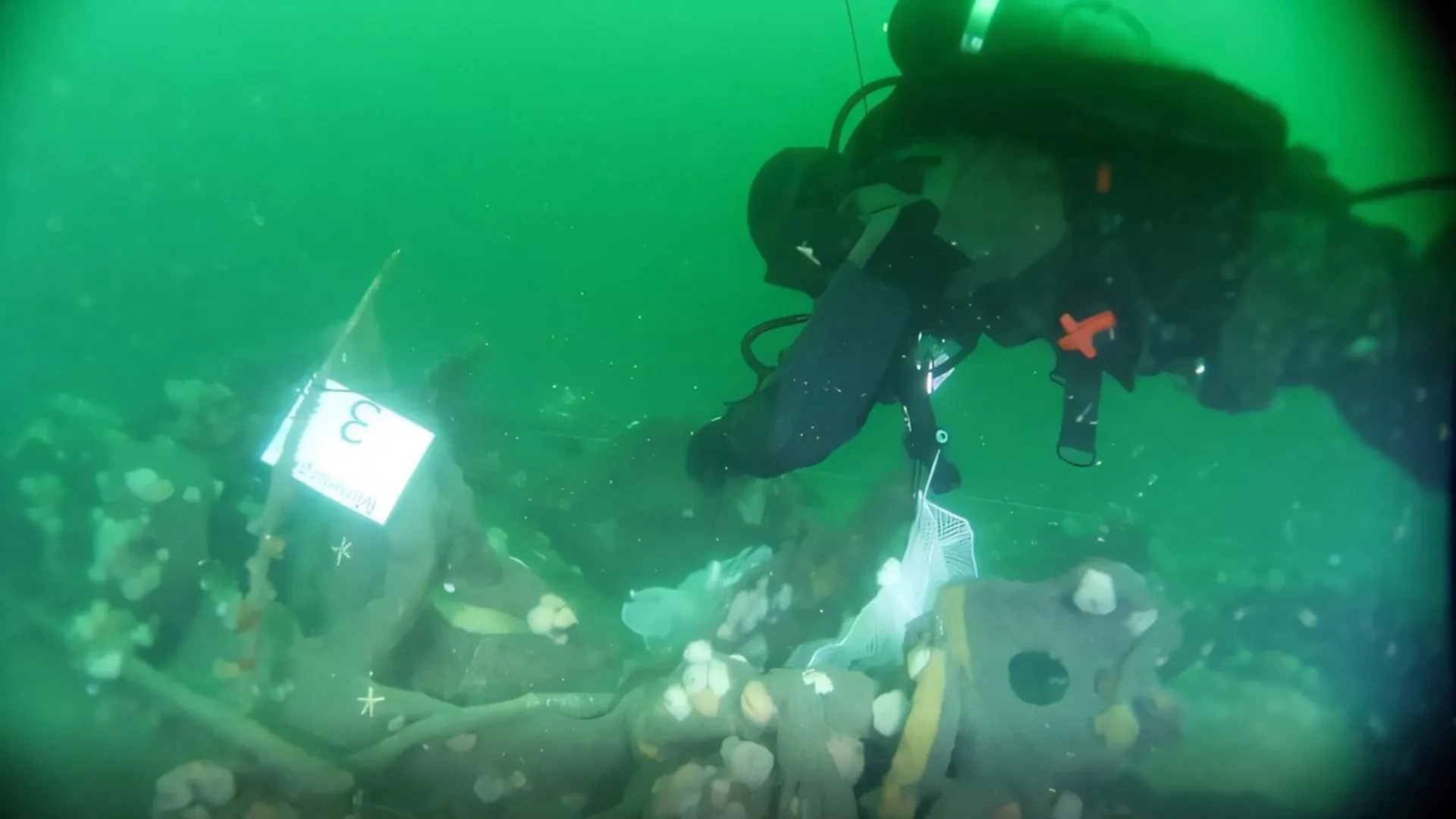
Because civilian diving is strictly prohibited on the wreck due to safety regulations and the sensitive nature of the site, Andresen and her research team relied heavily on the support and cooperation of professional navy divers. Following detailed operational instructions, the navy personnel descended to the wreck to gather critical data, collecting sediment samples, water samples, and wildlife samples from various locations directly on the submarine and across the surrounding seabed.
In addition to physical samples, the divers recorded comprehensive video footage and took high-resolution photographs. These visual records were subsequently analyzed by the research team to evaluate the physical exposure of the onboard mines and assess the overall structural condition of the deteriorating submarine hull.
The results of the analysis revealed an alarming reality: explosive material from the historic wreck is actively leaking into the surrounding marine environment.
“We found traces of TNT in the wildlife, the seabed, and the water column. Pollution is definitely occurring,” Andresen explains. “The question is how significant the effect is and how far from the wreck the pollution impacts the marine environment. It is likely a relatively localized source of pollution, but it will worsen as the wreck continues to deteriorate and expose more of the explosive material inside the mines.”
The findings underscore a broader, often overlooked legacy of the First World War, during which control of the North Sea became a central and fiercely contested theater of operations for both Germany and Great Britain.
The Battle for the North Sea
During the First World War, maintaining control of the North Sea was strategically vital to both the German and British war efforts. Domination of the region directly dictated the movement of essential food supplies, raw materials, and military equipment into and out of each country, giving either side the leverage to exert immense economic and military pressure on its adversary.
Because Germany possessed a smaller surface fleet compared to the vast Royal Navy, submarines quickly became a cornerstone of its naval strategy. German U-boats operated as stealth hunters, attempting to approach British merchant and military vessels unseen before destroying them with torpedoes or deck guns.
At the same time, both warring nations relied heavily on the deployment of naval mines to secure their own waters and restrict enemy movements. Historians estimate that approximately 190,000 mines were laid across the North Sea throughout the course of World War I, with military planners hoping that enemy ships would inadvertently sail into the concealed hazards.
The region was also the backdrop for the Battle of Jutland, fought off the coast of Hanstholm in Northern Jutland. It stands in history as the largest naval clash of the war, drawing massive German and British fleets into a ferocious engagement across the North Sea. More than 25 ships were sent to the bottom, and nearly 10,000 sailors lost their lives in the fighting.
Those immense wartime losses left the seabed of the North Sea heavily littered with shipwrecks and ordnance, a vast underwater graveyard that remains largely intact to this day.
More Than 10,000 Wrecks in Danish Waters
The UC-30 is far from an isolated incident; rather, it represents a tiny fraction of a much larger, systemic environmental challenge resting quietly off European coasts.
In 2024, Professor Andresen authored a comprehensive report commissioned by the Danish Environmental Protection Agency. The study examined the environmental risks posed by historical shipwrecks in Danish waters and evaluated potential strategies to prevent or mitigate the ongoing pollution they cause.
“In the report, I found that there are 10,127 wrecks in Danish waters. Around 15 percent of them date back to the years around and during the two world wars, spanning 1910 to 1920 and 1940 to 1945. That is quite a high number,” Andresen notes.
The Danish Environmental Protection Agency commissioned the research as part of its ongoing efforts to determine how Denmark can effectively meet the stringent environmental requirements set forth by the European Union Water Framework Directive. The findings strongly suggest that national and international authorities may eventually be forced to take direct, proactive action to address toxic contamination originating from specific high-risk wrecks.
“I am not aware of whether the agency has taken the work further since the report was published in 2024. However, research shows that the wrecks represent a source of pollution for the local marine environment,” she says.
Removing Explosives Is Not Simple
Addressing the threat of sunken munitions is an immensely complex and expensive undertaking, though some European nations have already begun taking substantial steps. Germany, for instance, has committed significant financial resources toward recovering select shipwrecks and World War II munitions from the Baltic Sea.
In the chaotic aftermath of the Second World War, Allied forces disposed of massive stockpiles of surplus ammunition by dumping tons of it directly into the ocean to prevent it from falling into hostile hands. Decades later, those hastily discarded weapons have transformed into an enduring, ticking environmental hazard for marine ecosystems.
“The Germans are further ahead with this than we are in Denmark. They sometimes retrieve explosives from the wrecks and neutralize them, but doing so is very costly,” Andresen points out.
Compounding the financial hurdle is the reality that attempting to destroy or remove explosives where they lie is not always the safest or most effective option. When military munitions are detonated underwater, the resulting blast wave can violently disperse toxic chemical contaminants throughout the surrounding water column and seabed. In certain locations, a controlled detonation could inadvertently exacerbate the pollution rather than resolve the underlying problem.
“It depends on the area where the wreck and munitions lie. Currents and seabed morphology play a major role. In some cases, detonating them can do more harm than good,” she explains.
Seabed Robots Could Help Find Dangerous Munitions
To navigate these delicate environmental dilemmas, Andresen is actively collaborating with international researchers through the EU-funded REMARCO project. The initiative is dedicated to exploring safer, more innovative methods for managing submerged munitions and historic shipwrecks without causing catastrophic collateral damage to marine life.
“Estamos trying to identify the most gentle solutions to the problem, as there is unfortunately no easy way to clean it up,” Andresen says, emphasizing the lack of a quick fix.
One promising approach currently being tested involves advanced autonomous robots capable of crawling directly across the seafloor. These specialized machines could map the precise geographical locations of dangerous munitions with unprecedented accuracy and help researchers monitor the structural deterioration of aging wrecks much more closely.
Looking ahead, developers hope that some of these subsea robots might eventually evolve beyond simple observation and data collection.
“In some cases, the robots can also pick up items, retrieve them from the sea and neutralize them. That could be one viable solution for the future,” she notes.
At the same time, marine experts caution that attempting to extract hazardous material from every single shipwreck across the ocean is neither practical nor strictly necessary. Many shipwrecks and their deadly cargo are already partially or entirely buried beneath thick layers of marine sediment, a natural barrier that greatly minimizes their ability to leach harmful pollutants into the surrounding water.
“Some wrecks are fully or partially buried in the seabed. When covered by sand, the risk of polluting the surrounding sea is significantly lower. It is a matter of identifying where the environmental threat is greatest—and then deciding whether the munitions on the wrecks should be removed,” Andresen concludes.