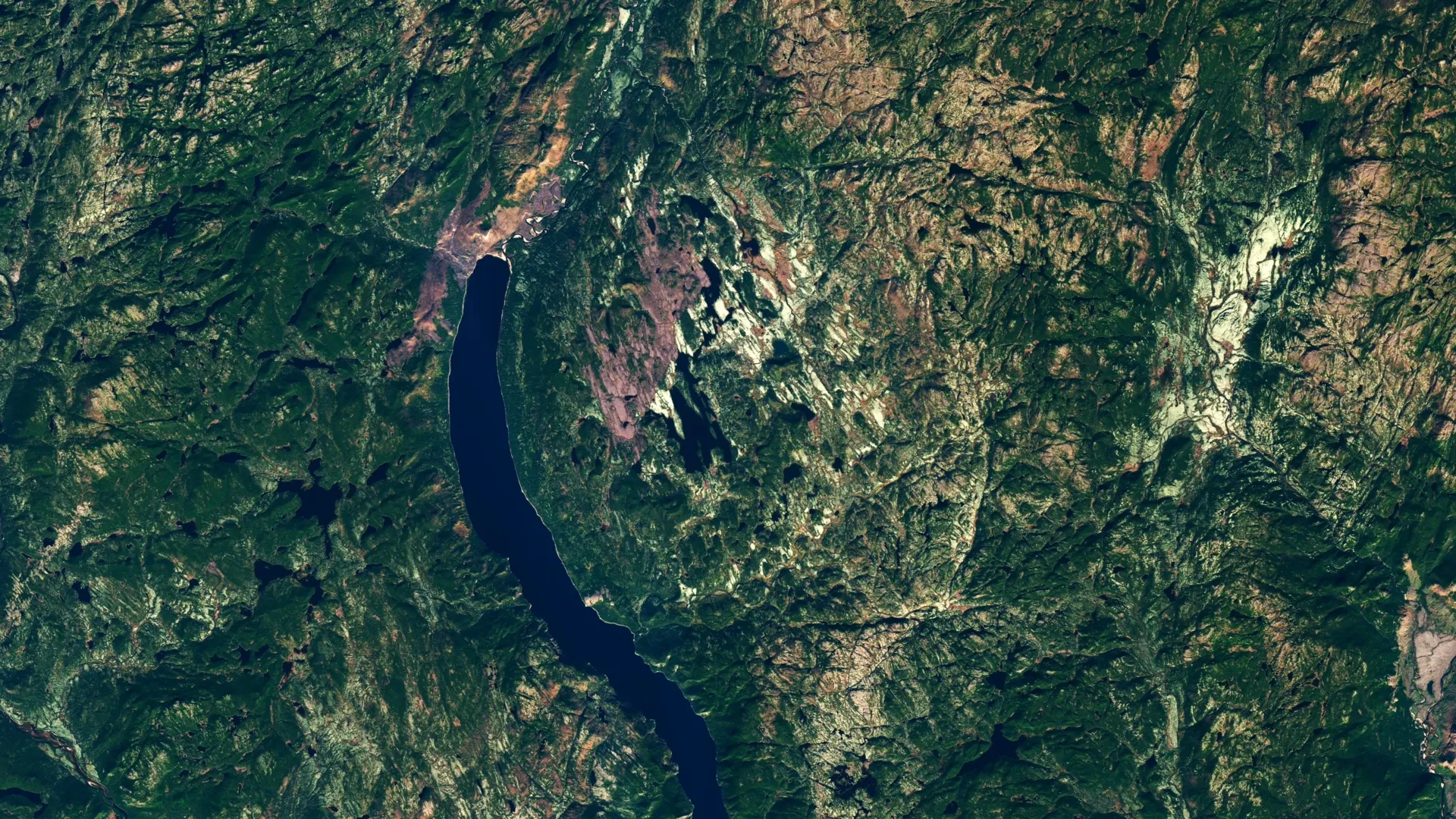
Earth possesses roughly 200 officially confirmed impact structures, yet planetary geologists have long maintained that hundreds more remain hidden across the globe, waiting to be uncovered by modern technology or sheer serendipity. One of those elusive, deeply buried structures has now been brought to light, and it ranks among the most substantial geological finds in recent years. The newly identified impact site, stretching an impressive 25 kilometers (16 miles) across the rugged landscape of Quebec, was first noticed not by a professional researcher using advanced orbital radar, but by an amateur astronomer who was simply mapping out a potential camping route.
The remarkable chain of events began in 2024, when amateur astronomer Joël Lapointe was preparing for an excursion into the remote and heavily forested Côte-Nord region of Quebec. While studying online satellite imagery to scout out terrain and identify prospective campsites, a peculiar, perfectly circular geographic feature near Lake Marsal caught his eye. Struck by its unusual symmetry and topography, Lapointe began to wonder if the depression could be the remnant of an ancient meteorite impact rather than a standard terrestrial geological formation. Driven by curiosity, he reached out to geological specialists across Europe and North America to share his satellite observations and gauge whether his hunch had any scientific merit.
Lapointe’s inquiry served as the critical catalyst for a deeper investigation. Later that year, a group of French researchers seized upon his tip and formally identified the lake area as the center of what could potentially become the 11th known impact structure in the province of Quebec. They presented their preliminary findings during a 2024 meeting of the Meteoritical Society. The hypothesis eventually crossed the desk of Gordon Osinski, a prominent planetary geologist at Western University in Ontario who also serves as the director of the globally recognized Impact Earth database.
Though Osinski initially viewed the claim with professional skepticism, the prospect of an unrecognized impact crater of that magnitude was too scientifically compelling to ignore. To verify the hypothesis firsthand, Osinski organized a grueling scientific expedition into the isolated and unforgiving Quebec wilderness in October 2025.
A Difficult Journey Into the Quebec Wilderness
Reaching the remote site proved to be an immediate test of endurance for the research team. Osinski and his colleagues began the final leg of their journey via floatplane, but the aircraft was unable to land directly on the shores of the target area due to the shallow and unpredictable local waters. Forced to improvise, the scientists had to unload their gear and wade through 50 meters—about 165 feet—of frigid, muck-filled water just to reach dry land.
The environmental conditions offered no reprieve once the team finally hauled their equipment ashore. The terrain was exceptionally rugged, waterlogged, and choked with swarms of aggressive insects, surrounded by what Osinski described as deep, twisty, and gnarly vegetation. Despite boasting a distinguished career filled with extensive fieldwork across six different continents, Osinski remarked that the remote Quebec site easily ranked among the most physically challenging and hostile environments he had ever encountered in his professional life.
To complicate matters further, historical geological surveys conducted decades prior had misinterpreted the local breccia rocks—fragmented rock cemented together by a finer matrix—as evidence of a completely different geological phenomenon. Specifically, past researchers had theorized that the circular depression was a funnel-shaped volcanic structure known as a diatreme, a geological pipe-like formation created when explosive gas-driven magma eruptions shatter surrounding bedrock.
However, as the grueling second day of the 2025 expedition unfolded, Osinski’s team began unearthing physical evidence that would entirely overturn the old volcanic hypothesis and confirm a much more violent cosmic origin.
Shatter Cones Reveal an Ancient Impact
The definitive turning point of the expedition occurred when researchers stumbled upon numerous rock outcrops bearing shatter cones. These rare, distinctively striated, cone-shaped fracture patterns in rocks form exclusively under the gargantuan, shock-wave pressures generated by hypervelocity meteorite impacts. Their widespread presence provided undeniable, definitive proof that the circular depression was carved out by an extraterrestrial collision rather than internal volcanic forces.
"It’s the only unequivocal evidence of an impact event that you can see in the field with the naked eye," Osinski explained, emphasizing the diagnostic value of the geological formations.
The cosmic projectile responsible for the ancient cataclysm possessed kinetic energy on a truly staggering scale, unleashing enough force to fracture the Earth’s crust and shape a complex impact structure spanning approximately 25 kilometers across. Geological mapping of the site reveals prominent features characteristic of large-scale impacts, including a distinct central uplift where the compressed bedrock rebounded upward following the initial compression wave, alongside towering cliffs displaying striking columnar jointing.
Reflecting on the sheer magnitude of the event, Osinski noted that if an impact of identical proportions were to occur in modern-day Quebec, the terrestrial consequences would be unimaginably catastrophic. The collision would trigger regional devastation on a scale capable of wiping out major metropolitan cities and injecting enough debris into the atmosphere to cause severe, long-term global climate disruptions.
A Crater About 390 Million Years Old
Laboratory analysis of the rock samples retrieved during the expedition indicates that the impact crater formed approximately 390 million years ago during the Devonian period. This specific geological dating places the cosmic collision roughly 100 million years before a significant, well-documented surge in impact cratering rates across the inner solar system, an era that scientists have theorized may be linked to massive fragmentation events and collisions occurring within the asteroid belt.
Following respectful consultations with the local Innu Council of Ekuanitshit, the researchers have chosen to honor the indigenous geography and heritage of the region by referring to the newly authenticated crater as Uhackatik.
While the research team considers the impact origin of Uhackatik to be scientifically confirmed beyond any reasonable doubt, final administrative protocol dictates that a specialized committee of the Meteoritical Society will review the data and provide formal, institutional recognition during its next scheduled meeting. Notably, Uhackatik stands as the largest impact crater discovered anywhere on Earth since the identification of the massive 31-kilometer Hiawatha structure hidden beneath the Greenland ice sheet in 2018.
Too Remote for Astronaut Training
Given Gordon Osinski’s prominent role within NASA’s first Artemis Geology Team—where he helps train astronauts to read planetary landscapes and conduct field geology—questions naturally arose as to whether the newly discovered wilderness crater might serve as a future training ground for space explorers. Osinski quickly dismissed the possibility, citing the extreme logistical hurdles of getting to the site. Because reaching the crater is so profoundly difficult, it is entirely unsuited for systematic astronaut training expeditions.
By contrast, Osinski points to another, much more accessible impact structure located further north in Labrador: the Kameshtashtan crater, also widely known as Mistastin Lake. That site, which formed during a younger geological epoch, is significantly easier to access and has already successfully hosted astronauts for planetary geology field training in the past.
An Amateur Observation Leads to a Major Discovery
For Joël Lapointe, the ordinary camping trip planning that inadvertently led to a monumental geological discovery has transformed into an unforgettable life experience. Speaking with media outlets including CityNews and Radio-Canada, Lapointe admitted that he was completely "over the Moon" when professional scientists officially verified that the mysterious circular pit on his computer screen was indeed a 390-million-year-old meteorite crater.
"I encourage everyone to not ignore intuition or an observation, even if it isn’t part of your field of expertise," Lapointe shared, hoping his story will inspire other curious minds to look closer at the world around them.
Citizen Scientists Can Join the Search
The extraordinary discovery of the Uhackatik crater highlights the growing and invaluable contributions that everyday enthusiasts and amateur researchers can make to professional science. For individuals who feel inspired to participate in similar explorations, NASA and other international scientific organizations offer numerous public citizen science programs designed to harness the power of distributed observation.
Through initiatives like the Daily Minor Planet project, volunteers from around the world can actively assist astronomers in searching vast archives of telescopic data for undiscovered asteroids and comets that might cross paths with Earth. Meanwhile, programs such as Impact Flash invite participants to carefully examine dark, unilluminated regions of the lunar surface captured by telescopes to spot transient flashes produced by real-time meteoroid impacts. Additionally, the Exoasteroids project provides citizen scientists with the tools and data needed to search for subtle signatures of asteroidal material orbiting distant stars far beyond our own solar system, proving that profound scientific breakthroughs can still begin with a single, observant pair of eyes.