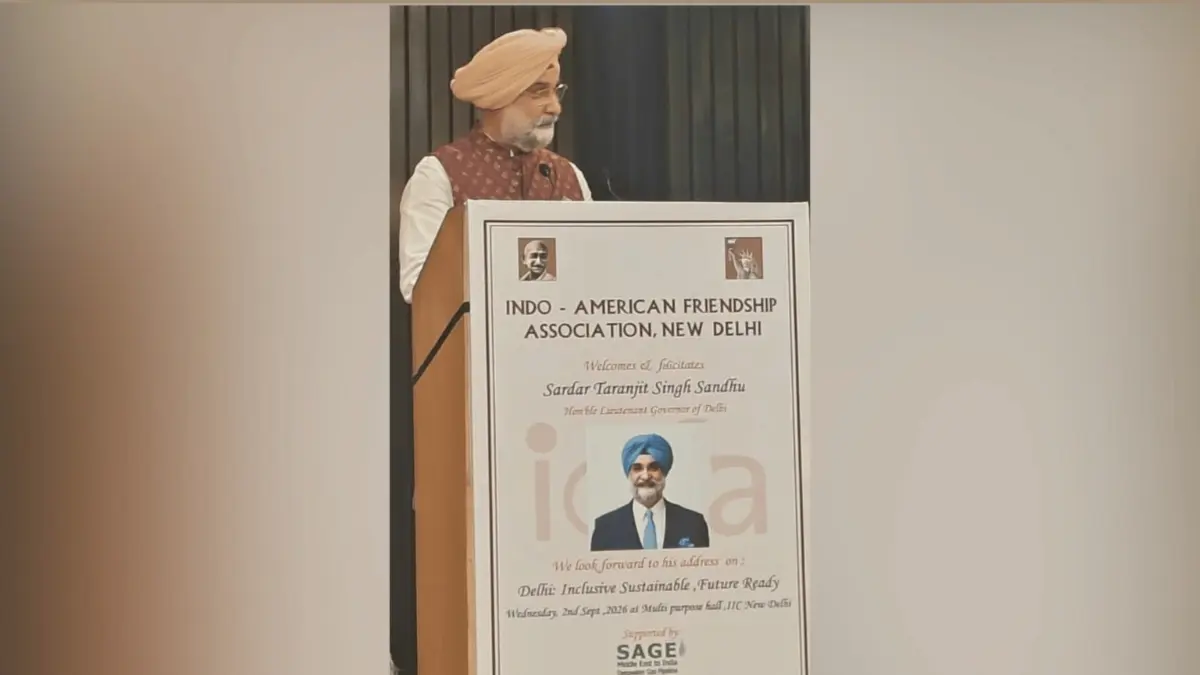
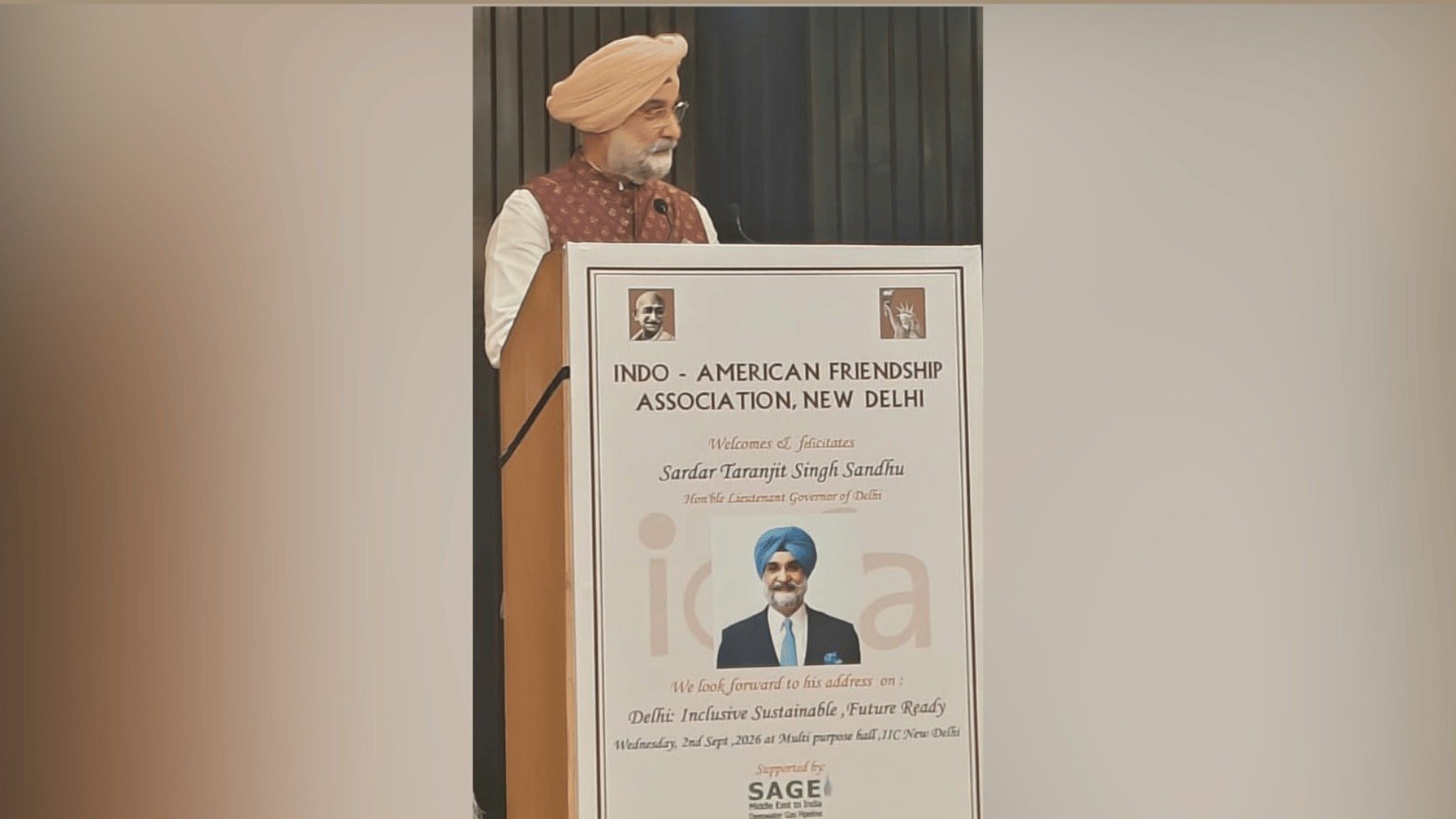
NEW DELHI — In a detailed policy address that mapped out the trajectory of India’s national capital for the coming decades, Delhi Lieutenant Governor Sardar Taranjit Singh Sandhu presented a comprehensive blueprint for urban transformation. Speaking at a high-profile reception hosted at the India International Centre by Ambassador Surendra Kumar (Retd.), Founder-President of the Indo-American Friendship Association, Lieutenant Governor Sandhu emphasized that the future of Delhi must rest on a delicate, intentional balance between rapid economic growth, environmental stewardship, technological innovation, and profound social inclusion.
The evening gathering, which brought together a distinguished audience of resident diplomats, former Indian ambassadors, and policy experts on September 2, served as a platform for a deep-dive conversation regarding the realities and responsibilities of managing one of the world’s most historically rich and densely populated metropolitan regions.
Opening his address, Lieutenant Governor Sandhu reminded the audience that Delhi has never been a static or immutable city. Over centuries of dynastic shifts, political transitions, and cultural synthesis, the capital has continually absorbed new communities, institutional frameworks, ideas, and human aspirations. Yet, it has managed to do so while carefully retaining its distinctive civilizational and cultural character.
However, the unprecedented scale and speed of contemporary urbanization present modern administrators with a unique set of challenges. For Lieutenant Governor Sandhu, the primary mandate for today’s leadership is to ensure that this historical evolution does not stall, but rather continues in a manner that is deeply inclusive, ecologically sustainable, and thoroughly future-ready.
"Our responsibility is not only to manage the city as it exists today, but to prepare it for the needs and aspirations of the generations that will inherit it," Lieutenant Governor Sandhu told the gathered dignitaries, setting a tone of intergenerational accountability that would echo throughout his remarks.
Inclusion at the Heart of Development
Moving to the structural pillars of his urban vision, Lieutenant Governor Sandhu identified social inclusion as the foundational requirement for any genuine progress in the national capital. In his view, the success of modern urban development cannot be measured solely by abstract economic indicators or physical square footage of concrete infrastructure. Instead, it must be judged by its tangible impact on the daily lives of ordinary citizens.
He stressed that equitable access to fundamental public goods—including quality education, reliable healthcare, affordable housing, efficient public transportation, and robust employment and entrepreneurship opportunities—must extend evenly across every strata of society. Particular care, he noted, must be taken to ensure that women, children, senior citizens, persons with disabilities, and economically vulnerable communities are not left behind on the margins of the city’s growth, but are instead empowered to participate fully and safely in the social, cultural, and economic life of urban Delhi.
"A modern city must be measured not simply by the infrastructure it creates, but by the opportunities it creates for its people," the Lieutenant Governor observed.
This people-centric philosophy represents a critical perspective as the capital continues to expand outward and upward, placing unprecedented pressures on its existing housing markets, transit systems, and civil infrastructure. By prioritizing the human element, the administration aims to steer urban expansion away from exclusionary enclaves and toward a cohesive metropolis that works for all of its inhabitants.
Sustainability as a Development Imperative
The second critical pillar of Lieutenant Governor Sandhu’s vision focuses squarely on environmental sustainability. Addressing the pressing ecological realities facing the capital region, he argued firmly that Delhi’s future economic and social growth cannot—and must not—come at the expense of its ecological well-being.
The everyday quality of life for millions of residents is directly intertwined with systemic environmental factors, such as ambient air quality, long-term water security, effective wastewater management, the preservation and expansion of green spaces, and the development of clean, sustainable mobility networks. This viewpoint aligns closely with his broader public advocacy, which consistently urges urban planners to move beyond conventional, concrete-heavy models of development. Instead, he advocates for a restorative paradigm that safeguards the city’s natural assets while simultaneously enhancing its liveability.
Recent multi-stakeholder discussions concerning Delhi’s long-term environmental health have similarly underscored the urgent need to protect vital ecological anchors, such as the Yamuna River floodplains, the Northern and Southern Ridge, and various urban biodiversity parks.
Connecting this local imperative to national policy frameworks, Lieutenant Governor Sandhu noted that this vision of sustainable growth finds strong resonance in the concept of "Sapt-Dhara," articulated by Prime Minister Shri Narendra Modi. This national framework places special emphasis on advancing the green economy, the blue economy, advanced technology, and grassroots innovation.
For Delhi specifically, the Lieutenant Governor pointed to accelerated transitions toward cleaner public mobility, expanded adoption of renewable energy, efficient water conservation systems, and the creation of greener public spaces as non-negotiable components of the capital’s developmental overhaul.
"A sustainable Delhi is not only an environmental objective; it is an investment in the health and well-being of future generations," he stated.
Technology with Responsibility
Recognizing the rapid pace of the digital age, Lieutenant Governor Sandhu outlined technology and innovation as the third major pillar of his administrative vision.
Emerging technologies, including artificial intelligence, advanced digital infrastructure, and data-driven governance tools, hold immense potential to fundamentally transform how megacities operate. From optimizing complex traffic and public transit flows to streamlining civic infrastructure maintenance and making public spaces more accessible, digital innovation can render government services vastly more responsive and transparent.
However, the Lieutenant Governor offered an important word of caution, reminding the audience that technology must never be allowed to become an end in itself.
"Technology must remain a means to serve citizens, not an end in itself," Sandhu asserted. He emphasized that as a future-ready city integrates more digital solutions into its daily administration, it must carefully balance technological innovation with strict accountability, data privacy protections, universal accessibility, and the preservation of public trust.
Delhi as an Economic and Knowledge Hub
Shifting his focus to the economic dimensions of the capital’s future, Lieutenant Governor Sandhu underscored the necessity of keeping Delhi positioned as a vibrant center of enterprise, investment, knowledge generation, and employment creation. Achieving this requires fostering a dynamic business ecosystem where established corporations can scale, innovative entrepreneurs can take calculated risks, and young job seekers can find meaningful and rewarding opportunities.
An important institutional framework supporting this economic ambition is the recently unveiled Delhi Master Plan 2047. Designed to guide long-term urban development over the coming decades, the master plan places heavy emphasis on strategic housing developments, transit-oriented development models, specialized education and medical hubs, regional connectivity, and environmental sustainability. The Union Ministry of Housing and Urban Affairs has routinely characterized the plan as a crucial roadmap not just for a developed national capital, but for a developed nation at large.
Furthermore, Lieutenant Governor Sandhu has consistently highlighted the critical necessity of linking modern education and vocational skill-building directly with employment and entrepreneurship ecosystems. This integration is viewed as vital if India is to successfully leverage its ongoing demographic advantage.
To realize this economic potential, the capital must focus relentlessly on improving the ease of doing business, nurturing skilled human capital, upgrading physical infrastructure, and enhancing regional connectivity.
People at the Centre
Even as discussions at the reception naturally touched upon complex themes of infrastructure finance, digital governance, and macroeconomic growth, Lieutenant Governor Sandhu repeatedly returned to what he considers Delhi’s single greatest asset: its people.
"The city’s greatest asset is not its roads or its technology. It is its people," he remarked.
The history of Delhi, he noted, has always been written by individuals who migrated to the city driven by hope and ambition, ultimately contributing their labor, culture, and intellect to its collective expansion. Consequently, constructing the next chapter of the capital’s history cannot be viewed as a task reserved solely for government ministries or municipal authorities.
"It requires partnership between government, citizens, business, academic institutions, civil society, and communities," he urged. Such multi-sectoral collaboration will be indispensable if Delhi is to successfully navigate the tension between rapid modernization and sustainable liveability in the decades ahead.
Ultimately, Lieutenant Governor Sandhu’s vision weaves together four tightly integrated objectives: robust economic vitality, strict environmental responsibility, responsible technological advancement, and deep social inclusion. His overarching message to the capital’s stakeholders is clear: Delhi’s transition into a modern global metropolis must not require the abandonment of its rich historical heritage. Instead, the national capital must learn to honor its past while boldly embracing new paradigms of development, innovation, and human opportunity.
As Delhi marches toward its 2047 milestone, striking the right balance between heritage and modernity, ecological sustainability and economic growth, technological capability and civic accountability will determine whether the city can genuinely emerge as a model global, inclusive, and future-ready capital.