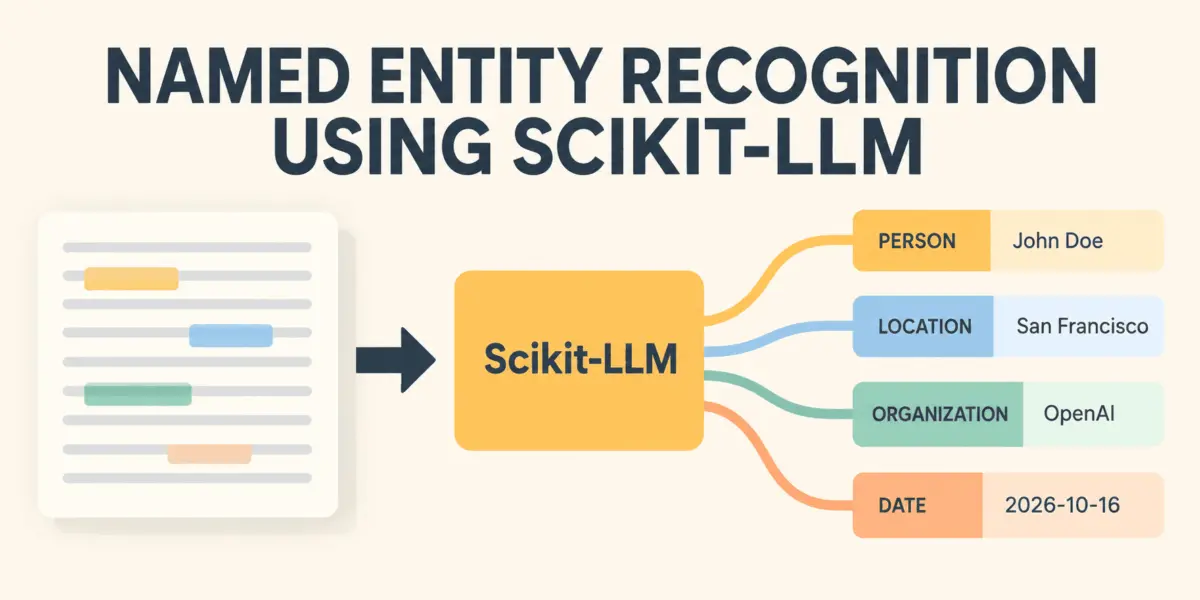
The process of converting unstructured, messy text into organized, structured data has long been a foundational challenge in data analysis and machine learning. Known as Named Entity Recognition (NER), this crucial task involves identifying, extracting, and categorizing relevant information from natural language sources to power predictive models and business intelligence pipelines. Historically, data scientists have relied on traditional natural language processing libraries to handle these extraction tasks. However, those legacy models typically demand massive training datasets and arduous fine-tuning cycles just to recognize custom, domain-specific entities accurately.
A significant shift is now underway in the artificial intelligence community, driven by the emergence of integration tools designed to bridge the gap between traditional machine learning frameworks and modern language reasoning. Among these, Scikit-LLM has risen in popularity as a streamlined framework that brings large language model reasoning capabilities directly into standardized machine learning workflows. Rather than forcing developers to build complex custom pipelines from scratch, the library allows engineers to execute a wide variety of target tasks—ranging from standard text classification to advanced, highly customized named entity recognition—in just a few simple setup steps.
Running Named Entity Recognition with Scikit-LLM
Recent demonstrations of the framework have highlighted how developers can leverage cloud-hosted inference providers to execute these workflows efficiently and economically. By combining Scikit-LLM with high-speed API endpoints such as Groq, developers can harness advanced language models while relying entirely on free-tier services. The prerequisite workflow involves setting up an account with the cloud provider, generating an authentication key, and securely storing it within development environments like Google Colab using secret management tools.
Once the environment is properly secured and the library is installed via standard Python package management, developers can initialize the Scikit-LLM configuration. Although the library is architected around OpenAI API standards, its flexibility allows users to override the base URL and redirect requests to any compatible high-speed provider. This design choice ensures that data teams are not locked into a single proprietary ecosystem, granting them the freedom to swap out underlying model providers as performance and cost requirements evolve.
Unlike conventional text classification tasks—where algorithms assign pre-defined class labels to discrete text inputs—large language model-driven NER relies heavily on what is known as an entity dictionary. This structure consists of a collection of key-value pairs where the keys represent the specific categories that need to be extracted, and the values provide detailed descriptions or instructions. These descriptions serve as contextual prompts that guide the underlying language model through its reasoning process, ensuring high accuracy even when processing ambiguous or domain-specific terminology.
In practical applications, such as analyzing business and technology news, developers typically define a targeted set of entity categories alongside a collection of raw, unstructured sentences. For instance, a technology-focused entity dictionary might define executives, corporations, specific hardware or software products, and geographical cities. When paired with sentences detailing major industry announcements—such as executive product unveilings at corporate summits—the model evaluates the text against the provided descriptions to identify relevant matches.
Executing the Extraction and Parsing the Results
The core computational work within the Scikit-LLM framework is handled by specialized estimators designed for specific natural language tasks. For named entity recognition, the library provides the GPTExplainableNER class, which wraps a compatible pre-trained model from the chosen provider. By passing the custom entity dictionary and the model identifier to this estimator, developers can invoke the fit_transform method to initiate the extraction pipeline. This triggers the language model to parse the raw text inputs and isolate the requested information based on the semantic definitions provided in the entity dictionary.
When the raw output is initially retrieved from the model, it often includes internal reasoning tags, XML-like delimiters, and string-serialized representations. While these detailed outputs provide valuable visibility into why the model made a specific categorization choice—such as recognizing an executive’s leadership role or identifying a product line—they require additional post-processing to be usable in downstream data applications.
To transform these verbose responses into clean, structured data, developers typically employ helper functions utilizing regular expression matching. By scanning the raw output for specific entity and tag boundaries, these utility scripts extract the core entity types and their corresponding values, filtering out the underlying reasoning text. The resulting data can then be neatly organized into standard Python dictionaries, categorized cleanly by entity type without any extraneous formatting artifacts.
The performance of this lightweight approach has drawn favorable attention from data professionals. Even with minimal configuration effort and zero training data required to build a custom model from scratch, the pipeline consistently isolates complex entities—ranging from prominent corporate leaders and proprietary hardware architectures to multinational technology corporations and municipal locations—with remarkable precision.
Wrapping Up
The integration of libraries like Scikit-LLM with accessible inference infrastructure marks a notable departure from traditional, resource-heavy natural language processing workflows. By leveraging pre-trained, open-source large language models for named entity recognition, data analysts and engineers can bypass the traditional bottlenecks of dataset collection and model fine-tuning. As organizations continue to seek out agile ways to derive structured intelligence from vast quantities of unstructured text, tools that simplify complex machine learning pipelines will undoubtedly play an increasingly central role in real-world artificial intelligence applications.