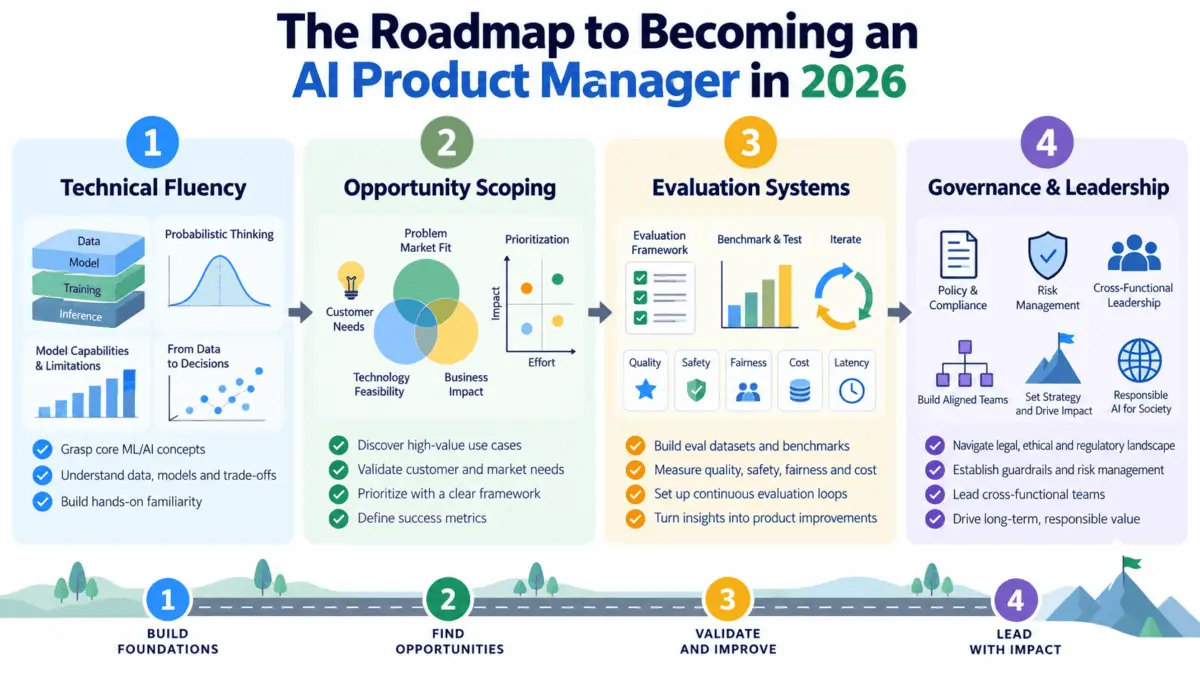
Artificial intelligence is rapidly reshaping the entire lifecycle of how software and digital experiences are built, shipped, and measured across industries. As organizations race to integrate advanced machine learning capabilities into their offerings, many are discovering that the primary obstacle is no longer a research limitation or an algorithmic bottleneck. Instead, the greatest challenge lies in closing the gap between a promising AI prototype and a reliable, production-ready product that users can trust. Industry observers note that this critical juncture is precisely where the modern AI product manager operates, serving as a vital bridge between experimental technology and practical, scalable utility.
Unlike traditional product managers who oversee deterministic systems where inputs reliably map to predictable outputs, artificial intelligence product managers must navigate a landscape defined by probabilistic behavior. AI outputs can shift, hallucinate, and vary widely across different user populations and use cases. Successfully managing this complexity requires deep fluency in machine learning trade-offs, rigorous evaluation systems, complex compute economics, and evolving regulatory frameworks. At the same time, these professionals must maintain clear, effective communication channels with software engineers, legal counsel, and executive leadership.
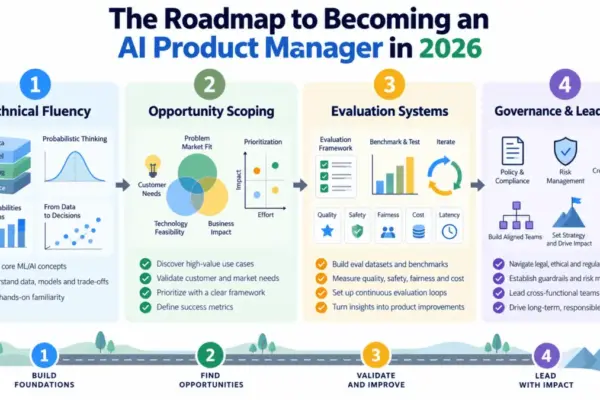
Industry experts have increasingly sought to categorize the path into this specialized domain, breaking the developmental trajectory down into core phases that move from foundational technical literacy through to strategic organizational leadership. Each phase builds upon the last, allowing professional skills to compound quickly once a fundamental mindset shift takes hold within the practitioner.
The initial phase of this professional evolution centers on developing technical fluency and adopting a distinctly probabilistic mindset. Aspiring AI product managers must first transition away from traditional deterministic thinking, where software operates predictably under rigid parameters, and embrace a paradigm where system outputs are likely, approximate, and heavily context-dependent. Rather than viewing this inherent variability as a flaw to work around, successful leaders learn to manage it as the standard terrain of modern software development.
Building early intuition around major architecture choices is essential during this phase. Practitioners do not need to implement these complex architectures themselves, but they must understand the fundamental trade-offs well enough to ask the right questions during scoping and constructively challenge engineering assumptions during planning. This technical grounding must be balanced with the management of core operational tensions that persist throughout a product’s lifecycle, specifically the constant balancing act between latency, cost, and accuracy. Token consumption rates, time-to-first-token metrics, and context-window sizing inevitably surface in nearly every strategic product discussion.
Once technical vocabulary is firmly established, the focus shifts toward AI opportunity discovery and feasibility scoping. Having a strong technical grasp allows professionals to identify which artificial intelligence opportunities are genuinely worth pursuing and which should be discarded. Structured frameworks, often visualized as specialized product canvases, help teams map specific tasks along critical axes, balancing the potential value delivered if the system performs well against the potential risks if it fails. High-leverage, low-risk tasks such as basic classification, summarization, and document extraction typically serve as strong early candidates for development, while high-risk applications involving safety, compliance, or irreversible actions require extensive evaluation infrastructure before deployment.
A critical competency at this stage involves making informed decisions regarding whether to build an internal solution, buy an existing platform, or assemble disparate tools. This decision-making process is simultaneously technical and financial, requiring a thorough understanding of the unit economics of compute. Product managers must model how gross margins will hold up as token consumption scales, compare GPU hosting costs against per-call API fees at higher volumes, and understand the cost implications of vector database queries relative to retrieval depth. Achieving comfort with inference-layer cost modeling distinguishes practitioners who build sustainable products from those whose impressive demonstrations collapse under heavy user load.
As projects move from scoping to execution, the focus transitions to user experience design, robust evaluation systems, and iterative improvement. This phase represents the sharpest divergence from conventional product management practices. Because a product’s outputs are inherently probabilistic, teams cannot rely solely on binary pass-by-pass or fail-by-fail testing; instead, they require comprehensive evaluation infrastructure.
Designing user experiences for non-deterministic interfaces introduces distinct challenges. Practitioners must determine how to effectively communicate uncertainty to users without eroding trust, how to design graceful degradation states when a model fails, and where to strategically insert human-in-the-loop checkpoints. Furthermore, they must establish reliable feedback loops—ranging from explicit user ratings to implicit behavioral signals—that allow the system to improve continuously over time. On the evaluation front, adopting evaluation-driven development is paramount, paired with mandatory red-teaming exercises involving structured adversarial testing, prompt injection simulations, and worst-case scenario modeling prior to launch.
The final phase of this professional trajectory addresses governance, compliance, and broader organizational leadership as products scale. Operating artificial intelligence systems at scale introduces complex regulatory, legal, and cultural challenges that require the product manager to act as an effective translator across diverse internal and external stakeholders. Regulatory literacy has rapidly transformed from a secondary concern into a fundamental requirement. Emerging legislation, such as the European Union’s artificial intelligence framework, national executive orders, sector-specific mandates in healthcare and finance, and cross-border data residency laws, directly influence what products can be built, where they can be deployed, and what documentation must be maintained.
Data lineage and privacy remain ongoing operational priorities, particularly regarding which customer data is transmitted to external model providers, what sanitization pipelines are utilized, and how enterprise compliance standards like SOC 2 or HIPAA shape architectural decisions. Cross-functional orchestration emerges as one of the most critical leadership skills at this level, requiring the ability to align research engineers focused on benchmarks, legal teams focused on liability, and executives focused on revenue and risk, all while maintaining absolute fidelity in translation.
The role of the artificial intelligence product manager continues to take shape across the technology sector, offering early practitioners a unique opportunity to define its standards and best practices. While the underlying technical landscape shifts at a rapid pace, the core professional disciplines remain consistent: understanding technical trade-offs, scoping initiatives with analytical rigor, measuring the metrics that matter, and steadily building trust with every stakeholder involved in the development lifecycle. Vinod Chugani, an AI and data science educator with a background in quantitative finance, emphasizes that the hallmark of a strong artificial intelligence product manager is intellectual honesty regarding uncertainty, treating evaluation as foundational infrastructure rather than a secondary consideration.