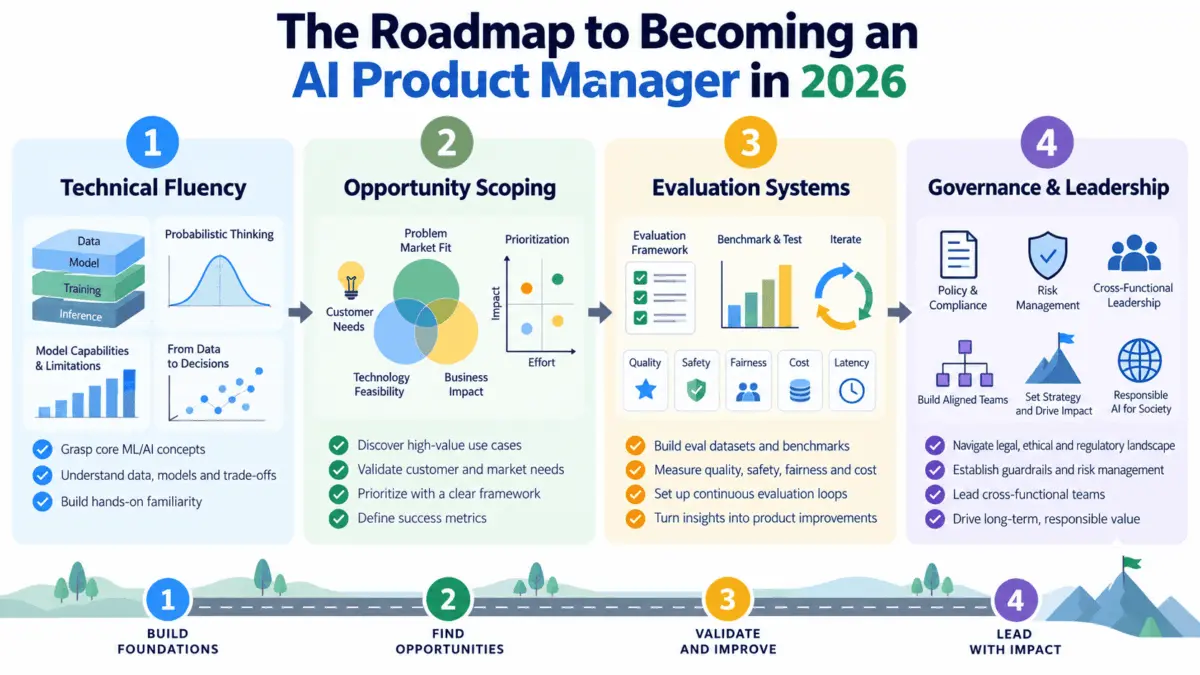
Artificial intelligence is fundamentally reshaping how digital products are conceptualized, built, shipped, and measured across industries. As organizations race to integrate generative models and machine learning capabilities into their core offerings, a widespread realization is taking hold: the primary hurdle between a promising AI prototype and a reliable, user-trusted product is not a research barrier, but a product management challenge. This critical operational gap is precisely where the role of the modern Artificial Intelligence Product Manager has emerged as an indispensable corporate function.
Unlike traditional product managers who oversee deterministic software systems with predictable rules and outcomes, AI product managers must navigate outputs that frequently shift, exhibit probabilistic behaviors, hallucinate, and vary significantly across diverse user populations. This specialized role demands deep fluency in machine learning trade-offs, automated evaluation systems, complex compute economics, and evolving regulatory frameworks. At the same time, practitioners must maintain the communication skills required to bridge the gap between software engineers, legal counsel, corporate executives, and end-users.
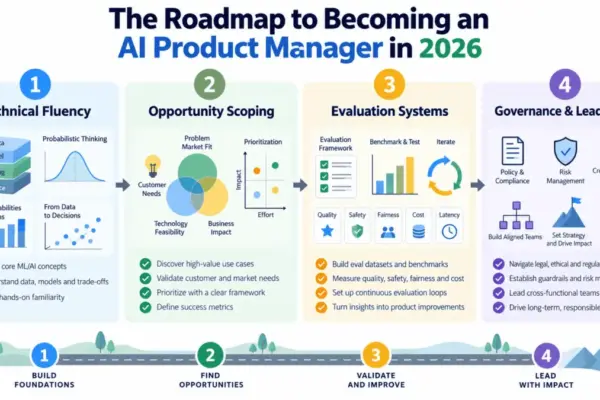
Industry observers and educators, including AI and data science mentor Vinod Chugani, have increasingly emphasized that mastering this domain requires a fundamental transformation in how product strategy is approached. Rather than treating AI features as minor updates to standard software roadmaps, organizations are recognizing that successful AI product leadership spans four distinct phases: establishing technical fluency, executing rigorous opportunity discovery, designing non-deterministic user experiences alongside evaluation infrastructure, and managing complex governance and organizational leadership.
Developing Technical Fluency and the Probabilistic Mindset
The foundational shift required of any aspiring or transitioning AI product manager involves moving away from traditional deterministic thinking and embracing a probabilistic mindset. Conventional software operates on predictable rules where a specific input consistently yields a designated output. In contrast, modern AI systems produce outputs that are fundamentally likely, approximate, and context-dependent. Experienced practitioners emphasize that this characteristic is not a technical flaw to be worked around, but rather the core operational terrain that product managers must learn to navigate.
To manage this environment effectively, product managers must build strong intuition around major architecture choices without necessarily needing to implement them directly. Understanding the operational trade-offs of large language models, retrieval-augmented generation pipelines, fine-tuning processes, and agentic workflows is essential. This technical vocabulary enables product managers to ask the right questions during early project scoping, evaluate feasibility accurately, and constructively challenge engineering assumptions during roadmap planning.
Throughout this initial phase, product managers must balance three perennial tensions that will dictate the success of their projects: latency, cost, and accuracy. Metrics such as token consumption, time-to-first-token, and context-window sizing surface in nearly every technical discussion. Developing early intuition around these hardware and algorithmic constraints ensures that product visions remain aligned with technical realities from day one.
AI Opportunity Discovery and Feasibility Scoping
Once technical vocabulary and a probabilistic mindset are established, the next critical competence involves identifying which AI opportunities are genuinely worth pursuing and filtering out use cases where the technology adds unnecessary complexity or risk. Industry frameworks such as the AI Product Canvas help teams systematically map tasks along two distinct axes: the business value delivered if the system performs successfully, and the operational risk incurred if it fails.
High-leverage, low-risk applications—such as automated document classification, text summarization, and routine information extraction—frequently serve as ideal early candidates for product integration. Conversely, high-risk tasks involving safety, regulatory compliance, or irreversible actions require extensive evaluation infrastructure and safety guardrails long before any code is deployed to production environments.
A central responsibility during this phase involves making strategic build, buy, or assemble decisions. This evaluation is simultaneously technical and financial, requiring product managers to master the unit economics of compute. Understanding how gross margins fluctuate as token consumption scales, how GPU hosting costs compare to external application programming interface fees at higher transaction volumes, and how database query expenditures interact with retrieval depth is vital. Mastering these financial models at the inference layer separates product managers who ship sustainable solutions from those who build impressive demonstrations that ultimately collapse under real-world usage loads.
AI User Experience, Evaluation Systems, and Iteration
Product management for artificial intelligence diverges most sharply from conventional software practices when addressing user experience design and system evaluation. Because product outputs are non-deterministic, teams cannot rely exclusively on binary pass-and-fail testing methodologies. Instead, organizations must implement robust evaluation infrastructures and adopt evaluation-driven development practices.
Designing user interfaces for probabilistic systems introduces unique interaction challenges that do not exist in traditional software environments. Product managers must determine how to communicate system uncertainty to users without eroding trust, how to design graceful degradation states when models generate incorrect information, and where to strategically insert human-in-the-loop checkpoints. Furthermore, they must establish reliable feedback loops—incorporating both explicit user ratings and implicit behavioral signals—to ensure the underlying system continuously improves over time.
Evaluation systems must also encompass rigorous pre-launch testing protocols. Structured adversarial testing, commonly referred to as red-teaming, helps uncover prompt injection vulnerabilities, boundary limitations, and worst-case behavioral scenarios before features reach public audiences. Establishing these validation procedures as standard pre-launch requirements rather than post-release additions remains a hallmark of mature AI product execution.
AI Governance, Compliance, and Organizational Leadership
As artificial intelligence products transition from initial deployment to enterprise-scale operation, the scope of product management expands to encompass regulatory compliance, legal risk management, and cross-functional leadership. Operating AI systems at scale introduces complex legal and cultural challenges that require the product manager to act as an effective translator among technical researchers, legal teams, and business executives.
Regulatory literacy has rapidly transformed into a core professional competency. Sweeping legislative frameworks, including the European Union artificial intelligence regulations, national executive directives, sector-specific healthcare and financial mandates, and international data residency laws, directly influence product feasibility, deployment locations, and documentation requirements. While product managers are not expected to function as legal counsel, they must develop sufficient literacy to identify regulatory exposure early in the development lifecycle.
Data lineage, privacy, and security represent ongoing operational priorities. Understanding precisely which customer data is transmitted to external model providers, what sanitization pipelines operate before inputs touch machine learning models, and how user opt-out policies are enforced remains critical. In enterprise markets, compliance standards such as Service Organization Control 2 and Health Insurance Portability and Accountability Act requirements heavily influence foundational architecture decisions.
Ultimately, successful AI product leadership relies on cross-functional orchestration—the ability to harmonize the perspectives of research engineers focused on performance benchmarks, legal teams managing liability, and business leaders monitoring revenue growth and risk exposure. Vinod Chugani, an educator and mentor in the AI and data science space, notes that the role continues to evolve rapidly, offering current practitioners a unique opportunity to shape industry standards while emphasizing intellectual honesty regarding technological uncertainty, robust fallback systems, and disciplined product execution.