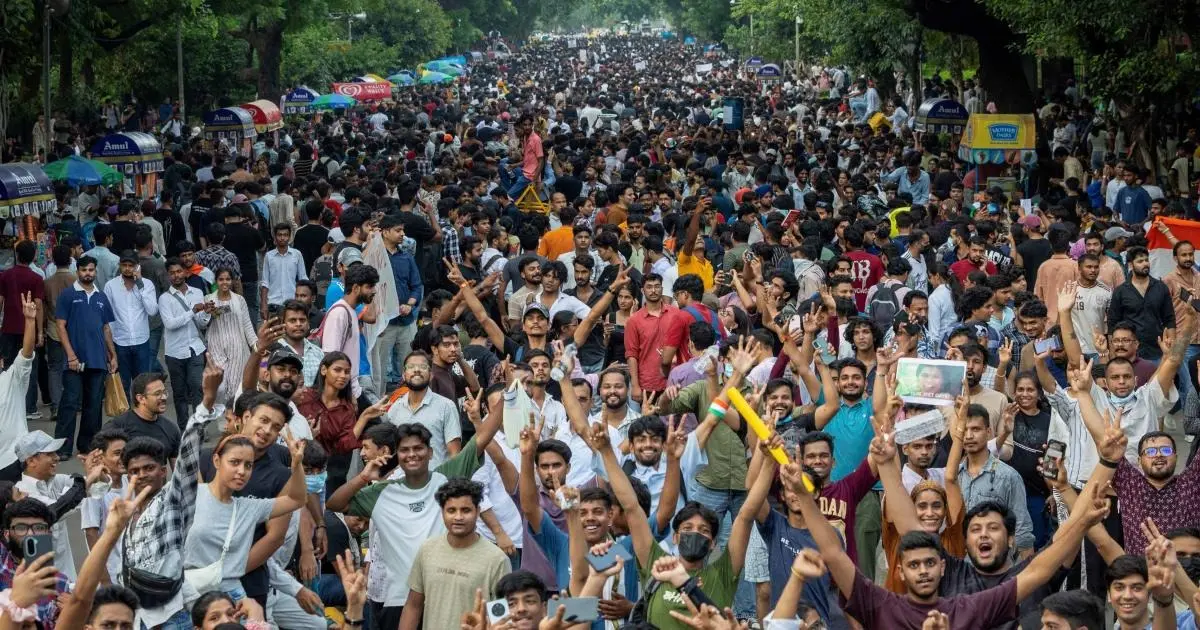
India is currently navigating a profound political rebellion that strikes at the very foundations of the nation’s democratic framework and its constitutional commitments. What began in the summer as student-led demonstrations over perceived irregularities in the country’s examination system has rapidly snowballed into a nationwide confrontation over the integrity of India’s elections. The unrest has intensified following a controversial government initiative that purged more than 130 million people from draft voting lists over the past year.
As tens of thousands of predominantly young citizens take to the streets of New Delhi and other major urban centers, the protests represent the most formidable challenge to Prime Minister Narendra Modi’s authority since he assumed office in 2014. Demonstrators are openly questioning the credibility of ostensibly independent national institutions, demanding the resignation of the country’s chief election commissioner, and holding the prime minister directly accountable for what they characterize as an erosion of democratic norms.
The uprising has injected a new brand of political energy into India’s public sphere, led largely by Gen Z students. Defying strict prohibitions on public assembly, breaching heavy security clampdowns, and enduring mass detentions, these young activists have used wit, grit, and digital media to relentlessly challenge state authority. While traditional opposition parties—led by Congress party figure Rahul Gandhi—have attempted to present a united front, the true driving force of the movement remains the organic, cross-partisan mobilization of youth who refuse to be sidelined.
In response, the federal government has treated the wave of dissent as an existential threat. Authorities have deployed more than 40,000 security personnel to the national capital, closed vital transit hubs, barricaded central districts, and suspended mobile internet services. With over 7,000 people detained, the state has demonstrated a firm determination to contain the demonstrations while steadfastly defending the leadership of the Election Commission and refusing formal dialogue with protesters or opposition leaders.
While political analysts agree that Modi faces no immediate electoral danger of being unseated—distinguishing these events from recent youth-led government overthrows in neighboring Bangladesh and Nepal—the administration confronts a subtler and more insidious vulnerability. For a strongman leader who has built his political brand on unquestioned personal authority and the centralized consolidation of power, the open, irrepressible defiance of a demographic that defies easy categorization as "antinational" threatens to puncture the aura of invincibility that has defined his tenure for over a decade.
The Promise of Equality
Modern India’s democratic legitimacy rests primarily on two foundational institutions: competitive examinations and public elections. Since gaining independence in 1947, the country has maintained a proud tradition of conducting free and fair elections administered by the Election Commission of India, an independent constitutional body endowed with sweeping authority. This institutional credibility has long served as the bedrock of Indian democracy.
Concurrently, public-sector employment and admissions to prestigious higher education institutions rely heavily on rigorous competitive national examinations. For millions of young Indians, these exams represent the principal gateway to socioeconomic mobility. In a stubbornly unequal society where wealth, family lineage, and political connections frequently distort institutional access, exams and elections function as the rare equalizing mechanisms that make the state’s constitutional promises tangible. Elections afford even the most impoverished citizens a sense of agency and dignity, driving traditionally high voter turnout, while exams sustain the meritocratic ideal that diligence can triumph over inherited privilege.
However, a series of compounding controversies over the past year has severely undermined public trust in both systems. In 2024, the primary nationwide entrance examination for medical schools was rocked by widespread irregularities, including the advance leakage of test papers. The resulting student outrage thrust the National Testing Agency—a centralized body empowered under Modi to oversee critical national exams—under intense scrutiny. Rather than achieving greater efficiency, centralization concentrated public anger squarely on the federal government, ultimately culminating in July with the resignation of the education minister.
Simultaneously, the Election Commission initiated a Special Intensive Revision (SIR) of electoral rolls to verify voter eligibility. Although such revisions fall within the commission’s statutory powers and had previously been conducted between 2002 and 2004, the current rollout sparked immediate controversy. Critics pointed to a lack of transparency, the imposition of burdensome documentation requirements on citizens, and the deployment of new software that allegedly allowed authorities to purge millions of names on trivial grounds while bypassing established local verification procedures.
According to critics, Chief Election Commissioner Gyanesh Kumar acted precipitously in executing the revision. Since June 2025, the SIR has flagged roughly 130 million names for removal. While many entries represented duplicate registrations or deceased individuals, millions of eligible citizens found themselves abruptly stripped of their voting rights and forced to navigate a laborious, intimidating administrative appeals process.
The consequences were laid bare during state elections in West Bengal, where the removal of nine million names left numerous citizens disenfranchised while their appeals remained pending. Although the BJP secured a historic victory in the state, the process drew sharp criticism from opposition leaders like Gandhi, who alleged the revision was being weaponized for electoral manipulation. Even in the absence of systematic targeting based on identity or political affiliation, the sheer scale of the administrative purge has raised credible fears of mass disenfranchisement.
Further compounding public frustration, the Supreme Court of India adopted a dismissive stance toward the crisis. The judiciary declined to intervene in the West Bengal disenfranchisement, suggesting that affected citizens could simply cast their ballots in subsequent election cycles once their appeals were adjudicated.
Public resentment deepened further in May when Chief Justice Surya Kant reportedly compared a delegation of young lawyers advocating for judicial transparency to "cockroaches." The remark backfired spectacularly, galvanizing a viral social media movement that eventually birthed the "Cockroach Janata Party." This digital and street-level phenomenon played a pivotal role in the July protests that forced the education minister’s resignation and has since fueled demands for the removal of the chief election commissioner.
Most significantly, the movement successfully linked the institutional crisis directly to Prime Minister Modi, puncturing his meticulously curated digital image. When young protesters turned to online platforms to mock the administration, they pierced a long-standing climate of political fear. By finding their voice through satire, dissenters managed to dismantle the aura of intimidation that had previously silenced critics and marginalized political opponents.
Their Own Future
Despite the energy of the youth movement, protesters continue to confront the unyielding reality of state power. The heavy-handed deployment of security forces in New Delhi and the criminalization of public assembly have only reinforced the determination of young Indians to reclaim public space as a fundamental democratic right.
For the Modi administration, the demand for Chief Election Commissioner Kumar’s resignation touches upon a deeper structural vulnerability. The prime minister has cultivated fierce loyalty within the ruling Bharatiya Janata Party by offering an implicit guarantee that loyal functionaries will be shielded from the consequences of their official actions. Conceding to public pressure and dismissing Kumar would signal a fracture in that protective compact, potentially eroding internal party discipline and emboldening political rivals ahead of the 2029 parliamentary elections.
Yet the greatest risk for the government lies in the danger of insularity—the temptation to believe its own official narrative while ignoring profound underlying socioeconomic grievances. Despite impressive headline economic growth figures, young Indians face a grim employment landscape. Graduate unemployment sits at 23 percent, white-collar job creation has slowed to a crawl, and nearly a quarter of individuals aged 15 to 29 remain entirely outside employment, education, or training programs.
When the very institutions designed to secure their futures—elections, courts, and independent oversight agencies—are perceived as failing, the traditional levers of state authority begin to lose their potency. As the Modi government weighs further repressive measures and attempts to dismiss the protests as the work of outside agitators, the uprising persists as a powerful testament to a generation determined to forge its own democratic destiny.