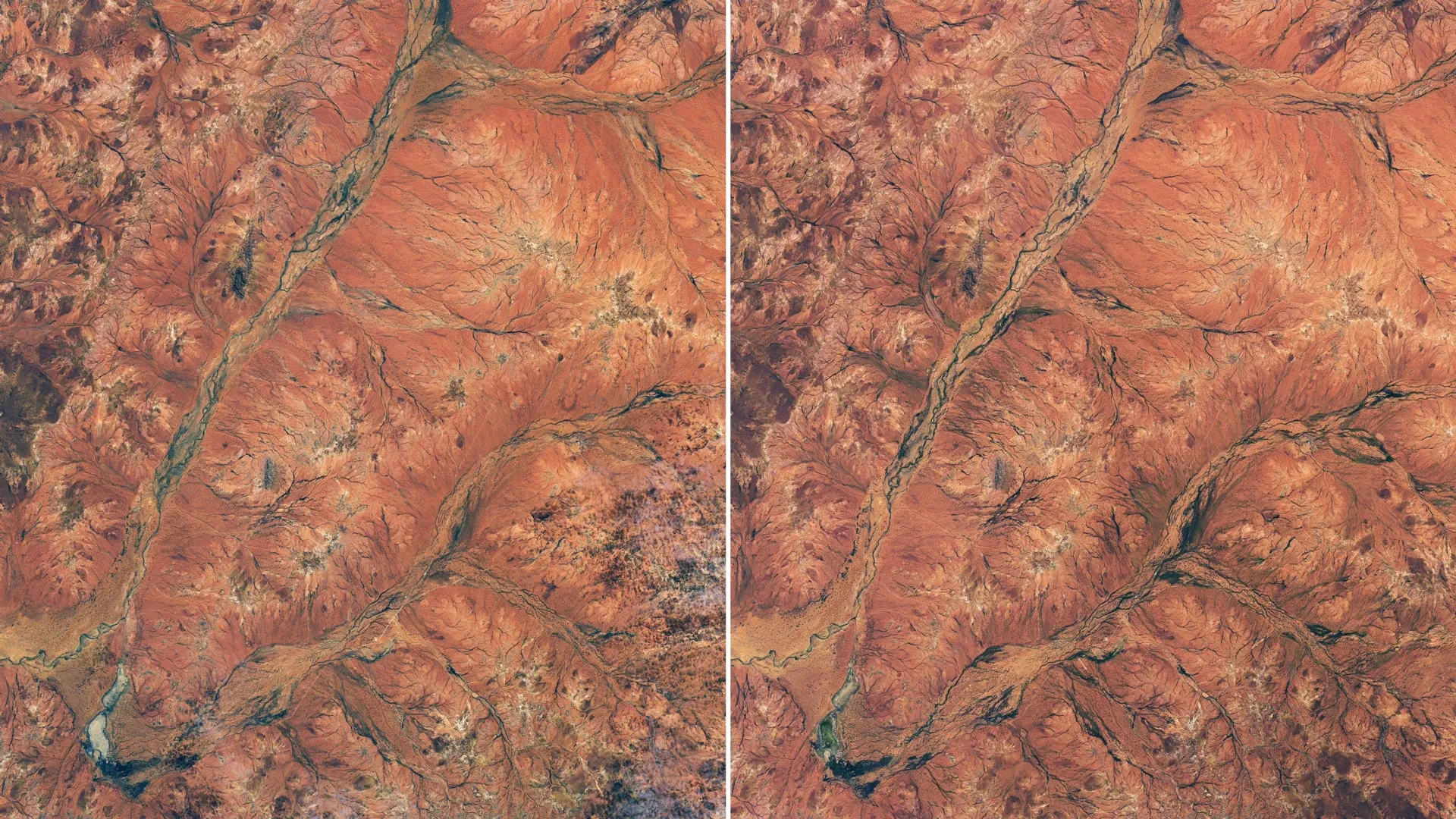
A spectacular and unexpected explosion of wildflowers has transformed the normally dry, rust-colored landscape of Western Australia into a vibrant patchwork of brilliant green and multicolored blooms. This remarkable botanical display follows months of unusually wet weather across the Southern Hemisphere winter of 2026, successfully awakening millions of seeds that had been lying dormant beneath the parched soil for years.
By late August 2026, large stretches of the region’s arid shrubland were completely covered in flowers, creating a breathtaking visual phenomenon. Local botanical and environmental experts believe this could very well be the most impressive and widespread wildflower season the area has experienced in nearly two decades. The sheer scale of the transformation is so immense that it can easily be observed from space, captured in striking detail by orbiting Earth-observation satellites that highlight the dramatic shift in the Australian landscape within a span of just twelve months.
NASA Satellite Images Reveal a Dramatic Transformation
The dramatic visual evidence of this natural spectacle has been documented by advanced space technology. Satellite images collected by the Operational Land Imager (OLI) aboard the joint NASA-USGS Landsat 8 satellite show a side-by-side comparison of the same remote part of Western Australia in late August 2025 and late August 2026. The imagery highlights a striking, undeniable increase in surface vegetation, turning a landscape historically characterized by dry earth and sparse ground cover into a lush, flowering expanse following the unusually wet conditions.
The location experiencing this rare botanical awakening is situated deep within the Murchison region, approximately 600 kilometers, or roughly 370 miles, north of Perth. This remote stretch of the Australian outback functions as an important agricultural and pastoral area, serving primarily as a grazing zone for sheep and cattle. Naturally, the landscape is typically dominated by hardy, resilient plants that have evolved over millennia to survive on severely limited rainfall.
Much of the region’s permanent vegetation consists of drought-resistant grasses, resilient saltbush, and mulga, a slow-growing evergreen tree capable of enduring extended periods of severe dryness. While wildflowers do emerge periodically across the outback, their abundance, color variety, and geographical reach can vary dramatically depending entirely on the precise timing and volume of regional rainfall. The 2026 season, however, proved to be an absolute anomaly, driven by atmospheric conditions that thoroughly saturated the deep-seated seed banks resting quietly beneath the surface.
Unusually Heavy Rains Trigger a Wildflower Explosion
The exceptional display witnessed throughout 2026 was made possible by a consistent series of meteorological events, specifically cold fronts that carried much-needed moisture deep into the arid interior of the continent. According to official data from Australia’s Bureau of Meteorology, the region experienced a notably wet transition into the colder months, beginning with above-average rainfall in June, followed by an August that proved to be vastly wetter than normal historical averages.
These highly favorable moisture conditions allowed seeds that had remained completely inactive in the baking, dry soil to rapidly germinate en masse. The result was an extraordinary variety of wildflowers spreading across vast swales of the landscape, creating a sudden riot of color that temporarily erased the traditional boundaries of the desert ecosystem.
This colorful transformation extended far beyond the open range, reaching directly into the compounds and grounds of a prominent radio astronomy observatory operated by the Commonwealth Scientific and Industrial Research Organisation (CSIRO), Australia’s national science agency. Among the sudden sea of petals were several threatened and vulnerable plant species, adding substantial ecological and conservation significance to the seasonal spectacle. The presence of these rare flora has drawn the attention of researchers, as the observatory grounds have actively helped track and protect these vulnerable plants on land that was historically utilized for livestock grazing.
Where Wildflowers Bloom Beneath Deep-Space Telescopes
While the blooming flowers created an extraordinary and picturesque scene directly on the ground, the observatory’s primary, day-to-day work takes place far beyond the confines of Earth’s atmosphere and the immediate horizon.
Known officially as Inyarrimanha Ilgari Bundara, the CSIRO Murchison Radio-astronomy Observatory is a highly specialized, remote research facility entirely dedicated to exploring and studying the universe through the specialized lens of radio astronomy. Its sprawling antenna arrays are engineered to detect faint radio signals emitted by distant celestial objects, allowing astrophysicists and astronomers to observe, map, and catalog various sources across the southern sky.
The extreme isolation of the observatory’s geographic location is a critical requirement for this advanced scientific work. The facility sits squarely within a government-designated "radio quiet" zone, where local communication systems, consumer electronic equipment, and vehicular transmissions are heavily restricted and monitored to actively reduce electromagnetic interference with sensitive scientific instruments.
Even relatively weak, everyday signals generated by modern human technology can easily drown out or distort delicate radio observations from deep space. By strictly limiting these technological disturbances, astronomers can successfully detect and analyze extremely faint cosmic emissions traveling across billions of light-years to reach our planet.
Australia’s Radio Telescopes Have Helped NASA Explore Space
Australia’s advanced radio astronomy facilities boast a long, distinguished history of supporting some of NASA’s most ambitious and historic space exploration missions. This international scientific partnership spans decades and has played a pivotal role in humanity’s outward journey into the solar system.
A prime example is the Murriyang radio telescope, located in Parkes, New South Wales. This iconic instrument played a crucial tracking role in 1962 for Mariner 2, the spacecraft that successfully executed humanity’s first planetary science mission, marking a monumental milestone in the exploration of other worlds. Furthermore, the telescope played a vital, unforgettable role during the Apollo 11 Moon landing in July 1969, serving as a primary receiving station for television signals and communications transmitted from the historic lunar landing site.
In addition to Parkes, CSIRO manages the Canberra Deep Space Communication Complex, which stands as one of three critical nodes comprising NASA’s worldwide Deep Space Network. Alongside sister facilities in California and Spain, this global network maintains uninterrupted, round-the-clock communications with robotic spacecraft traveling throughout the solar system and out toward interstellar space. The complex also provides essential tracking support for radar measurements and ongoing radio astronomy research initiatives.
Demonstrating the enduring strength of this international scientific alliance, both the Murriyang telescope in New South Wales and the Canberra complex actively contributed tracking and communication support to NASA’s Artemis II mission in April 2026, seamlessly continuing Australia’s multi-generational involvement in human space exploration.
For a brief, magical period in 2026, however, one of Australia’s most remote and scientifically vital astronomical research regions offered a rare, breathtaking spectacle much closer to home. While its high-tech telescopes continued their tireless vigil scanning the distant, silent universe, unusually generous winter rains breathed sudden life into the surrounding outback, painting the desert floor in a brilliant, temporary tapestry of wildflowers.