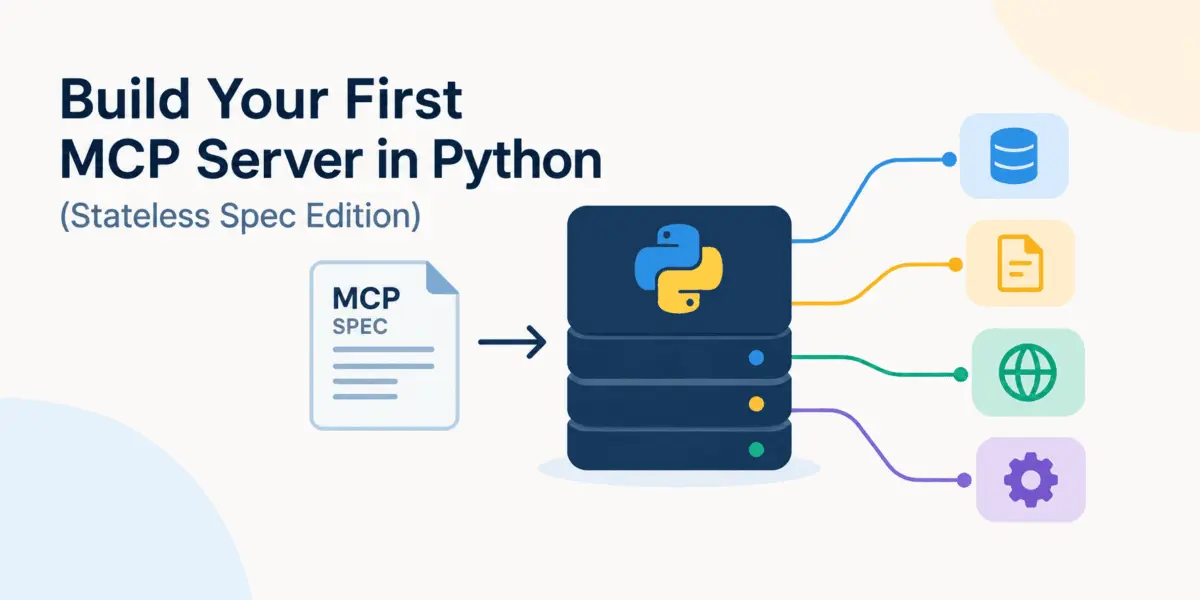
The Model Context Protocol has undergone a fundamental architectural evolution following a major update to its core specification. Released in late July, the updated protocol framework transitions core operations into a stateless model. Under the revised guidelines, modern clients are no longer required to establish a protocol session prior to dispatching requests, while servers have dropped their reliance on session identifiers for ordinary requests. This transition significantly simplifies the process of scaling MCP servers behind standard HTTP infrastructure, removing the friction traditionally associated with persistent connection management.
Concurrently, the official Python SDK has advanced to version 2 as its primary stable release line. This latest iteration introduces a higher-level MCPServer application programming interface designed to streamline how developers define tools, resources, and prompts using standard Python functions. Rather than manually crafting complex schemas or managing low-level protocol metadata, developers can leverage native Python type hints and decorators to expose functionality to large language models. This shift aligns protocol development more closely with ordinary Python software engineering practices, reducing boilerplate code and making network-accessible AI applications easier to build and maintain.
To demonstrate these capabilities in a practical setting, developers are increasingly turning to compact, domain-specific implementations. A prime example involves constructing a developer knowledge-base server designed to operate without any user session state on the server side. In this architectural pattern, every incoming request contains all the necessary data required for processing, embodying the stateless design principles championed by the new protocol specification. The server architecture integrates three primary primitives: a tool for searching the knowledge base, a resource for reading available articles, and a prompt template for drafting support replies.
The underlying mechanism relies heavily on the capabilities of the v2 Python SDK. When a developer defines a search function within the server script, the SDK automatically infers the input schema from the function’s signature and type annotations. Parameters and default values defined in the Python code seamlessly translate into structured definitions expected by the language model host, eliminating the need to write separate JSON schemas or tool manifests. Similarly, resources provide read-only data akin to a conventional HTTP GET request, while prompts offer reusable templates that can be initiated by users or host applications rather than being invoked autonomously by the model.
Adopting the Streamable HTTP transport mechanism further enhances the accessibility of these applications. During the development phase, engineers can utilize specialized development commands packaged with the SDK to launch the server alongside an interactive inspection tool. This utility provides a graphical interface for viewing registered tools and testing invocations locally before deploying the service to a production environment. For live deployments, the server can run as a standalone application or integrate directly into larger asynchronous web frameworks, allowing the MCP endpoint to coexist seamlessly within existing enterprise architectures.
The shift toward a stateless core addresses significant scaling challenges present in earlier versions of the protocol. Previously, maintaining bidirectional state required multi-instance deployments to rely on sticky routing or centralized session storage to ensure that related requests reached the same worker process. Under the updated specification, requests are entirely self-contained. Load balancers can freely distribute incoming traffic across multiple worker nodes without concern for session affinity, making horizontal scaling straightforward and efficient.
Crucially, transitioning the protocol core to a stateless model does not prevent applications from managing state where necessary. Instead of burying session data within the protocol layer, the architectural responsibility shifts to the application layer through the use of explicit identifiers. For example, operations that require tracking state—such as managing a shopping cart or handling a multi-step user interaction—can generate and pass unique handles explicitly through the model. This design ensures that the protocol remains lightweight and flexible while empowering developers to implement whatever persistence mechanisms their specific use cases demand.
As machine learning engineers and software developers continue to adopt the updated Python SDK and its stateless architecture, the integration of external tools and data sources into AI workflows becomes increasingly frictionless. By removing the overhead of connection handshakes and persistent session tracking, the latest protocol specification streamlines deployment pipelines across diverse cloud environments. The ongoing evolution of these developer tools highlights a broader industry trend toward simplifying the infrastructure layer that supports modern language model applications.