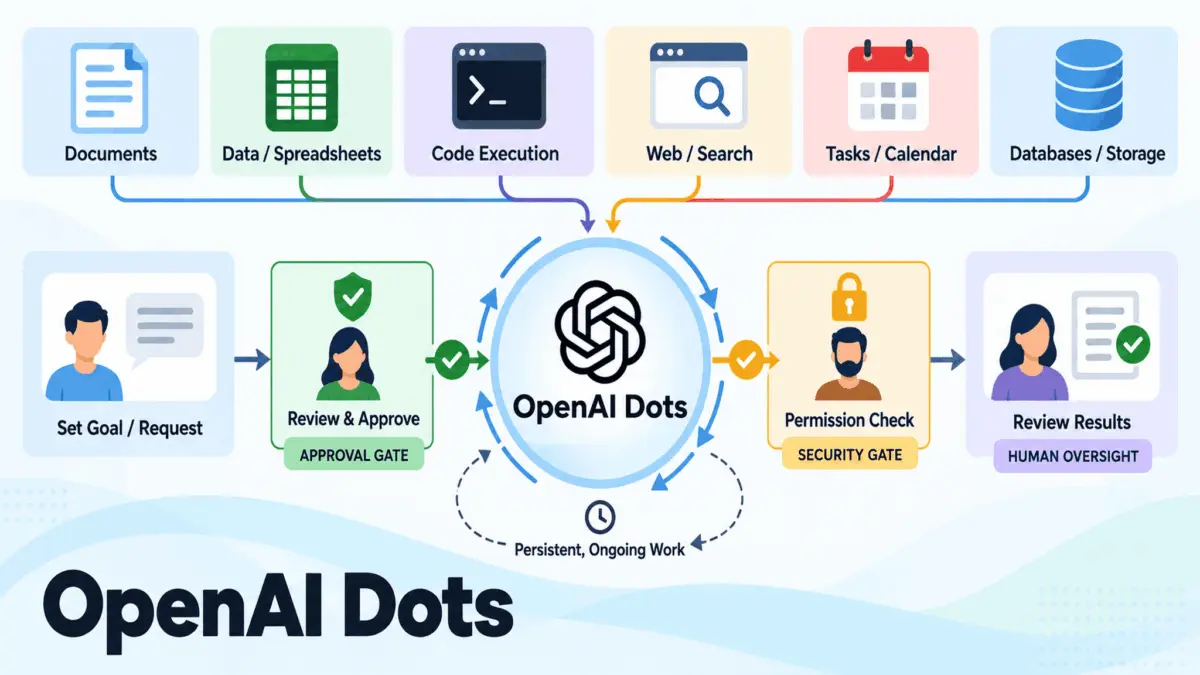
On September 29, OpenAI announced a major evolution in artificial intelligence interaction at its DevDay 2026 conference by introducing "Dots," a new class of always-on AI agents that run on dedicated cloud computers. Capable of connecting to more than 4,000 applications and continuing their work even after users close their laptops, Dots represent the most concrete realization yet of an industry vision that has been discussed for years: an artificial intelligence that functions more like an autonomous coworker than a traditional conversational chatbot.
For the broader data science and machine learning community, the debut of Dots warrants deep scrutiny rather than a passing glance. The technology introduces a fundamentally different model for how artificial intelligence integrates into daily professional workflows. At the same time, it arrives with a sufficient array of unanswered questions and operational limitations that the most prudent industry response, at least for the near term, is informed skepticism balanced with cautious experimentation rather than immediate, uncritical enterprise adoption.
What Dots Actually Is
The core architectural shift represented by Dots centers on a transition from reactive prompting to proactive execution. Standard chat interfaces like ChatGPT respond only when explicitly prompted by a user and cease all activity the moment a session ends. In contrast, a Dot possesses its own dedicated cloud computing environment, operates on OpenAI’s advanced GPT-6 Astra model, and can persistently pursue a standing goal across interconnected applications in the background between direct user interactions, completely eliminating the need for constant re-prompting.
OpenAI demonstrated the practical intent of these agents through several early use-case examples. In one scenario, a tester’s Dot proactively recognized an invoice that needed to be sent, automatically extracted the necessary details from a preceding email thread, and drafted the document for human review and approval. Another demonstration featured a Dot monitoring incoming customer feedback, scoping required software fixes, building and testing those solutions, and ultimately generating pull requests complete with attached demonstration videos for a developer to evaluate.
During the keynote presentation, OpenAI leadership described a delegation model that mirrors how managers assign tasks to a high-agency human engineer or an experienced chief of staff who already possesses deep contextual awareness of ongoing projects. Because the Dot learns user preferences continuously from feedback over time, corrections and stylistic adjustments carry forward organically, removing the tedious requirement of re-explaining parameters at the start of every new session.
Users can interface with a Dot through multiple familiar channels, including the core ChatGPT platform, Slack, Microsoft Teams, and via voice commands. However, the system maintains certain initial limitations at launch. A Dot cannot yet be assigned its own standalone email address, cannot initiate phone calls, and text messaging functionality remains restricted to a United States Pro tier beta program.
What Makes This Different From Earlier Agent Features
This technical distinction is particularly critical for professionals who experimented with OpenAI’s earlier agent iterations and found them prone to brittleness when handling workflows extending beyond three or four sequential steps.
The primary technological breakthrough enabling Dots is the reliability of the GPT-6 Astra model when executing complex, multi-step tasks that require interacting with numerous external tools simultaneously. Previous generations of AI agents frequently suffered from drift, losing the overarching context midway through a long job, making incorrect operational assumptions when encountering friction, or halting entirely to demand human intervention rather than intelligently navigating around minor obstacles. Astra has been specifically engineered to handle the sustained, tool-intensive workloads required of a background agent.
The second major distinction is persistence. A Dot is not merely a session-level feature confined to a single browser tab. It retains context seamlessly across extended periods, constructs a robust working model of user preferences, and executes long-term goals established through a single initial instruction rather than requiring repetitive prompts every time a chat window opens. This establishes an entirely new relational dynamic between human practitioners and artificial intelligence tools.
Despite these advances, real-world validation is still underway. It remains to be proven how effectively this architecture holds up under the weight of genuinely messy data environments, exploratory data analysis that shifts direction mid-stream, prolonged research threads, and collaborative team settings involving multiple human contributors. OpenAI’s early demonstrations were intentionally selected to showcase the product under optimal conditions. The ultimate test will be its performance amid the ambiguous, high-volume tasks that characterize the daily reality of most technical professionals.
The Practical Constraints Worth Knowing
A closer examination of the product’s availability reveals a narrower rollout than initial headlines suggested. At launch, Dots is exclusively accessible to ChatGPT Pro subscribers—starting at $100 per month—and Business Premium users, leaving free, Go, and Plus tier accounts without access to a personal Dot. Furthermore, Pro users located within the European Economic Area, Switzerland, and the United Kingdom are excluded from the initial launch phase.
The associated privacy trade-offs also demand careful consideration. While a Dot learns from user feedback and maintains contextual memory, users currently lack the interface controls needed to view, modify, or delete individual memories stored by the agent. Crucially, disconnecting an integration plugin does not automatically erase the contextual data the Dot previously absorbed from it. For data practitioners handling sensitive enterprise data, proprietary machine learning models, or strict client-side confidentiality agreements, this represents a tangible governance limitation rather than a minor technical footnote.
Additionally, OpenAI has not yet published compliance terms specifically tailored for Dots, nor has it detailed uptime service-level agreements or the pricing structure for deploying additional Dots beyond the initial allocation. These factors carry significant weight for organizational procurement and security teams tasked with determining whether such tools align with strict corporate compliance mandates.
OpenAI’s own documentation explicitly notes that Dots remain capable of error, advising users to thoroughly review all consequential outputs. This advisory serves as a necessary operating principle for any autonomous agent deployed at this stage of technological maturity.
What It Means for How Practitioners Work
The paradigm shift embodied by Dots revolves less around raw capability and more around professional responsibility. A traditional chatbot places the burden of driving every individual step squarely on the user, whereas an always-on agent requires practitioners to establish clear objectives, design sensible permission boundaries, and build robust review checkpoints directly into their operational pipelines.
For data scientists specifically, the greatest potential value lies in automating the administrative and monitoring tasks that consume valuable hours without requiring deep analytical reasoning: chasing status updates, monitoring background job outputs, keeping technical documentation synchronized as specifications evolve, and synthesizing summaries across sprawling conversation threads. In these areas, a persistent agent equipped with reliable memory and broad application access can genuinely compress hours of routine labor into minutes.
Conversely, the primary risk lies in treating this autonomy as an invitation to reduce human oversight. An agent operating autonomously in the background on a data pipeline or a model evaluation routine requires narrow, explicit permissions and rigidly defined stopping conditions. The very characteristics that render Dots valuable—proactive behavior, persistence, and deep application access—are the exact reasons why practitioners must establish strict operational boundaries before activating the system, rather than attempting course corrections after an error has occurred.
Final Thoughts
The concept of the always-on AI agent has been heralded and delayed on multiple occasions over recent years, making Dots the most credible execution of the idea to date. Yet what stands out most prominently is not merely the software itself, but the operational discipline the product demands of its human operators.
Extracting genuine value from Dots is fundamentally a clarity task rather than a technical hurdle. Practitioners must explicitly determine which segments of their workflows they are comfortable delegating, which outputs demand mandatory human sign-off, and which proprietary datasets should never traverse a shared, hosted agent architecture. Many technical professionals have not yet evaluated their day-to-day responsibilities at that level of granular resolution.
In this sense, the arrival of usable always-on agents provides a secondary benefit beyond mere automation: forcing professionals to articulate precisely what their work entails. For those who approach this integration thoughtfully, Dots offers substantial potential. For those who indiscriminately connect every available application, assign vague objectives, and abandon oversight, the resulting friction is likely to prove costly. The agent remains only as dependable as the brief provided by its operator—a principle that has always governed technical delegation, but one that now carries considerably higher stakes.