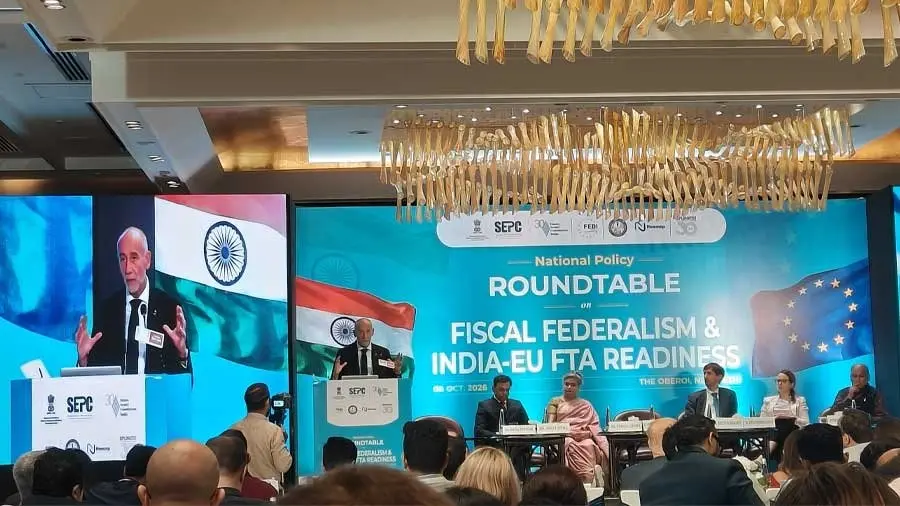
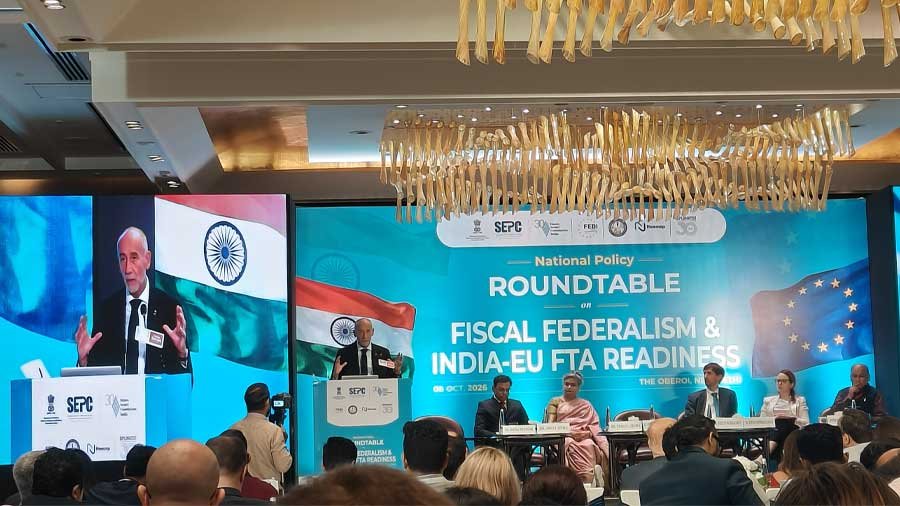
New Delhi — At the recently concluded National Policy Roundtable on Fiscal Federalism and India–EU FTA Readiness in New Delhi, H.E. Jean-Eric Paquet, Ambassador of the European Union to India and Ambassador-designate to Bhutan, delivered a clear and forward-looking message: the successful conclusion of negotiations for the landmark India–European Union Free Trade Agreement (FTA) marks a historic milestone, but the true test of the pact lies in its execution.
Speaking to an audience of senior policymakers, diplomats, industry leaders, and economic experts on October 6, Ambassador Paquet emphasized that turning a major international trade accord into tangible economic opportunities will require synchronized efforts across national governments, regional administrations, businesses, and diverse institutional networks.
The successful culmination of India–European Union Free Trade Agreement negotiations represents a major political and economic milestone in the enduring relationship between India and Europe. Following years of dialogue and the formal relaunch of talks in 2022, both sides announced the conclusion of negotiations in January 2026. The Government of India has formally described the agreement as a vital milestone within one of its most strategic international economic partnerships.
However, according to Ambassador Paquet, the real challenge now lies in translating high-level political commitments into practical, daily opportunities for businesses, investors, workers, and consumers across both geographies. The roundtable in New Delhi served as a timely platform to examine India’s preparedness for this next phase of bilateral economic relations, addressing the intricate realities of implementing such a sweeping agreement within India’s complex federal structure and throughout the European Union’s member states.
The high-level policy dialogue was organized by the Services Export Promotion Council (SEPC), working in close association with the Hanns Seidel Foundation India, the Federation of European Business in India, KMC, NEECOP, and The Diplomatist. By bringing together key voices from government and the private sector, the event fostered a comprehensive discussion on how to bridge the gap between national trade policy and ground-level economic reality.
Reflecting on the extensive diplomatic and technical effort required to reach this juncture, Ambassador Paquet noted that the political momentum behind the agreement had gathered remarkable speed over the preceding two years. Sustained, high-level engagement between New Delhi and Brussels helped both sides demonstrate a genuine willingness to engage in serious, pragmatic negotiations. Describing the breakthrough, the Ambassador noted that it stands as a major political achievement for the partnership between India and Europe, reflecting a shared commitment to open, rules-based trade.
Yet, because of the immense scope and depth of the agreement, Ambassador Paquet cautioned that implementation cannot be treated as a responsibility confined solely to central government authorities. Instead, successful execution will demand active participation from governments, administrative bodies, fiscal authorities, and commercial enterprises across India’s various states and Union territories. Simultaneously, it will require deep engagement with the economic ecosystems of individual EU member states.
This multi-level, federal dimension is precisely what makes forums like the New Delhi roundtable indispensable. Indian businesses must carefully evaluate what the agreement means for specific regional markets within Europe, just as European companies must familiarize themselves with the diverse regulatory environments, logistical realities, and market opportunities across India’s individual states.
From Negotiation to Execution
The India–European Union Free Trade Agreement has been structured to offer extensive market access across a broad spectrum of goods and services. Official factsheets released by the Government of India indicate that the EU’s commitments cover nearly 97 percent of tariff lines and encompass more than 99 percent of India’s overall export value. Furthermore, immediate duty elimination covers 90.7 percent of India’s export value, with additional products designated for phased liberalisation over time.
While these impressive figures establish a strong foundation, Ambassador Paquet underscored that statistical metrics only matter if commercial actors are fully prepared to leverage the opportunities they create. The critical process ahead involves ensuring that all participants across every sector—spanning both goods and services—possess complete awareness of the agreement’s terms and mechanics, enabling them to proactively anticipate and capitalize on emerging market openings.
The agreement is widely anticipated to generate substantial commercial opportunities across a diverse array of industries. Indian exporters stand to gain significantly from improved access for labor-intensive sectors, including textiles, leather, footwear, marine products, tea, coffee, spices, and gems and jewellery, among others. In addition, the pact includes vital commitments regarding services trade and professional mobility, opening pathways for skilled personnel and service providers.
Simultaneously, European businesses will secure enhanced access to the rapidly expanding Indian market. This includes sectors where European engineering expertise, advanced technology, and foreign direct investment can directly contribute to India’s ongoing economic transformation and industrial modernization.
Ambassador Paquet urged stakeholders to view the FTA not merely as a traditional tariff-reduction accord, but rather as a comprehensive institutional framework capable of supporting much deeper, long-term economic integration between two of the world’s most dynamic economic regions.
Building a Common Economic Space
Placing the bilateral agreement within a broader geopolitical and macroeconomic context, the Ambassador highlighted the timeliness of the pact. At a time when global trade patterns are experiencing increased fragmentation and international supply chains are undergoing continuous reassessment, India and Europe share a unique opportunity to construct a more reliable, resilient, and predictable economic relationship. Describing the partnership, he emphasized that the agreement represents much more than traditional trade.
The FTA, in his view, can actively contribute to the creation of a broader, interconnected economic space. This space would seamlessly link Indian and European markets, supply chains, logistics networks, investment flows, and technological innovations.
He noted that trade and investment cannot be treated as isolated phenomena. Greater market access inherently demands efficient logistics and robust supply chains, while stronger supply chains rely in turn on sustained investments in physical infrastructure, advanced technology, and domestic production capacity.
This ambitious vision rests upon a substantial pre-existing economic foundation. Official government data indicates that bilateral merchandise trade between India and the European Union reached USD 136.54 billion during the 2024–25 fiscal year, with Indian exports to the EU accounting for USD 75.85 billion. Additionally, bilateral trade in services stood at an impressive USD 83.10 billion in 2024, demonstrating the already high intensity of economic exchange between the two partners.
The States Will Matter
A central theme of Ambassador Paquet’s address focused on the critical role played by India’s states and Union territories. Although the FTA is negotiated and signed at the national level, its practical economic impact will be felt directly across India’s diverse regional jurisdictions. Commercial enterprises operate within local ecosystems defined by state-specific infrastructure, taxation policies, administrative procedures, logistical networks, skill levels, and regulatory frameworks.
This decentralized operational reality makes the principles of fiscal federalism particularly relevant to the successful implementation of the trade agreement. Ambassador Paquet pointed to the vital importance of ensuring that domestic taxation frameworks and regional regulations actively support, rather than inadvertently hinder, the commercial opportunities unlocked by international market access. He also emphasized the necessity of maintaining an ongoing, open dialogue between public administrations and the business community to identify and resolve practical implementation hurdles at the earliest possible stage.
Indicating the European Union’s readiness to collaborate closely with Indian institutions, the Ambassador confirmed that EU authorities are fully prepared to work alongside local stakeholders as the agreement progresses through its remaining procedural steps toward full implementation.
A Call to Businesses: Prepare Now
Perhaps the most emphatic message delivered by Ambassador Paquet was directed squarely at the private sector. Although the FTA still requires several formal procedural steps—including legal reviews and institutional approvals—before it officially enters into force, companies have been strongly advised not to adopt a wait-and-see approach.
The formal conclusion of negotiations in January 2026 initiated a structured period of legal scrutiny and administrative preparations designed to transition the agreement into an operational treaty. During this interim phase, proactive corporate strategy will determine which enterprises successfully capture early-mover advantages.
Emphasizing the urgency of commercial preparation, Ambassador Paquet urged business leaders to act immediately. Companies should be actively auditing their supply chains, evaluating prospective European partners, conducting thorough market research, and familiarizing themselves with the precise regulatory requirements that will govern preferential access once the agreement becomes operational.
For policymakers and institutional leaders across both India and Europe, the mandate is equally clear: construct and refine the administrative, digital, and regulatory infrastructure required to ensure the agreement functions with maximum efficiency once implemented.