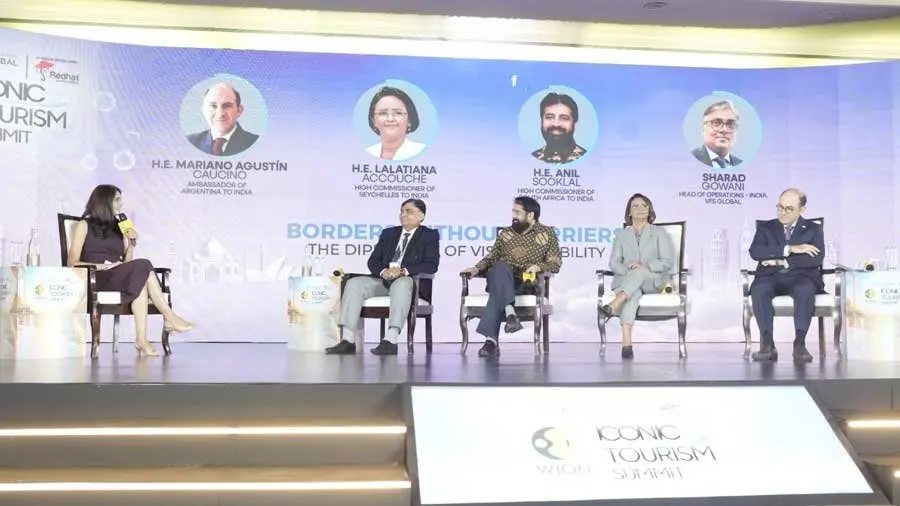
At the recent WION Iconic Tourism Summit, an assembly of international diplomats and mobility-sector experts convened to examine a transformative question for the modern era: how can countries make international travel smoother, faster, and more accessible without compromising national security? The high-level panel discussion, titled "Borders Without Barriers: The Diplomacy of Visas and Mobility," brought together prominent diplomatic figures and industry leaders to discuss the evolving intersections of tourism, aviation, digitalisation, and people-to-people exchanges.
Moderated by Molly Gambhir, the conversation moved far beyond the traditional mechanics of visa processing to explore a larger geopolitical and economic reality. The panelists addressed how nations can successfully dismantle unnecessary administrative barriers while preserving the integrity, trust, and security that underpin modern global mobility. As highlighted during the summit, well-facilitated travel acts as a vital bridge between nations, powerfully reinforcing cooperation across tourism, international business, higher education, and diplomatic relations.
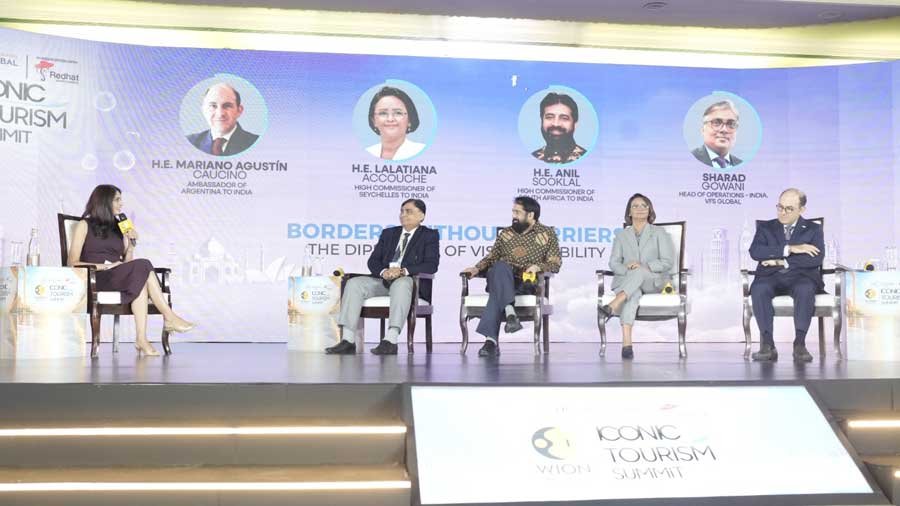
The panel featured H.E. Mariano Agustín Caucino, Ambassador of Argentina to India; H.E. Lalatiana Accouche, High Commissioner of Seychelles to India; H.E. Prof. Anil Sooklal, High Commissioner of South Africa to India; and Sharad Gowani, Head of Operations for India at VFS Global. Each participant offered unique insights into how their respective regions are adapting to the demands of contemporary travelers while strengthening bilateral and multilateral ties.
Lalatiana Accouche: "We are not only neighbours; we are like sisters and family"
For H.E. Lalatiana Accouche, human mobility is entirely inseparable from the deepening diplomatic and cultural relationship between India and Seychelles. The dialogue comes at a particularly poignant historical juncture, as 2026 marks both the 50th anniversary of diplomatic relations between the two nations and the 50th anniversary of Seychelles’ independence. Over the past five decades, India and Seychelles have steadily expanded their bilateral cooperation, building deep partnerships across maritime security, education, hospitality, digitalisation, and people-to-people engagement.
Reflecting on the next phase of this enduring relationship, H.E. Accouche stressed that future diplomatic objectives must prioritize strengthening links not merely at the governmental level, but directly between ordinary citizens through tourism, educational exchanges, and cultural interactions. She emphasized that the mobility of people opens up boundless areas for mutually beneficial cooperation.
Her remarks also placed the tourism sector firmly within the broader framework of Indian Ocean geopolitics. Seychelles and India have increasingly collaborated on maritime security and institutional capacity building, recognizing that the Indian Ocean serves as both their shared geographical setting and a crucial strategic interest. H.E. Accouche noted that cooperation at sea is of paramount importance for island nations, highlighting India’s ongoing assistance in enhancing maritime security and keeping regional waters safe.
The overarching message conveyed by the High Commissioner was one of deep partnership rather than mere geographical proximity. Capturing the people-first character that defines the bilateral relationship, she remarked that the two nations view one another not just as neighbors, but as sisters and family.
This relationship has gained significant fresh momentum throughout 2026. During Prime Minister Narendra Modi’s state visit to Seychelles in June, the two governments unveiled a commemorative logo celebrating fifty years of official diplomatic ties. Furthermore, both leaderships agreed to intensify bilateral cooperation across tourism, direct air connectivity, and other people-centric initiatives designed to bring the two island and mainland populations closer together.
Ambassador Mariano Agustín Caucino: "We are opening as much as possible"
Shifting the focus to Latin America, Argentina’s Ambassador to India, Mariano Agustín Caucino, argued that the most tangible expression of effective tourism diplomacy is the proactive removal of redundant bureaucratic barriers.
While firmly acknowledging that every sovereign nation retains the absolute right to determine its own immigration and border policies, Ambassador Caucino underscored that Argentina is actively pursuing a progressive approach to welcome more Indian travelers. He explained that his government is working to open doors as widely as possible to encourage international tourism and cultural exchange.
As a primary example of this policy shift, Ambassador Caucino pointed to a major regulatory change introduced in 2025. Under this framework, Indian passport holders who possess eligible, valid United States visas are permitted to enter Argentina for tourism purposes for up to 90 days without needing to apply for a separate Argentine visa. Official consular guidance confirms this streamlined pathway, which significantly reduces the administrative burden on prospective visitors.
For the Ambassador, such progressive measures are far more than mere administrative conveniences; they often determine whether a distant, long-haul destination remains realistically accessible to an international traveler. Alongside visa facilitation, Ambassador Caucino emphasized that air connectivity plays an equally crucial role in bridging continents. Restoring or expanding direct flight routes, or optimizing travel pathways through major international hubs such as Madrid, can drastically reduce the logistical friction involved in traveling between India and South America.
He maintained that concrete measures are urgently required to promote global tourism, with aviation policy and visa facilitation working in tandem rather than operating as isolated silos. His core message remained straightforward: if nations genuinely desire to attract a greater influx of international visitors, they must actively simplify the journey required to reach their shores.
H.E. Anil Sooklal: "We are in a Global South Tourism Moment"
Expanding the conversation beyond individual bilateral ties, H.E. Prof. Anil Sooklal directed attention toward broader geopolitical movements, asserting that the next phase of global tourism must fundamentally challenge how destinations within the Global South are represented, perceived, and connected.
Prof. Sooklal declared that the international community is currently experiencing a defining "Global South tourism moment." This phrase captures the rising economic and cultural significance of cooperation among developing nations, as well as the leading role that influential countries like India and South Africa play in driving this transformation.
India and South Africa already share deep historical roots and robust people-to-people connections. South Africa is home to a substantial population of Indian origin, and the two nations have cultivated a powerful diplomatic partnership through prominent multilateral forums such as BRICS. Despite these profound ties, Prof. Sooklal pointed out that a major logistical gap continues to hinder closer integration: the lack of direct aviation connectivity.
He noted that India and South Africa currently lack direct passenger flight services between their major economic centers. Current aviation data indicates that there are no direct flights operating between Mumbai and Johannesburg, forcing travelers to route through alternative regional hubs such as Nairobi, Addis Ababa, Mauritius, Doha, or Dubai. Recognizing the Johannesburg-Mumbai corridor as a critical underserved market opportunity, government officials and aviation industry stakeholders from both nations have held ongoing discussions regarding the possibility of restoring direct flight services.
Alongside aviation reform, Prof. Sooklal reiterated that comprehensive visa facilitation remains a fundamental prerequisite for boosting travel. However, his vision for mobility extended well beyond tourism, calling for a deliberate expansion of educational, academic, and cultural exchanges, particularly among the younger generation.
Recalling the historical flow of South African students to India during the apartheid era, Prof. Sooklal advocated for the creation of specialized visa categories and simplified administrative pathways designed to encourage students and researchers to travel in both directions. He expressed a strong desire to see more South African students pursuing higher education in Indian institutions, alongside an increased presence of Indian students attending universities across Africa, including South Africa.
For Prof. Sooklal, enhancing youth mobility is ultimately about fortifying bilateral relationships at a foundational level. Emphasizing the core philosophy behind his vision, he concluded that the younger generation must be placed firmly at the center of international relations.
Sharad Gowani: "Security and accessibility need to go hand in hand"
Addressing the operational realities underpinning the entire global mobility framework, Sharad Gowani, Head of Operations for India at VFS Global, focused on the delicate balance between administrative efficiency and border protection.
Gowani observed that today’s increasingly digital-savvy travelers operate with high expectations of immediacy. Whether navigating initial visa applications, tracking processing statuses, or managing document submissions, modern travelers demand speed, transparency, and operational flexibility. However, he stressed that faster processing times must never come at the expense of rigorous security protocols.
As Gowani noted, security and accessibility must go hand in hand to maintain the integrity of international borders. This balance is especially critical given the operational role of VFS Global, which functions as an administrative and technology-services partner to sovereign governments and diplomatic missions worldwide while ensuring that final visa adjudication authority remains strictly with the respective national authorities. VFS Global currently partners with 69 client governments, operating over 3,900 application centers across 165 countries, having successfully processed more than 514 million transactions since its inception in 2001.
Detailing the mechanics of modern processing, Gowani described a secure ecosystem where safety protocols begin at the initial moment of application and persist seamlessly through document handling, biometric data collection, secure logistics, and final passport return. He also underscored the rapid technological evolution toward digital-first applications and remote services.
Digital platforms are already reducing the necessity for physical in-person appointments in various administrative workflows, while advanced biometrics and identity verification technologies continue to evolve. Gowani noted that the necessary hardware infrastructure is already largely established, and the primary objective moving forward is to connect these disparate technologies efficiently.
Ultimately, Gowani emphasized that technological innovation must serve a broader, overarching purpose: ensuring that legitimate travelers equipped with proper documentation can navigate bureaucratic systems smoothly, while preserving the strict safeguards that sovereign governments require. This equilibrium between convenience and institutional integrity will likely dictate the shape of international mobility for generations to come.