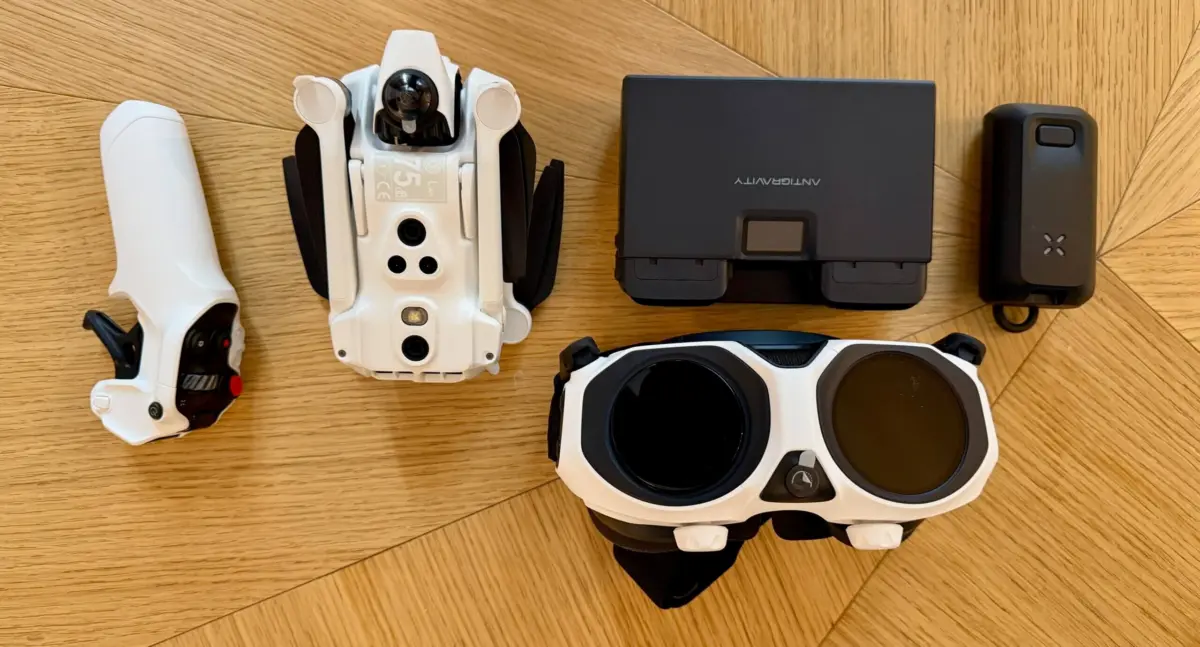
Drones have undeniably transformed the landscape of modern travel videography, offering sweeping, cinematic perspectives that were once accessible only to major motion picture studios. Yet, despite their widespread popularity among road-trippers and global explorers, traditional drones have long come with a complex set of operational friction points. Navigating strict regulatory weight thresholds, wrestling with precise manual framing, and managing fragile external gimbals often complicate what should be an inspiring creative process.
Enter the Antigravity A1, a device released in late 2025 that attempts to render the traditional camera gimbal obsolete for a vast segment of creators. By leveraging an innovative dual-lens 360-degree capture system, the A1 records everything in every direction simultaneously. The resulting experience shifts the paradigm of aerial videography away from the stressful, split-second decisions of traditional piloting, offering instead a "fly now, frame later" workflow that feels less like operating a remote aircraft and more like directing a virtual camera within a pre-recorded digital environment.
Two Lenses and No Blind Spots
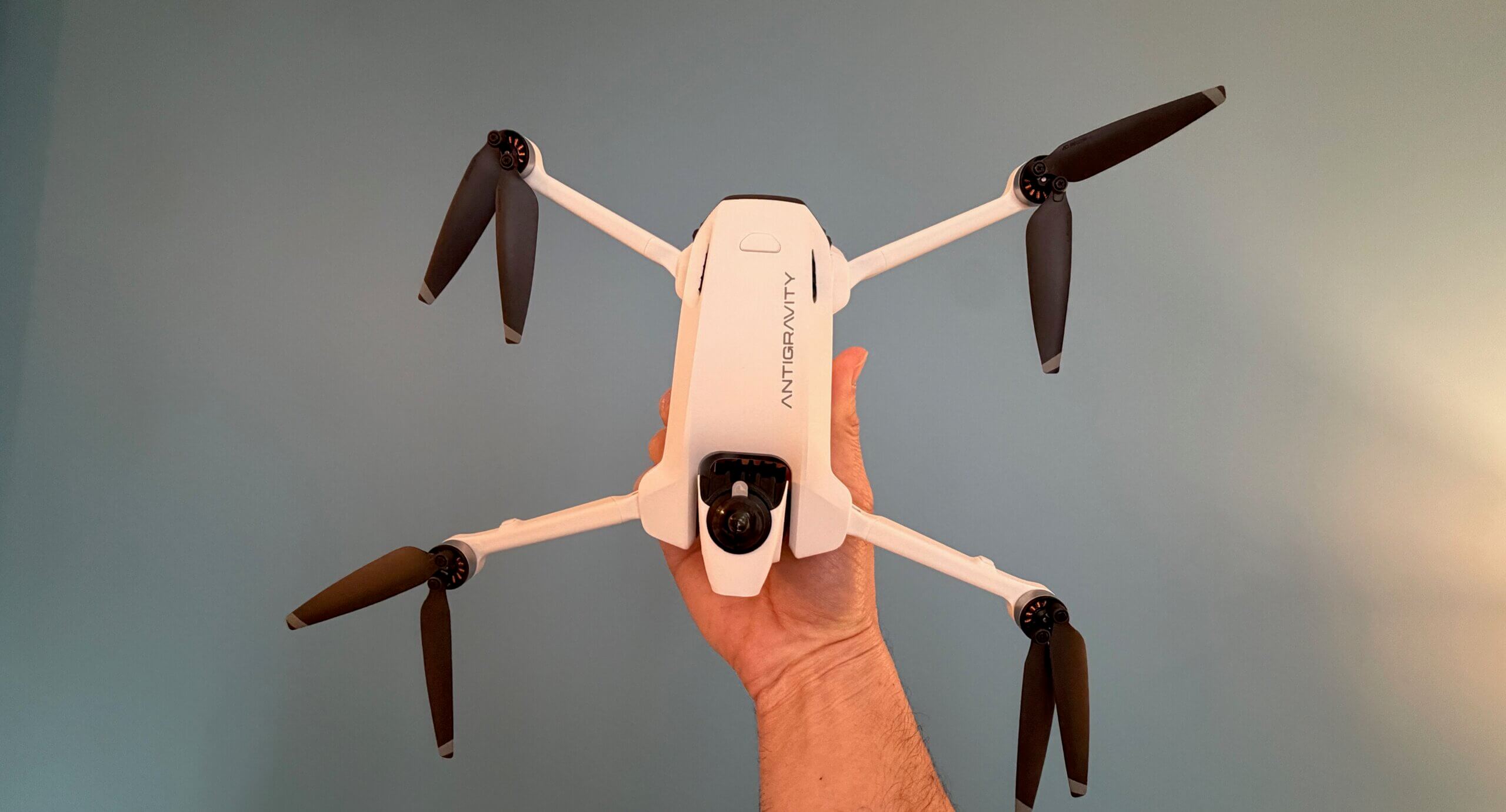
What sets the Antigravity 360 system apart from conventional models is its revolutionary optical layout. While the vast majority of consumer drones rely on a single, forward-facing lens mounted on a motorized mechanical gimbal, the A1 utilizes two ultra-wide-angle lenses positioned symmetrically on the top and bottom of the central fuselage. Each lens captures an impressive 200-degree field of view. When these dual image feeds are stitched together internally, they overlap to form a seamless, complete 360-degree sphere.
One of the most striking visual achievements of this design is the automatic digital removal of the drone itself in the final exported footage. Without a mechanical gimbal or landing gear blocking the frame, videos achieve the uncanny illusion of a camera floating entirely unsupported in mid-air.
Beneath these lenses lie robust 1/1.28-inch CMOS sensors. While these sensors are physically smaller than the premium one-inch sensors found on heavy-duty, professional-grade photography drones, they are remarkably large compared to the hardware typically packed into traditional 360-degree action cameras. This scale translates directly into enhanced low-light performance and a substantially broader dynamic range. Creators can capture delicate details in both bright highlights and deep shadows—a critical capability when shooting under the harsh, high-contrast conditions of a midday sun.
Furthermore, regulatory compliance remains a major hurdle for drone operators worldwide, as many aviation authorities enforce strict licensing and registration mandates for aircraft weighing 250 grams or more. Antigravity engineered the A1 to weigh precisely 249 grams when equipped with its standard battery. By landing safely below this critical regulatory threshold, the aircraft sidesteps commercial registration requirements in many jurisdictions, offering a frictionless travel experience for mobile creators.
The physical construction of the drone matches its sophisticated internal technology. It utilizes a high-grade carbon-fiber-reinforced polymer, which provides a markedly superior strength-to-weight ratio compared to the standard ABS plastic frequently utilized in more budget-oriented models. The folding mechanism exhibits a satisfying, tactile precision that suggests long-term durability on the road. When completely folded down for transport, the aircraft roughly approximates the footprint of a large smartphone, albeit approximately three times as thick.
An Immersive Flight Experience
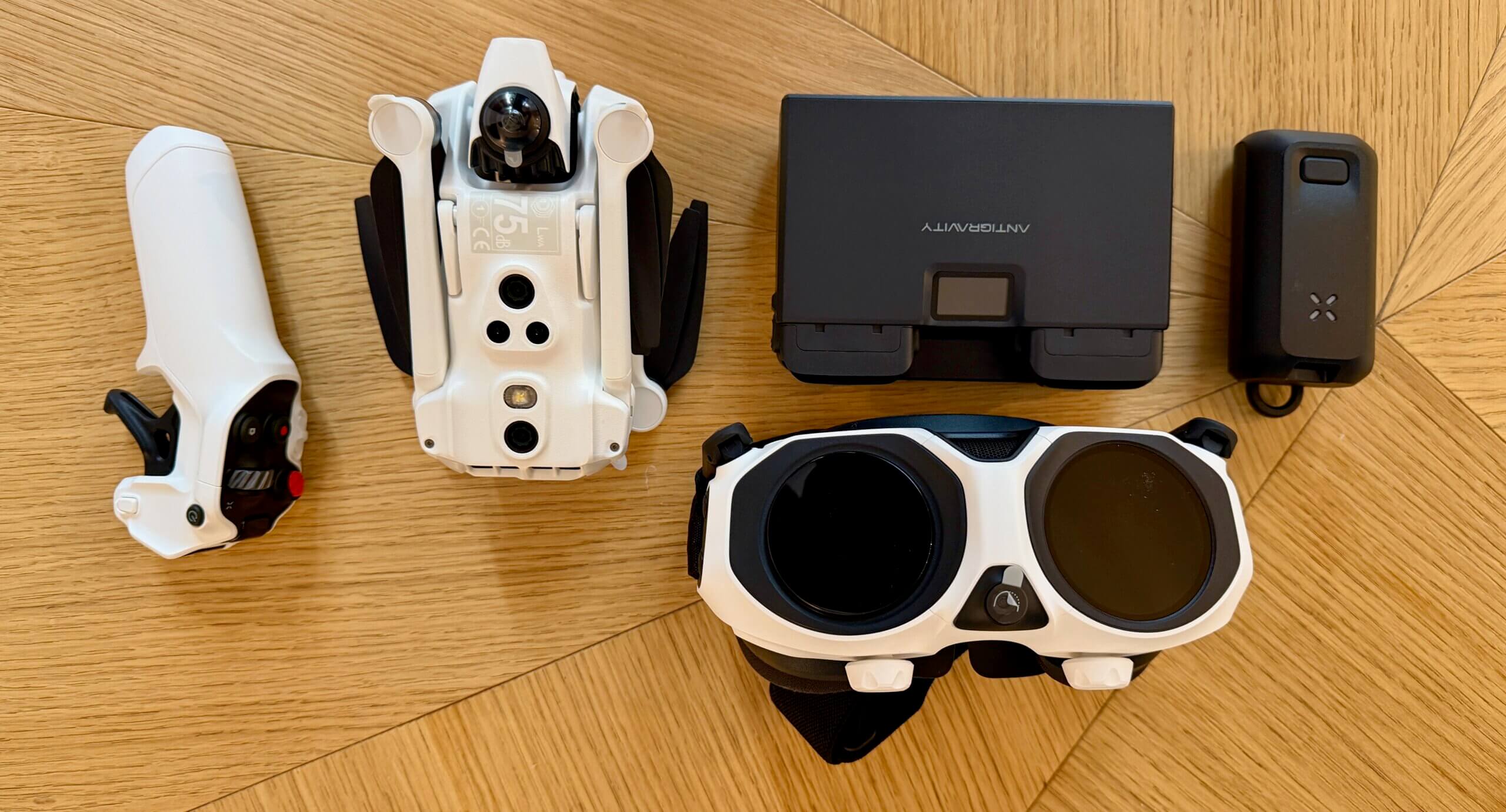
The operational ecosystem of the Antigravity A1 extends far beyond the aircraft itself, centering heavily on an intuitive flight experience driven by advanced control peripherals.
The accompanying vision goggles are sleek and lightweight, housing dual 4K micro-OLED displays capable of a smooth 120Hz refresh rate. Featuring near-zero latency and integrated head tracking, the goggles fundamentally change how a pilot interacts with the sky. Because the drone continuously records in a full 360-degree sphere, the user is never restricted to merely watching the narrow perspective directly ahead of the aircraft. A simple turn of the head to the left pans the visual feed instantly, while looking downward reveals the terrain passing directly beneath. This setup delivers a profound sense of presence and spatial awareness that traditional fixed-camera drones cannot replicate.
Piloting the aircraft is managed via a single-handed motion controller designed around absolute simplicity. Users simply point the controller in the intended direction of travel and pull a trigger to accelerate. Banking left or right is achieved by tilting the wrist, while raising the nose of the controller initiates a climb. This streamlined approach enables even complete novices to navigate complex spatial environments with confidence within minutes.
However, for experienced FPV (First-Person View) pilots who demand the tactile precision required for manual acrobatic maneuvers, the A1 retains compatibility with a traditional "Mode 2" stick controller. Despite this professional option, the fluidity of the motion-control system means the vast majority of users will likely find little reason to switch back.
Advanced Camera Performance and Stabilization
The marketing materials for the Antigravity 360 prominently feature the specification of "8K Resolution." In a conventional digital camera, an 8K resolution designates every pixel packed densely into a standard 16:9 rectangular frame. In the realm of 360-degree video, however, those same pixels are distributed across the entirety of a spherical canvas. When a creator subsequently "reframes" that expansive 8K sphere into a traditional flat video file, the resulting export represents a selective crop of the overall capture.
Color science has also seen notable advancements compared to older generation 360-degree recording devices. The A1 incorporates a "Vivid" profile tailored for creators seeking punchy, social-media-ready aesthetics straight out of the box, alongside a professional 10-bit "Log" profile designed for editors who require maximum latitude when color-grading footage in post-production suites.
Equally impressive is the onboard stabilization architecture, driven by Antigravity’s proprietary "FlowState" algorithms. The technology successfully dampens external turbulence, allowing the drone to operate smoothly even in gusty 20-mile-per-hour winds, maintaining a visual horizon as steady as a heavy studio tripod.
Streamlined Editing and Post-Production
Managing massive 360-degree video files has historically proved to be a computational bottleneck, but the proprietary "Antigravity Studio" application aims to smooth this workflow. The software enables wireless footage downloads at speeds reaching up to 80MB/s, allowing creators to reframe their visual narratives directly through their smartphone’s internal gyroscope. By simply playing back the recorded file and physically moving the phone through space, users can "film" the scene dynamically in real time.
Additionally, the application features an artificial intelligence tool known as "Auto-Frame." This utility automatically detects and tracks primary subjects within the spherical footage, generating a polished cut that keeps the action centered without manual keyframing. For solo content creators juggling multiple responsibilities in the field, this automation effectively functions as a virtual camera crew that ensures critical moments are never missed.
Flight Dynamics and Battery Realities
Battery technology remains an inherent physical bottleneck across the consumer drone sector. The standard Intelligent Flight Battery included with the A1 provides a theoretical maximum flight duration of 24 minutes. Under real-world operating conditions characterized by moderate wind resistance and continuous recording, users can practically expect closer to 19 or 20 minutes of airtime.
While a 20-minute window may sound brief on paper, the effective output per minute of flight is significantly higher than that of a traditional drone. Because pilots are no longer forced to repeatedly fly identical flight paths to capture varying angles—having recorded every possible angle simultaneously—a single 20-minute flight can yield an equivalent amount of usable content to multiple flights with conventional aircraft. For those requiring extended sessions, an optional "Pro Battery" pushes flight times to 39 minutes, though the heavier cell marginally impacts the nimble agility of the airframe.
Aerodynamically, the A1 adopts the flight characteristics of a "cinewhoop" style platform, favoring stable, predictable handling over twitchy, aggressive maneuverability. With a top speed of approximately 36 miles per hour, the aircraft easily tracks moving subjects like cyclists or automobiles, though it is not designed to compete with high-speed racing drones.
Practical recovery features are also built into the system, most notably "Turtle Mode." Should the aircraft experience a minor crash that leaves it resting upside down in the dirt or grass, the drone can autonomously utilize its propellers to flip itself back upright, sparing the pilot the inconvenience of a retrieval walk.
Ultimately, the Antigravity 360 A1 bridges the widening chasm between traditional aerial cinematography and the immersive potential of virtual reality. By removing the mechanical constraints of gimbals and the cognitive load of manual framing, the platform allows creators to shift their primary focus back to the core narrative they set out to capture. While the underlying optical sensors do not yet rival the uncompromising fidelity of high-end cinema drones, and the dual lenses demand careful handling during transport, these compromises are minor trade-offs for the creative liberation the technology affords.