Arctic sea ice has long presented a puzzling contradiction to the scientists who study it. While standard meteorological models rely heavily on wind speeds to predict how sea ice drifts across the polar oceans, observational data consistently reveals a discrepancy. The ice rarely moves quite the way wind forces alone would dictate; it frequently travels at unexpected speeds and spreads across the ocean surface at a much slower rate than simple predictive frameworks suggest.
For years, researchers have debated why these discrepancies persist. Proposed explanations have ranged from unusual atmospheric circulation patterns and deep-ocean eddies to fractures running deep through the frozen sheets. However, a new study led by researchers at the University of California, Riverside, points to an entirely different, remarkably straightforward mechanism: individual blocks of ice repeatedly colliding with one another.
The findings, which could significantly enhance scientists’ ability to forecast sea ice dynamics as the polar region continues to experience rapid warming, were recently published in the academic journal Physical Review Letters. The research effort was spearheaded by Bryan Shaddy, who began the work as an undergraduate at UC Riverside and is now based at the University of Southern California. Shaddy collaborated with UCR materials scientist Alex Greaney and Bhargav Rallabandi, an associate professor of mechanical engineering at the institution.
Arctic Sea Ice Is Made of Moving Floes
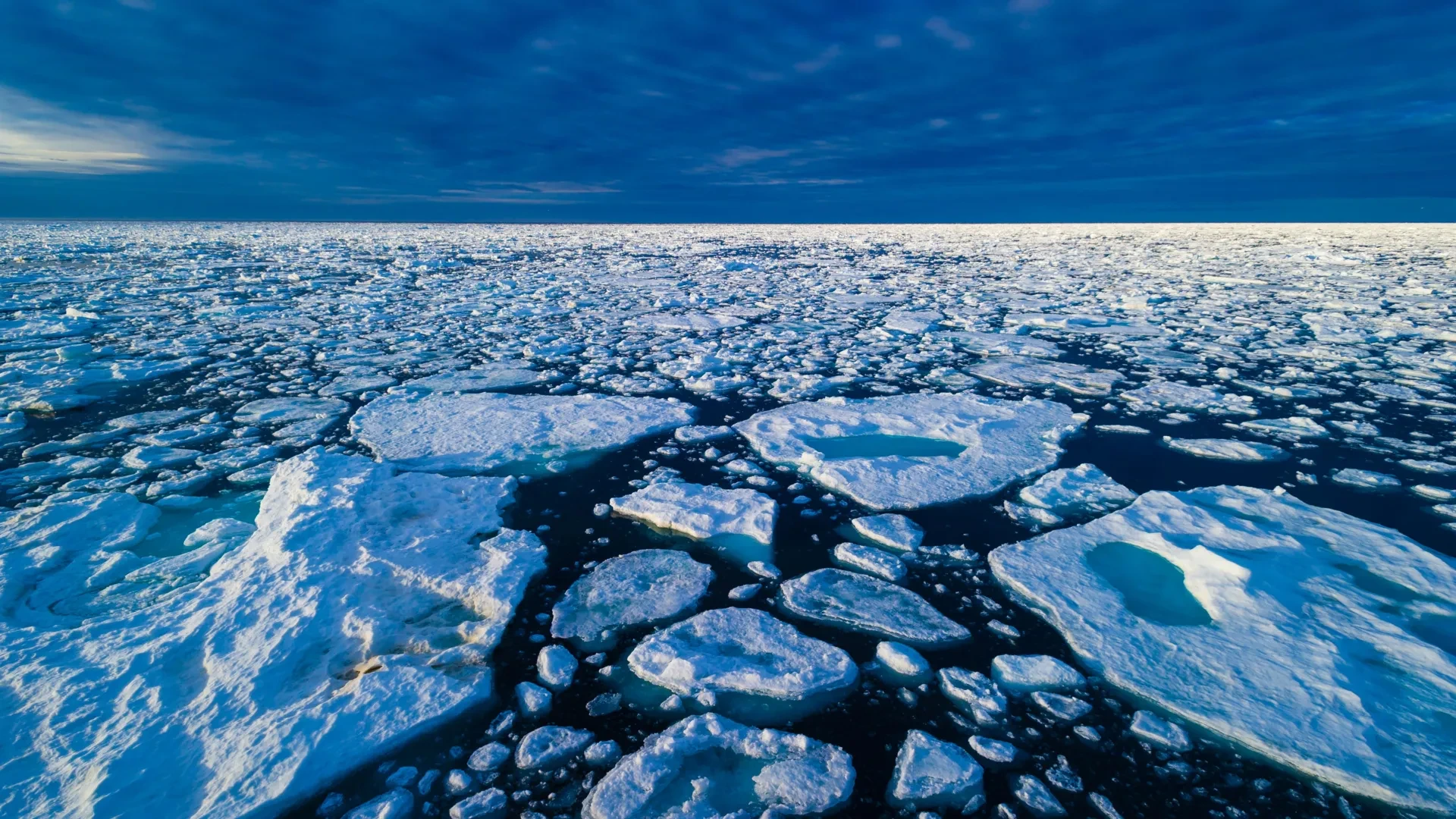
To understand the mechanics of the new study, it helps to visualize the physical state of the Arctic Ocean. Rather than forming a single, continuous, and unbroken sheet of frozen water across the top of the planet, Arctic sea ice is structurally fragmented. It is divided into countless separate, discrete slabs known as floes. These individual pieces vary dramatically in scale, ranging from small chunks just several meters across to colossal slabs stretching several kilometers wide.
As winds sweep across the polar expanse, they push against these massive floes, forcing them to drift across the open water and slowly pull apart from one another. Although atmospheric wind serves as one of the primary drivers controlling sea ice motion, decades of empirical observations have demonstrated its limitations as a standalone predictive tool.
Ice sheets routinely travel at speeds that basic wind-driven models fail to anticipate. Furthermore, they disperse across the marine environment at a fraction of the velocity those models project.
While alternative theories involving ocean eddies, complex wind behaviors, and internal cracking have been heavily investigated, the UC Riverside research team suggests that many of these baffling patterns can be resolved by analyzing the basic, persistent physics of neighboring floes bumping into each other.
"If you get a lot of ice floes together in the same place with some wind, they bump into each other and transfer energy to neighbors," Rallabandi explained, highlighting the core premise of the study. "We showed that that’s the only ingredient you need to explain these observations."
Simulating a Crowded Field of Ice
To rigorously test this hypothesis, the researchers developed an advanced computer simulation designed to treat floating ice in a manner analogous to granular materials. Specifically, the model conceptualizes the ice floes somewhat like grains of sand or gravel moving through a storage silo. The critical distinction, however, is that these massive granular "grains" are actively floating on a dynamic ocean surface while being subjected to the unpredictable, turbulent force of Arctic winds.
The newly engineered simulation meticulously incorporates both the hydrodynamic drag exerted by the underlying ocean water and the continuous, repeated physical collisions occurring between adjacent floes as they shift and drift.
To validate the accuracy of their computer model, the researchers cross-referenced their simulation data with empirical, real-world measurements collected from the Fram Strait. Located between Greenland and the Norwegian archipelago of Svalbard, the Fram Strait serves as a crucial oceanic gateway through which vast quantities of Arctic sea ice flow on their eventual journey toward the Atlantic Ocean.
By inputting localized wind and ice conditions measured directly in the field—along with just a single additional parameter that exerted minimal influence on the broader outcome—the computer model successfully replicated three distinct historical observations that had previously defied simple scientific explanation.
The simulation accurately matched the rate at which sea ice naturally spreads, the wide distribution of speeds at which individual floes travel across the water, and the subtle ways in which ice motion fluctuates over varying timescales ranging from hours to days.
Why Collisions Matter So Much
The profound influence that collisions exert on Arctic ice dynamics stems primarily from the dense packing characteristic of the region. Under many conditions, Arctic sea ice becomes tightly constrained, leaving little open water between adjacent slabs.
Within these dense ice fields, individual floes experience frequent impacts with neighboring pieces—collisions that occur at a frequency far exceeding the rate at which the driving winds themselves shift direction or intensity. Every single collision acts as an energy dissipation mechanism. It strips away a portion of the kinetic energy imparted by the wind, effectively dampening the momentum of the floe and restricting the distance it can travel before striking yet another barrier of ice.
This constant, repetitive jostling provides a coherent physical explanation for why sea ice does not simply continue to accelerate and disperse indefinitely under the persistent influence of the wind.
Looking forward, these insights could refine long-term predictions regarding sea ice transport as the Arctic environment undergoes unprecedented climatic evolution. Both the total percentage of the ocean surface covered by ice and the average physical size of individual floes dictate the frequency and intensity of these collisions. In turn, those microscopic collision rates govern how rapidly the macroscopic ice field can expand or contract.
This innovative analytical framework successfully bridges the gap between small-scale, local mechanical interactions and large-scale movement patterns unfolding across vast geographic expanses.
A Possible Tool for Climate Models
While the newly published study does not explicitly forecast the exact geographical destinations of Arctic sea ice under future global warming scenarios, the implications for climate science are profound. Rallabandi noted that the newly validated model could empower scientists to investigate complex, pressing questions—such as whether evolving ice conditions might enable floes to fracture and disperse more easily, thereby drifting into warmer southern waters where they would melt at accelerated rates.
Beyond localized transport questions, the work holds significant promise for global climate modeling. Comprehensive global climate models currently face immense computational hurdles, as they cannot possibly track every individual component within the vast population of relatively small floes spanning the Arctic Ocean.
Instead, climate scientists require effective methodologies to parameterize and represent their collective, aggregated behavior. A physically grounded model of how ice floes interact provides a viable pathway to capture crucial mechanical processes that would otherwise occur at scales too small to resolve individually.
For Rallabandi and his colleagues, one of the most compelling takeaways of the research is that a relatively uncomplicated physical process can account for the intricate, chaotic motion observed in the natural world.
Physics That Extends Beyond Sea Ice
The fundamental principles governing this research are not uniquely confined to the frozen waters of the polar north. The underlying mathematics and physics may apply broadly to a wide array of physical systems far beyond glaciology.
Any complex scenario involving a multitude of discrete objects experiencing collisions while simultaneously driven by a noisy, unpredictable external force could theoretically exhibit similar behavioral patterns. The researchers point toward potential applications in entirely different scientific and industrial domains, including the study of avalanches, landslides, advanced materials science, and the behavior of particle-filled inks utilized in modern 3D printing technologies.
"The model is not restricted to ice," Rallabandi said, summarizing the broader applicability of the team’s work. "It just needs a noisy source of force and the things that are moving to experience collisions."