Drones have transformed modern travel and content creation, allowing enthusiasts and professionals alike to capture sweeping, cinematic aerial views that were once restricted to high-budget Hollywood productions. Despite strict regulatory environments governing where and how they can be flown, millions of travelers continue to pack them into their road-trip gear. While the market features numerous reputable hardware manufacturers, recent releases continue to push the boundaries of what portable aircraft can achieve. Among the most innovative arrivals in late 2025 is the Antigravity A1, a device engineered to render the traditional camera gimbal obsolete for a vast segment of digital creators.
By leveraging an advanced dual-lens 360-degree capture system, the Antigravity A1 records visual data in every direction simultaneously. This technological approach introduces a “fly now, frame later” workflow that alters the traditional piloting experience. Instead of meticulously framing shots in real-time while wrestling with wind resistance and camera orientation, operators can simply focus on flying the aircraft safely, leaving the compositional decisions to post-production. The resulting experience feels less like traditional drone piloting and more like directing a virtual camera within a fully captured digital environment.
Two Lenses Equal No Blind Spots
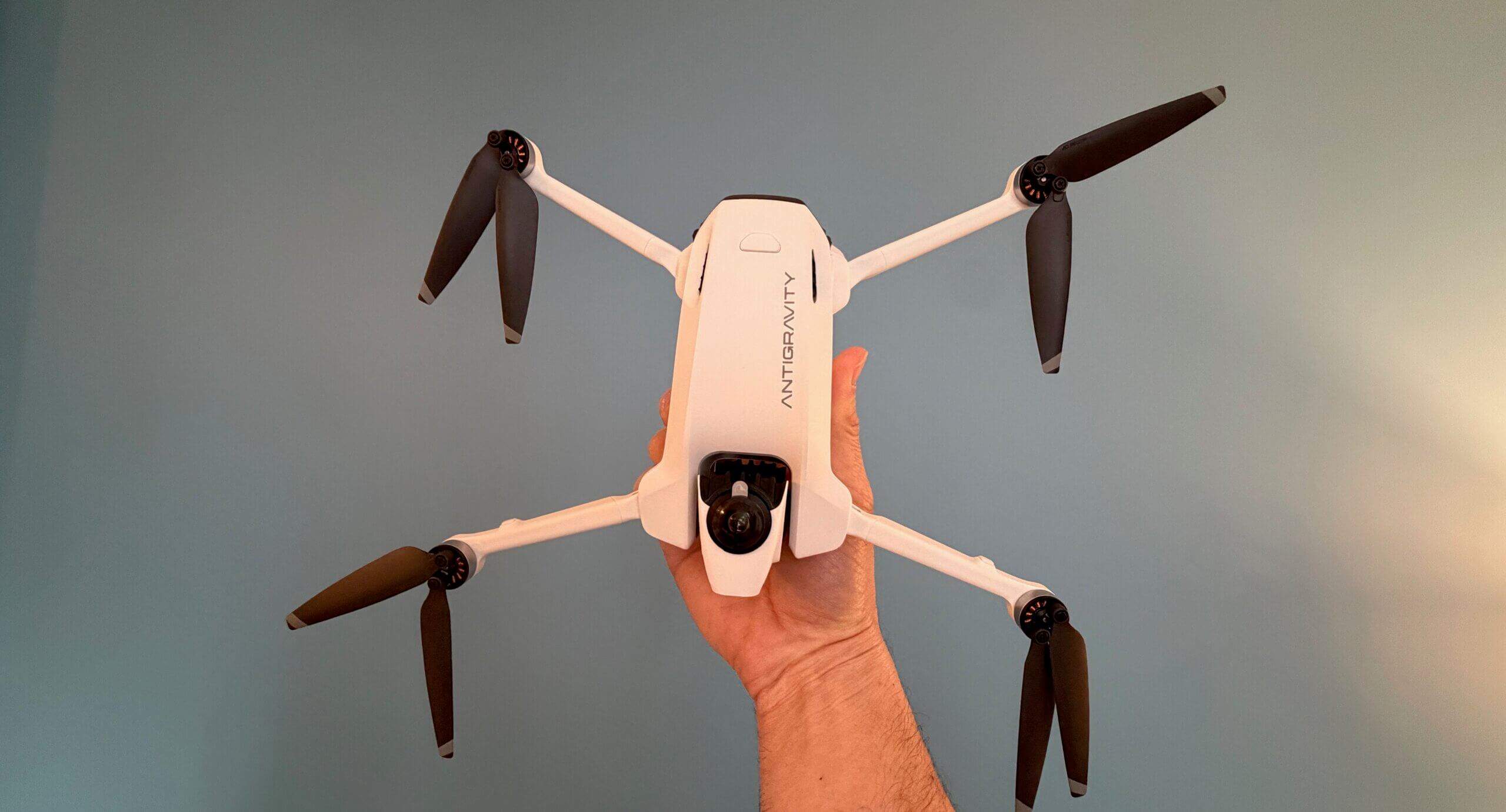
The defining engineering characteristic of the Antigravity 360 platform is its dual-lens configuration. While standard consumer drones rely on a single, forward-facing camera mounted on a mechanical gimbal, the A1 utilizes two ultra-wide-angle lenses positioned symmetrically on the top and bottom of the central fuselage. Each lens captures a staggering 200-degree field of view. When the internal software stitches these overlapping video feeds together, it creates a seamless, spherical 360-degree environment.
A remarkable byproduct of this dual-lens system is the digital removal of the drone itself in the final exported footage. Without a protruding landing gear or body blocking the frame, the video creates the distinct optical illusion of a standalone camera floating untethered in mid-air, supported by nothing visible.
Beneath these lenses lie 1/1.28-inch CMOS sensors. While marginally smaller than the full 1-inch sensors found in select professional-tier photography drones, they are significantly larger than the sensors typically embedded in standard 360-degree action cameras. This physical advantage translates directly into superior low-light performance and an expanded dynamic range. Creators can capture complex lighting scenarios—retaining intricate details in both brilliant highlights and deep shadows—that would otherwise be washed out or crushed under the harsh glare of a midday sun.
Regulatory frameworks worldwide typically mandate that any unmanned aerial vehicle weighing 250 grams or more must be officially registered and subjected to significantly stricter operational restrictions. Recognizing this critical regulatory threshold, Antigravity engineered the A1 to tip the scales at precisely 249 grams when outfitted with its standard battery. By keeping it one gram under the legal threshold, the manufacturer ensures that casual operators and travelers can fly the device without navigating tedious registration requirements in many jurisdictions.
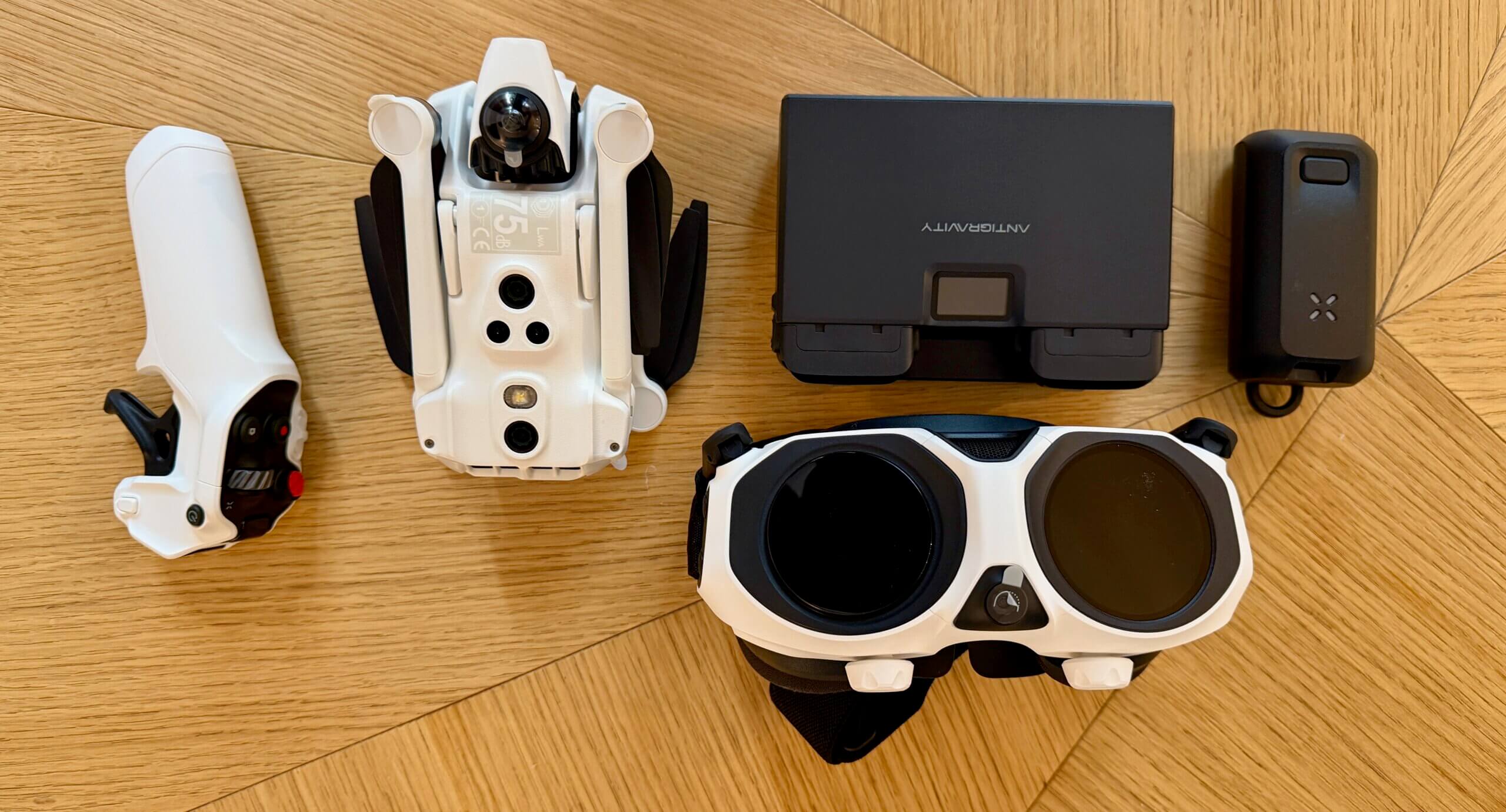
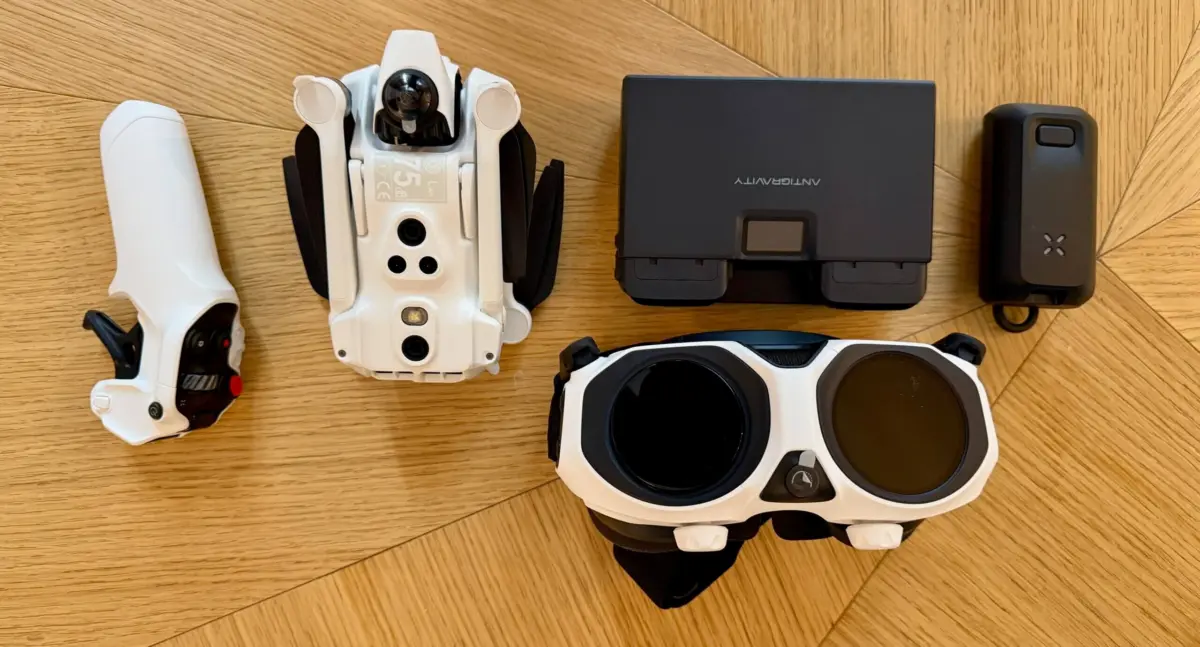
Furthermore, the physical build of the aircraft exudes durability. It is constructed from a high-grade carbon-fiber-reinforced polymer, providing a superior strength-to-weight ratio compared to the standard ABS plastic frequently utilized in more budget-friendly models. The mechanical folding arms snap into place with a satisfying, tactile precision that implies robust long-term reliability. When fully collapsed for transport, the fuselage measures roughly the dimensions of a large smartphone, albeit approximately three times as thick.
The Flight Experience and Control Mechanics
Piloting the Antigravity A1 relies heavily on its accompanying ecosystem, particularly the specialized vision goggles. Sleek and lightweight, these headsets feature dual 4K micro-OLED displays boasting a fluid 120Hz refresh rate. Visual latency is kept to virtually zero, and the system incorporates responsive integrated head-tracking technology. Because the drone continuously records in a full 360-degree sphere, the pilot is never restricted to viewing merely what lies directly ahead of the aircraft’s nose. Turning one’s head to the left instantly pans the visual feed to the left, while looking downward reveals the terrain passing directly underneath. This immersive setup generates a profound sense of spatial presence that simply cannot be replicated by traditional fixed-camera drones.
Flight control is managed via a single-handed motion controller. Operators point the device intuitively toward their desired destination and pull a trigger to accelerate. Tilting the wrist causes the drone to bank laterally, while raising or lowering the nose of the controller commands altitude adjustments. This streamlined scheme allows absolute novices to navigate intricate spaces proficiently within minutes of taking off. However, for veteran FPV (First Person View) pilots who demand the absolute precision of manual acrobatic flight, the A1 also supports a traditional "Mode 2" dual-stick controller. Despite this alternative, the fluidity of the motion control system is such that most users will find little reason to revert to legacy sticks.
Camera Performance and Software Capabilities
The marketing materials for the Antigravity 360 proudly highlight "8K Resolution," though this metric functions differently than it does in traditional videography. In a standard single-lens camera, 8K resolution packs every individual pixel into a conventional 16:9 rectangular frame. In a 360-degree video ecosystem, those same pixels are distributed across the surface of a complete geometric sphere. When a creator "reframes" that spherical 8K recording into a standard flat video export, the final file represents a cropped subset of the total image capture.
Despite this technical distinction, the camera’s underlying color science represents a substantial leap forward from older generations of 360 hardware. The A1 includes a vibrant default profile tailored for social media creators seeking punchy, ready-to-publish colors, alongside a professional 10-bit Log profile. The latter option provides color graders with the flexibility needed to seamlessly match A1 footage with primary cinema cameras in a post-production suite. Additionally, stabilization is managed by Antigravity’s proprietary FlowState algorithms, which perform remarkably well; users can pilot the aircraft steadily through 20-mph gusts, and the resulting video remains as steady as if captured from a stationary tripod.
Once footage is captured, the Antigravity Studio companion application facilitates wireless video downloads at speeds reaching up to 80 megabytes per second. Users can reframe their projects simply by manipulating their mobile device, utilizing the phone’s internal gyroscope to "film" the scene dynamically in real-time. For solo creators operating without a dedicated production crew, the app’s AI-driven Auto-Frame feature automatically identifies primary subjects and generates smooth, professional cuts that keep targets locked in focus throughout the sequence.
Battery Life and Operational Dynamics
Battery technology remains the fundamental physical bottleneck for all lightweight unmanned aircraft. The A1’s standard Intelligent Flight Battery yields a theoretical maximum of 24 minutes of airborne time under optimal conditions. In practical, real-world scenarios involving moderate winds and continuous recording, operators should anticipate closer to 19 or 20 minutes of actual flight.
While twenty minutes may sound brief, the "work-per-minute" metric is considerably higher than that of a traditional drone. Because operators do not need to fly identical flight paths repeatedly to capture differing directional angles, a single 20-minute session can frequently yield as much usable footage as three separate flights with a conventional camera drone. For creators requiring extended airtime, an optional Pro Battery pushes total flight duration to an impressive 39 minutes, though the added mass slightly dampens the aircraft’s physical agility.
Aerodynamically, the A1 performs akin to a cinewhoop-style flyer, prioritizing stable, predictable movement over aggressive, twitchy acceleration. With a top speed capped at approximately 36 miles per hour, it is sufficiently swift to keep pace with cycling or driving subjects, though it cannot compete with specialized racing drones. A particularly welcome inclusion is "Turtle Mode," which allows the aircraft to autonomously flip itself upright using its propellers if it happens to land upside down during a crash, sparing the operator an inconvenient retrieval walk.
The Antigravity 360 (A1) stands out as a genuinely transformative release in the consumer drone market. By eliminating the mechanical complexities of gimbals and removing the anxiety associated with real-time manual framing, the device liberates creators to concentrate entirely on narrative storytelling. While ultimate optical resolution may still trail behind ultra-expensive cinema drones and the lenses require careful handling to avoid scratches, these are minor compromises for the vast creative freedom the platform delivers, successfully bridging the gap between traditional aerial cinematography and immersive visual media.