In the modern enterprise, data infrastructure operates at a scale and velocity that makes manual tracking virtually impossible. A dashboard suddenly displays a metric that defies business logic, a compliance regulator demands immediate proof regarding the provenance of a specific data point, or an essential data pipeline suffers a catastrophic failure in the dead of night. In almost every one of these high-pressure scenarios, engineers, analysts, and compliance officers are ultimately forced to confront the exact same fundamental question: where did this data actually come from?
To eliminate the costly delays of manual investigation, the Precisely Data Integrity Suite has introduced an automated approach to data lineage that addresses the complexity of modern cloud ecosystems. By seamlessly incorporating two distinct lineage methodologies—static and operational—the platform provides organizations with a continuous, end-to-end map of their data landscape. This automated system tracks information from its raw origin through every transformation layer, all the way to the business dashboards and reports where enterprise decisions are made.
The challenge of data provenance has grown exponentially as companies adopt multi-cloud environments, modern data stack tools, and complex analytics pipelines. Without a unified view, IT and data governance teams find themselves managing isolated islands of information. A business intelligence tool like Tableau understands its own connected dashboards, while data transformation engines and cloud platforms track their respective workloads. However, connecting those fragments into a coherent narrative has historically required exhaustive manual effort and custom documentation that quickly becomes outdated.
The Precisely Data Integrity Suite solves this structural visibility gap by capturing lineage at both the definition and execution levels, offering organizations deep column-level granularity that transforms raw metadata into actionable intelligence.
Static Lineage: Derived from Metadata
To understand how data flows across an enterprise, data teams must first examine how systems define their relationships. Certain lineage questions can be answered definitively through metadata definitions alone without requiring any execution logs. For instance, business intelligence platforms typically maintain records of which underlying tables feed specific dashboards, while data factory pipelines inherently document what information they read and write. Static lineage captures these foundational relationships directly from the source.
This approach works by establishing a connection to a data source and extracting built-in metadata definitions, including database schemas, table structures, and explicit transformation rules. When an organization catalogs a connection, the Data Integrity Suite automatically queries the source system, reads these structural definitions and relationships, and stores them within a centralized catalog as a normalized lineage graph.
One of the primary advantages of static lineage is its operational efficiency. Because it does not require running production workloads or capturing real-time events, static lineage can successfully extract tracking information from legacy sources or older systems that were never originally configured with runtime observability features. It captures the intended architecture of the data ecosystem, mapping out how databases, warehouses, and reporting tools are designed to interact with one another.

Operational Lineage: Captured from Execution
While static metadata provides a clear picture of how data systems are architected, many critical transformations occur dynamically at runtime. Certain lineage questions can only be answered by observing what actually happens when workloads execute. For example, when a data transformation model processes information between cloud data warehouse tables, there is often no traditional database definition to harvest from the host platform itself. Instead, the cloud database records the exact query executed during the job run in its system logs.
The Data Integrity Suite captures operational lineage by tapping directly into runtime execution records, such as the Snowflake ACCESS_HISTORY view and the Databricks system.access.column_lineage system tables, both of which update continuously as queries run in production. By leveraging these native execution histories, the platform gains visibility into dynamic data movements that static metadata definitions might otherwise miss.
Furthermore, operational lineage incorporates runtime events emitted by data orchestrators integrated with OpenLineage, an open-source standard for collecting lineage metadata. This integration significantly broadens tracking capabilities far beyond the natively supported sources within the Data Integrity Suite. Any external tool, script, or orchestrator capable of emitting OpenLineage events can contribute directly to the same unified lineage graph, ensuring that modern, modular data stacks are fully visible to governance teams.
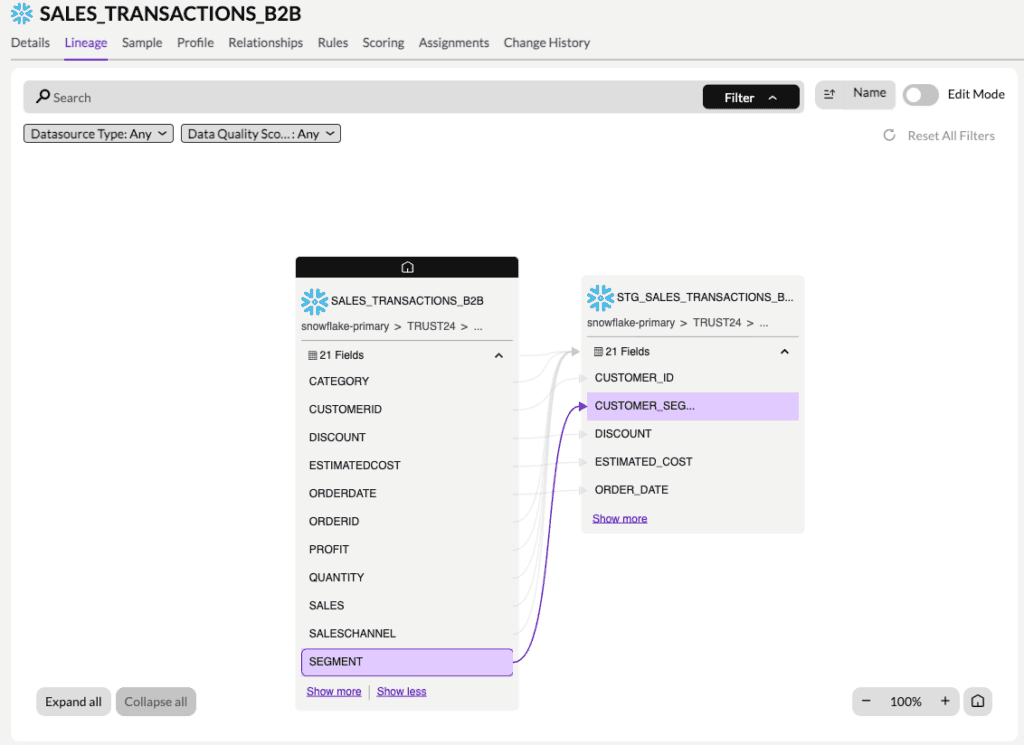
Crucially, both static and operational lineage operate at the field and column level rather than remaining restricted to broad dataset or table-level summaries. Knowing which specific output column in an executive report traces its values back to a particular source column provides a level of precision that is essential for accurate troubleshooting, regulatory reporting, and impact analysis.
Stitching Fragmented Landscapes Into a Unified View
Within the Data Integrity Suite, comprehensive data lineage is built through a continuous process of metadata harvesting and automated stitching. When users configure connections for different data sources across the enterprise, the platform collects static and operational lineage at the column level and persists these insights within its centralized Data Catalog.
Initially, this information exists as fragmented pieces. An enterprise data warehouse understands its internal query history, and a reporting application knows its specific data sources, but neither system possesses native awareness of the other. As the Data Integrity Suite processes these disparate sources, it utilizes intelligent placeholder mechanisms when it encounters references to assets that have not yet been cataloged. These placeholders hold the lineage relationship open until the corresponding asset is eventually integrated into the catalog, at which point the fragments connect and the overarching lineage graph expands.
Over time, as more systems are cataloged, these disconnected islands merge into a continuous, end-to-end map. A fully realized lineage view might track data seamlessly from Amazon S3 object storage, through complex Snowflake transformations, and onward to Qlik Cloud analytics dashboards. This unified perspective is generated automatically and maintained dynamically, ensuring that the lineage map adapts as the underlying cloud environment evolves.
Lineage Across the Data Integrity Suite
The true value of automated data lineage multiplies significantly when it is integrated with the broader capabilities of an enterprise data platform. Within the Data Integrity Suite, lineage serves as an operational bridge connecting data quality, governance, business terminology, and compliance.
When an automated data quality rule flags an anomaly or fails entirely, teams no longer need to embark on a time-consuming scavenger hunt to find the root cause. By tracing lineage upstream from the failing column, engineers can quickly identify the exact source system, ingestion script, or transformation pipeline that introduced the error. Conversely, impact analysis utilizes the exact same lineage graph to answer critical planning questions before alterations are made, allowing database administrators and data engineers to evaluate what might break if a table structure or column definition is modified.
Enterprise business terms are frequently rendered ineffective if they cannot be reliably connected to physical data assets. The platform’s Business Glossary establishes standardized definitions for governed terminology such as "Net Revenue" or "Active Customer" across the organization. Data lineage bridges the gap between abstract business definitions and technical implementation by tracing those governed terms all the way down to the physical columns that produce or consume the data.
This deep traceability extends naturally to data sensitivity and compliance requirements. When a column is tagged as sensitive or personally identifiable at its origin, that classification can be tracked forward through every downstream transformation and dashboard that inherits the data. For compliance teams operating under stringent financial-services regulations and data privacy laws, this capability delivers unprecedented visibility into where regulated data lives, how it is processed, and where it travels across the enterprise architecture.
Why Automated Data Lineage Matters for Governance and Trust
Modern organizations should not be forced to launch exhaustive manual investigations every time an unexpected data discrepancy arises or an external audit is announced. The Precisely Data Integrity Suite addresses this operational friction by automating the collection and maintenance of data lineage across business intelligence tools, extraction pipelines, databases, and multi-cloud platforms.
By combining static lineage—which captures architectural intent—with operational lineage—which captures real-world execution—the platform bridges the historical gap between how data systems are designed and how they actually perform. Supported by granular column-level tracking and deep integrations with data quality rules, business glossaries, and security classifications, automated data lineage transitions from a passive catalog artifact into an essential foundation for enterprise governance and institutional trust.