The United Kingdom has officially levied severe economic sanctions against Cryptomus, a chameleon-like cryptocurrency payment platform that cybersecurity and blockchain intelligence experts identify as a central conduit for laundering funds derived from ransomware attacks, narcotics trafficking, darknet markets, digital fraud, and cybercrime services. According to authorities and investigators, the platform’s operations have actively assisted the Russian government and associated financial institutions in circumventing international financial restrictions imposed in the wake of the ongoing war.
Announced on October 8, the U.K. sanctions target Cryptomus—which has operated under various corporate aliases, including Certa Payments and Xeltox Enterprises—for processing illicit financial transactions that ultimately benefit the Russian state and its restricted financial infrastructure. The sweeping regulatory action freezes any assets held by Cryptomus within British banks and legally bars all British companies and citizens from engaging in commercial activities or providing virtual services to the platform. Alongside Cryptomus, the U.K. government also targeted several other virtual payment platforms and services implicated in similar activities, specifically naming VexPay, TokenSpot, and the Tsunami Payments service.
The targeting of Cryptomus highlights a persistent challenge in global financial regulation: digital asset platforms that repeatedly rebrand, shift operational domains, and exploit regulatory loopholes to sustain high-volume illicit transactions. Investigative findings previously published in December 2024 by security researcher Brian Krebs revealed that Cryptomus served as a critical payment processor for dozens of Russian cryptocurrency exchanges and underground websites hawking specialized cybercrime tools and services. Since emerging in the digital landscape in 2022, the platform has systematically changed its corporate identity multiple times. Most recently, following a record-breaking enforcement action by Canadian authorities, the platform launched a parallel service under the name "Heleket."

Major blockchain analysis firms have emphasized that the U.K. sanctions strike directly at the complex infrastructure underpinning Russia’s wartime economy. In an October 8 blog post addressing the regulatory measures, blockchain data-crunching giant Chainalysis noted that Cryptomus and its successor entity Heleket had evolved into premier payment hubs for illicit financial activity on a global scale. According to Chainalysis data, these interconnected services received higher volumes of illicit funds across tracked categories than traditional cryptocurrency mixers in their dataset, with the number of unique illicit counterparties surging past 900 in a single month during late 2025.
Independent investigations by other premier blockchain intelligence firms have further underscored the vast scale of illicit funds moving through the platform. In April 2026, TRM Labs published findings indicating that Cryptomus had processed more than $7 billion in total cryptocurrency transactions since its inception in 2022. This massive transaction volume included capital directly linked to vendors of child sexual abuse material, international terrorist financing networks, and human trafficking operations. TRM Labs also observed that while Cryptomus experienced a temporary cratering in transaction volume after instituting stricter "know your customer" (KYC) compliance policies, the platform deftly circumvented regulatory pressure by deploying Heleket as a parallel, no-KYC payment processing alternative.
Richard Sanders, an experienced blockchain analyst and investigator who spent months mapping out the intricate payment infrastructure of Cryptomus and transacting directly with its customer base, noted that the U.K. sanctions represent a critical turning point in international law enforcement. Sanders pointed out that while Canada had previously levied a historic CAD $176 million fine against Cryptomus for severe anti-money laundering violations, monetary penalties alone are often insufficient to stop determined cybercrime-friendly enterprises.
Writing on LinkedIn, Sanders emphasized the profound tactical difference between financial fines and targeted government sanctions. A financial fine, he explained, does not inherently stop a digital asset payment processor from continuing to process transactions, whereas comprehensive sanctions effectively dismantle the operational capacity of the enterprise. This distinction, Sanders argued, makes the British action uniquely impactful, especially given that Canada’s massive fine ultimately proved difficult to enforce and collect.

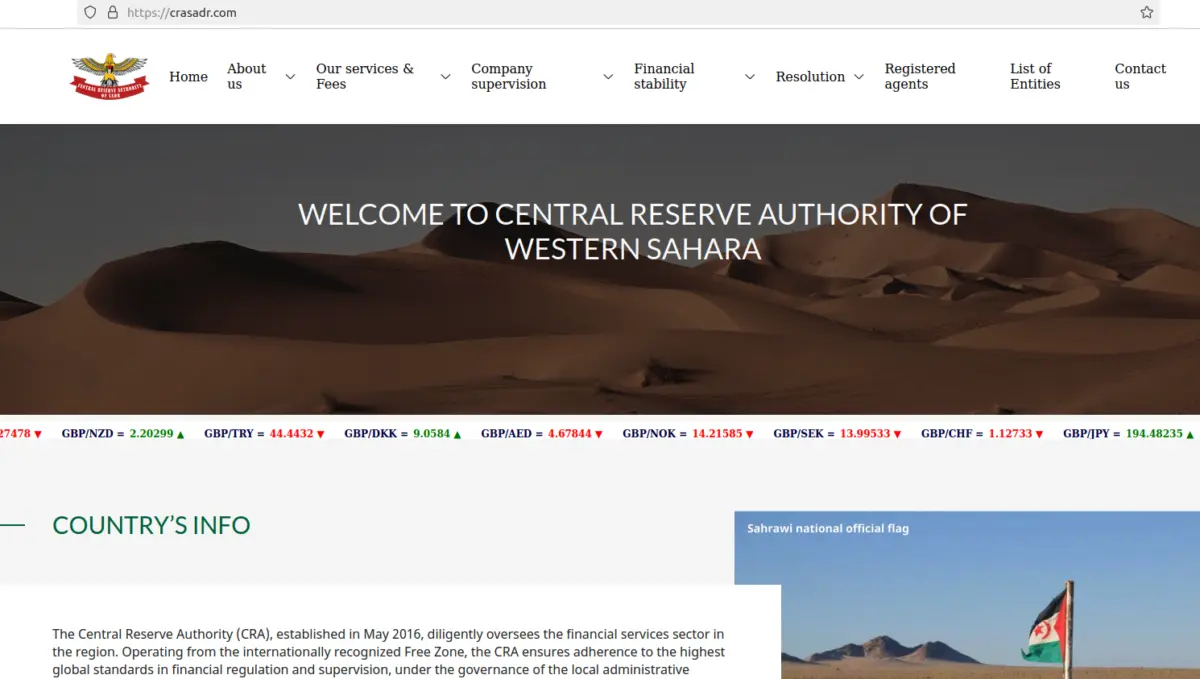
The investigation into Cryptomus has continually exposed bizarre corporate structures and unusual regulatory justifications. In its 2024 investigation, Krebs on Security traced the corporate lineage of Cryptomus back to Certa Payments, finding that the sole shareholder of the parent company was a 25-year-old Ukrainian woman. This individual simultaneously headed several other corporate entities, including the WS Management and Advisory Corporation. This particular organization billed itself as an exclusive regulatory body responsible for issuing licenses to cryptocurrency businesses, foreign exchange brokers, and online gaming operations incorporated within the Western Sahara, a disputed region in northwest Africa that is not widely recognized as a sovereign nation.
Further digital forensics revealed the operational mechanics behind this pseudo-regulatory framework. The official website of the supposed regulatory body, operating under the domain crasadr.com, explicitly claimed to assist applicants with corporate formation, bank setups, online gaming permits, and foreign exchange brokerage licensing. Furthermore, historical infrastructure analysis showed that one of Certa Payments’ former web properties shared a server hosting environment with twelve distinct domains, including rasd-state.ws, which served as the online portal for the so-called Central Reserve Authority of the Western Sahara.
The U.K. sanctions against Cryptomus and its affiliates also mark a significant diplomatic and enforcement milestone among Western intelligence and law enforcement allies. According to blockchain investigators, this enforcement action is the first known instance where a member of the "Five Eyes" intelligence-sharing alliance—comprising Australia, Canada, New Zealand, the United Kingdom, and the United States—has formally sanctioned a cryptocurrency operation that was originally incorporated within the jurisdiction of another Five Eyes partner country.
As international regulators increasingly align their sights on cross-border crypto laundering operations tied to geopolitical conflicts and organized crime, the coordinated crackdown on Cryptomus, Heleket, TokenSpot, VexPay, and Tsunami Payments signals a diminishing tolerance for digital asset platforms that operate as financial lifelines for sanctioned states and underground cybercrime syndicates. With its British asset freezes now in effect and its network severely disrupted, the multi-aliased platform faces unprecedented operational hurdles as global authorities close in on its infrastructure.