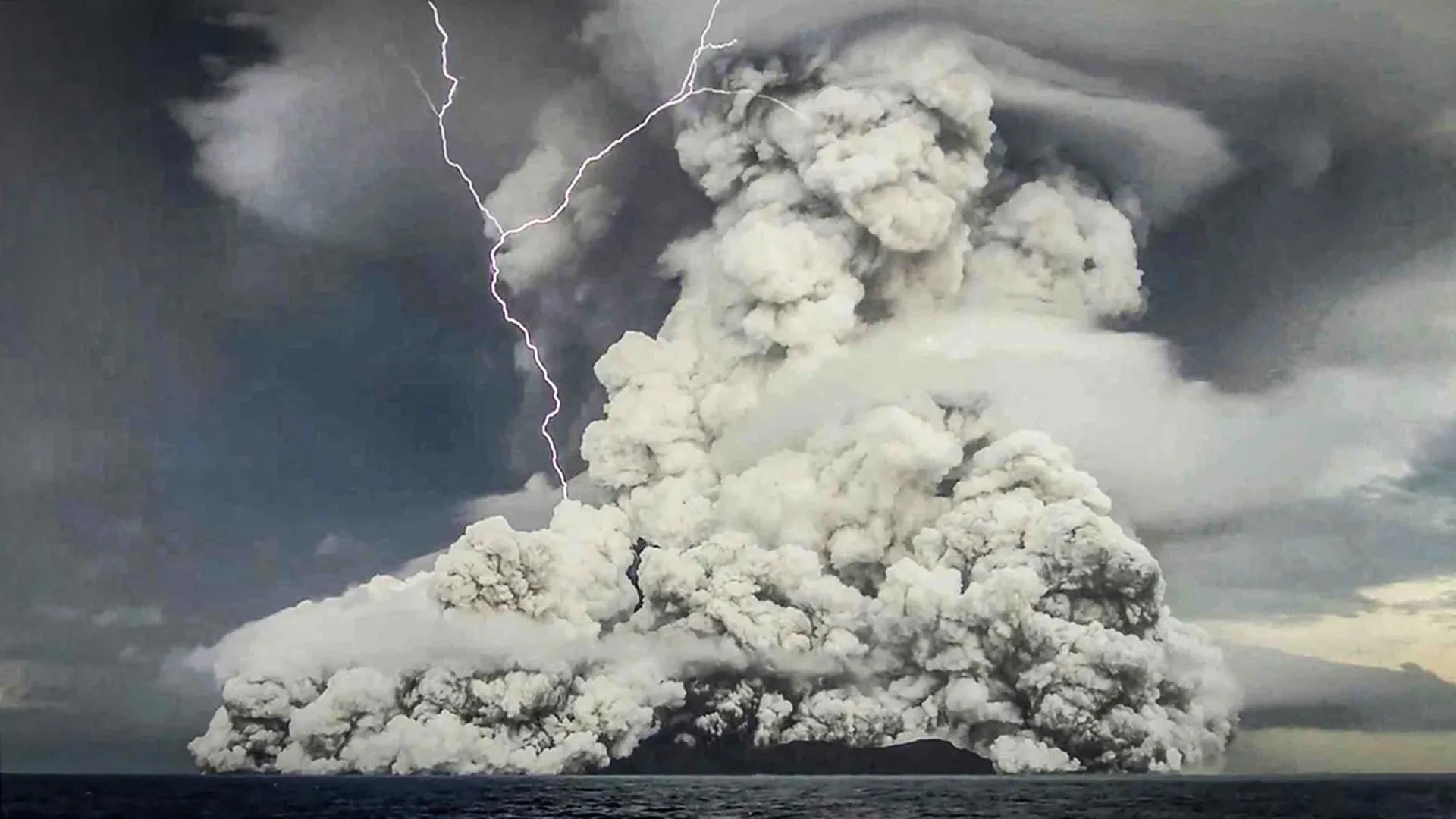
When the Hunga Tonga-Hunga Ha’apai volcano erupted beneath the South Pacific waves in January 2022, the cataclysmic explosion sent shockwaves around the globe and ranked among the most powerful volcanic events of the modern era. While scientists immediately recognized the sheer scale of the geological disruption, researchers have now uncovered a completely unexpected consequence of the event. It turns out that the enormous volcanic cloud did not just inject massive amounts of material into the atmosphere; it also appears to have helped destroy some of the methane pollution produced by the volcano itself.
This groundbreaking finding could carry profound implications that extend far beyond a single underwater eruption. The scientific community has grown increasingly focused on identifying innovative ways to reduce atmospheric methane, a potent greenhouse gas that drives global warming at an alarming rate yet disappears from the atmosphere much faster than carbon dioxide. Understanding how nature can occasionally accelerate that chemical removal process could eventually assist researchers in developing novel strategies for slowing near-term global warming and mitigating rapid climate shifts.
A Strange Signal in the Volcano Cloud
Researchers made this unexpected discovery by carefully analyzing satellite observations of the colossal plume generated by the January 2022 eruption. Within the data, they detected exceptionally high levels of formaldehyde, a chemical compound that provided an invaluable forensic clue about the complex reactions occurring inside the volcanic cloud.
In atmospheric chemistry, formaldehyde is produced briefly as an intermediate step during the natural reactions that break methane molecules apart. Because formaldehyde has a very short lifespan and degrades quickly, discovering unusually large quantities of it acts as a reliable chemical fingerprint. It signals unequivocally that methane destruction is actively and continuously taking place.
"When we analyzed the satellite images, we were surprised to see a cloud with a record-high concentration of formaldehyde. We were able to track the cloud for 10 days, all the way to South America. Because formaldehyde only exists for a few hours, this showed that the cloud must have been destroying methane continuously for more than a week," explains Dr. Maarten van Herpen from Acacia Impact Innovation BV, who served as the first author of the new study, which was published in the journal Nature Communications.
"It is known that volcanoes emit methane during eruptions, but until now it was not known that volcanic ash is also capable of partially cleaning up this pollution," he adds.
Calculations performed by the research team indicate that the volcano released roughly 300 gigagrams of methane during the explosive event. That total is roughly equivalent to the annual methane emissions produced by more than two million cows. Yet, simultaneously, the towering plume removed approximately 900 megagrams of methane per day, a daily consumption rate that is also comparable to the emissions of two million cows.
Salt, Sunlight and Unexpected Chemistry
The scientific explanation behind this atmospheric phenomenon involves an unusual and potent combination of volcanic ash, seawater, and intense sunlight. The foundational chemistry driving this process was actually first identified by researchers in 2023, though it was observed in a vastly different environmental context.
During that earlier research, scientists discovered that Saharan dust blown across the Atlantic Ocean can mix thoroughly with sea salt whipped up by breaking ocean waves. Together, these airborne materials combine to form microscopic particles known as iron salt aerosols, which remain suspended throughout the lower atmosphere. When sunlight strikes these aerosol particles, complex chemical reactions are triggered that release highly reactive chlorine atoms.
Because chlorine is intensely reactive, it aggressively attacks methane molecules, helping to break them apart and neutralize their greenhouse gas potential. This discovery added a previously underappreciated mechanism to scientists’ understanding of tropospheric chemistry, illuminating how natural airborne dust interacts with the lowest layer of Earth’s atmosphere where daily weather occurs.
"What is new — and completely surprising — is that the same mechanism appears to occur in a volcanic plume high up in the stratosphere, where the physical conditions are entirely different," notes Professor Matthew Johnson from the Department of Chemistry at the University of Copenhagen, who is one of the key researchers behind both discoveries.
The Hunga Tonga eruption created exceptionally favorable conditions for this specialized chemistry to unfold. Because the volcano exploded forcefully beneath the ocean surface, it blasted colossal quantities of salty seawater upward alongside vast clouds of pulverized volcanic ash. A significant portion of this mixture was driven high up into the stratosphere, the atmospheric layer sitting directly above the troposphere.
Researchers propose that as unfiltered sunlight struck this high-altitude mixture of ash and sea salt, it generated large amounts of reactive chlorine. Those chlorine atoms subsequently reacted with the methane present in the plume, successfully destroying a portion of the greenhouse gas released by the eruption itself. The extraordinary concentrations of formaldehyde detected from space provided the definitive chemical evidence that this extraordinary process was actively occurring.
Why Destroying Methane Matters
Methane currently accounts for approximately one third of all global warming. Although it is present in the atmosphere in far smaller quantities than carbon dioxide, methane traps heat with terrifying efficiency. Measured over a 20-year timescale, methane is roughly 80 times more potent at warming the planet than carbon dioxide.
At the same time, there is a fundamental difference in how long these two primary greenhouse gases persist. Methane typically remains in the atmosphere for about a decade before natural chemical reactions remove it, whereas a significant portion of carbon dioxide can influence the global climate for centuries or even millennia.
That relatively short atmospheric lifespan makes methane an exceptionally attractive target for rapid climate intervention. Successfully cutting methane emissions today could begin producing a noticeable, cooling benefit within roughly a decade. For this reason, climate scientists frequently describe methane reduction as an "emergency brake" on global warming, noting that rapidly lowering atmospheric methane levels could help curb temperature spikes over the coming decades and potentially reduce the risk of crossing dangerous climate tipping points.
Researchers emphasize, however, that reducing methane is by no means a substitute for curbing carbon dioxide emissions. Long-term temperature stabilization and climate health still ultimately require profound, sustained reductions in CO2 output.
Could Scientists Copy What the Volcano Did?
The newly published findings could also provide valuable inspiration for engineers, researchers, and climate technology companies currently investigating methods to deliberately accelerate methane destruction on a global scale.
An emerging field of climate research focuses heavily on atmospheric methane removal. Instead of merely working to prevent new methane from entering the atmosphere, scientists are actively exploring whether engineered chemical processes could safely increase the breakdown rate of methane already present in the air. The Hunga Tonga eruption may have provided a dramatic, large-scale natural demonstration of one such viable mechanism.
A major hurdle in this field, however, is proving beyond a shadow of a doubt that any proposed technology actually removes the targeted methane. Atmospheric methane is widely dispersed across enormous volumes of air, making relatively small changes notoriously difficult to measure with statistical confidence.
"How do you prove that methane has been removed from the atmosphere? How do you know your method works? It’s very difficult. But here we address that problem by showing that methane breakdown can in fact be observed using satellites," explains Dr. Jos de Laat from the Royal Netherlands Meteorological Institute, who served as the senior author of the study.
The findings may also force atmospheric scientists to reconsider how they calculate the global methane budget. The methane budget functions essentially as an environmental accounting system, where scientists estimate how much methane enters the air from natural and anthropogenic sources—such as wetlands, agriculture, fossil fuel extraction, and geological activity—and compare those figures with the amount removed through atmospheric chemistry and other sinks.
According to the research team, atmospheric dust has not historically been fully incorporated into those global calculations. If volcanic ash and other forms of mineral dust can significantly accelerate methane destruction, existing estimates regarding how methane moves through and interacts with the atmosphere may require meaningful adjustments.
"We now know that atmospheric dust — for example from a volcanic eruption — impacts the methane budget, meaning the budget of how much methane is added to the atmosphere and how much is removed. Because dust has not previously been taken into account, it is important that we correct the data on which these estimates are based," Matthew Johnson states.
Satellites Watched the Chemistry Unfold
To uncover these dynamics, the research team relied heavily on precise measurements gathered by TROPOMI, an advanced atmospheric monitoring instrument deployed aboard the European Space Agency’s Sentinel-5P satellite. TROPOMI orbits the Earth and scans the atmosphere daily, tracking trace gases closely linked to air pollution and global climate change.
Detecting formaldehyde inside a high-altitude stratospheric volcanic plume, however, pushed the sophisticated instrument well beyond the standard operating conditions for which its routine measurements were originally designed.
"Retrieving formaldehyde from TROPOMI in a stratospheric volcanic plume is far outside the instrument’s standard operating conditions — we had to carefully correct the satellite’s sensitivity for the unusual altitude of the signal and account for interference from the high sulfur dioxide concentrations. Getting these corrections right was essential to confirm that what we were seeing was real," noted Dr. Isabelle De Smedt of the Royal Belgian Institute for Space Aeronomy.
Implementing these meticulous corrections allowed the research team to confirm that the unusually strong formaldehyde signal was entirely genuine, validating its use as a reliable tracer for tracking methane destruction within the drifting volcanic cloud.
The research team believes these insights could encourage industry engineers to investigate whether the natural chemistry observed in the wake of the Hunga Tonga eruption can be replicated safely and effectively in controlled settings.
"It’s an obvious idea for industry to try to replicate this natural phenomenon — but only if it can be proven to be safe and effective. Our satellite method could offer a way to help figure out how humans might slow global warming," concludes Matthew Johnson.
Any future attempt to intentionally manipulate atmospheric chemistry would naturally demand rigorous study to fully understand potential unintended ecological consequences. Nevertheless, the Hunga Tonga event provides the scientific community with an unprecedented real-world example of methane destruction occurring on a massive scale, alongside a proven framework for monitoring the chemical process from space.
The scientific study was published in the journal Nature Communications. The international research team includes Maarten van Herpen of Acacia Impact Innovation BV in the Netherlands; Isabelle De Smedt of the Royal Belgian Institute for Space Aeronomy in Belgium; Daphne Meidan and Alfonso Saiz-Lopez of CSIC in Spain; Matthew Johnson of the University of Copenhagen in Denmark; Thomas Röckmann of Utrecht University in the Netherlands; and Jos de Laat of the Royal Netherlands Meteorological Institute in the Netherlands. The research received financial support from Spark Climate Solutions.