Artificial intelligence has officially transitioned from a side initiative into a core force shaping enterprise data strategy in real time. Across industries, predictive, generative, and Agentic AI are moving rapidly from experimentation to expectation, transforming how organizations approach operational efficiency and technological growth. Yet, as a major new industry study reveals, this widespread momentum masks a complex web of structural challenges that could threaten long-term success if left unaddressed.
According to the 2026 State of Data Integrity and AI Readiness report—published by Precisely in partnership with the Center for Applied AI and Business Analytics at Drexel University’s LeBow College of Business—more than half of data leaders, or 52%, report that artificial intelligence is now the primary force influencing their data programs. However, beneath this surface-level momentum, enterprise leaders have revealed two deeply connected realities: high levels of organizational confidence sitting alongside remarkably uneven operational preparedness.
Industry analysts emphasize that these are not separate issues. Instead, confidence and readiness amplify each other, and if organizations fail to address them directly, the resulting friction could undermine the very business outcomes they expect artificial intelligence to deliver. The data reveals a clear and recurring pattern across the global corporate landscape: confidence remains exceptionally high, while preparedness is patchy at best. It is precisely within this widening gap between perception and reality that organizational risk lives.
The Confidence-Reality Disconnect in AI Readiness
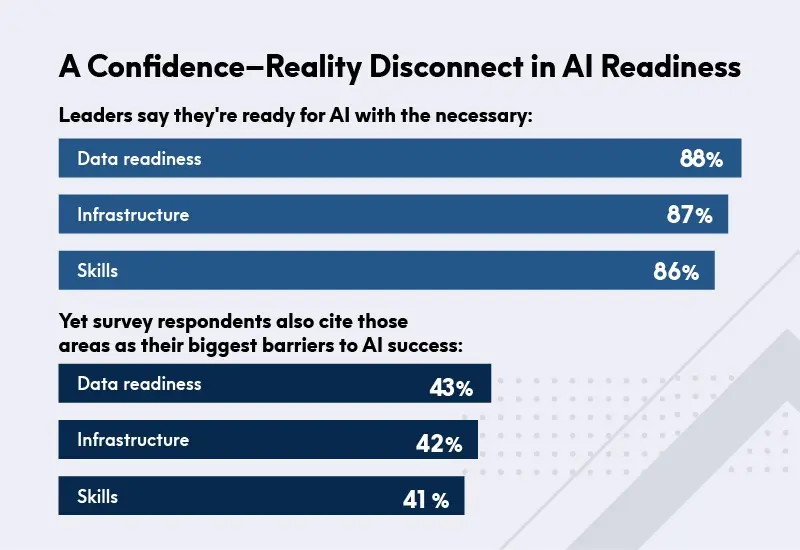
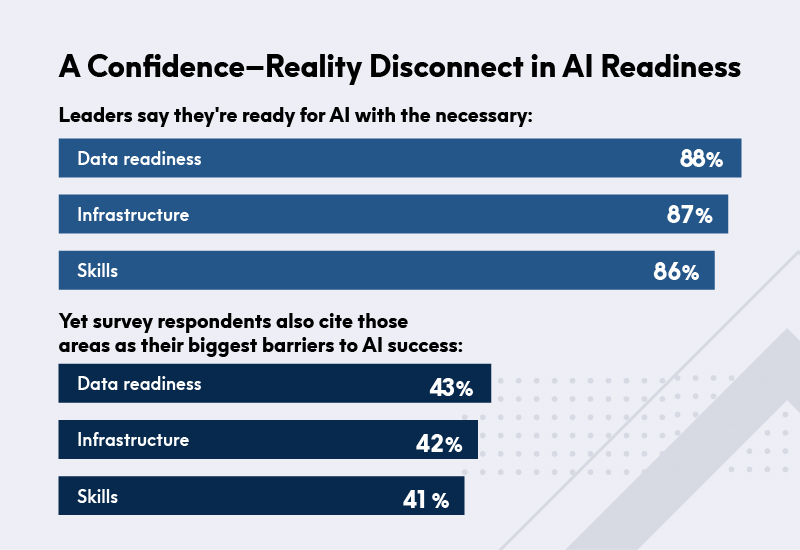
On the surface, corporate organizations appear remarkably ready for the artificial intelligence revolution. Eighty-eight percent of surveyed leaders claim they possess the necessary data readiness to support AI initiatives, 87% believe they have the required underlying infrastructure, and 86% state they have the appropriate workforce skills in place.
Paradoxically, those exact same areas are cited by those very same leaders as their single biggest obstacles to AI success: data readiness is flagged as a primary hurdle by 43%, infrastructure by 42%, and skills gaps by 41%. This represents a profound structural disconnect within modern corporate leadership.
Observers note that this phenomenon stems from measuring readiness at the wrong altitude. At a high strategic level, many organizations genuinely are ready. They have invested heavily in modern platforms, launched numerous pilot projects, secured executive budgets, and ensured that artificial intelligence aligns with broader corporate priorities—at least on paper.
In fact, 71% of leaders state that their AI strategy aligns with overarching business goals. Yet, beneath that high-level alignment, only 31% have established concrete metrics tied directly to hard business key performance indicators, such as revenue growth, cost reduction, or customer satisfaction. This is precisely where the disconnect becomes visible.

Artificial intelligence pilots frequently succeed in controlled, highly managed environments where the underlying data is heavily curated, feedback loops are exceptionally tight, and stakeholder expectations are carefully controlled. However, when these AI models transition out of the sandbox and into production across complex business functions, disparate systems, and diverse stakeholders, the underlying operational immaturity is exposed—often all at once. Without measurable business alignment, corporate prioritization quickly becomes fuzzy, funding becomes unstable, and promising prototypes stall out before they can ever mature into durable enterprise capabilities. Ultimately, genuine AI readiness depends on sustaining positive outcomes repeatedly and at scale.
Skills: The Hidden Multiplier and Risk Amplifier
The persistent skills gap is another major theme highlighted in this year’s report, though the underlying issue is considerably more complex than a simple hiring shortage. More than half of all leaders, standing at 51%, cite talent and skills as their top need for achieving comprehensive AI readiness, yet only 38% feel genuinely prepared with the appropriate staff skills and continuous training programs.
Crucially, the data shows that no single skill gap dominates the corporate landscape. Instead, the challenge is systemic, reflecting how deeply interconnected the technological and operational capabilities behind enterprise AI truly are. Scaling artificial intelligence successfully requires a broad array of specialized skill sets working in tandem across the entire organization, spanning engineering, data science, responsible AI practices, and core business operations.
Addressing this dynamic, Dr. Murugan Anandarajan, Professor and Academic Director at Drexel LeBow’s Center for Applied AI and Business Analytics, points out that the modern skills gap is not merely about a lack of isolated technical talent. Rather, it highlights an urgent need for professionals who can operate across data management, business strategy, and AI governance simultaneously. According to Anandarajan, this reality carries major implications for how both commercial enterprises and academic institutions must prepare the incoming workforce for the era of Agentic AI.
Among the most heavily underestimated competencies in the modern enterprise is the ability to connect abstract business intent directly to technical implementation. Professionals must be able to explain complex AI outcomes in terms that executives can act on, rather than simply admire from a distance. Without clear translation of artificial intelligence into tangible business outcomes, advanced models inevitably operate in dangerous isolation. Without rigorous governance, operational risks compound rapidly, and without precise measurement, return on investment remains purely aspirational.
Organizations Navigate AI Maturity Along Different Trajectories
The report also outlines a clear progression in how different organizations attempt to close the gap between initial AI readiness and long-term business outcomes, revealing that success depends heavily on the alignment between institutional readiness and stated corporate goals.
For organizations reporting low AI alignment—those rating their success in achieving objectives as "not at all" or "not well"—the primary challenge is rarely a shortage of cutting-edge tools or raw technical talent. Instead, the core issue is a lack of clear leadership direction. Corporate leaders frequently assume that gaps in infrastructure, cited by 23%, or internal skills, cited by 25%, are the root cause of their stagnation. However, the data demonstrates that a lack of executive mandate and strategic alignment is what truly stalls progress, leaving investments fragmented and unable to gain meaningful traction.
Meanwhile, mid-tier performers—organizations achieving their AI goals "somewhat"—generally understand what operational success looks like, but they lack the necessary resources to execute effectively. The report shows that these companies most commonly cite financial investment, at 22%, and workforce skills, at 23%, as their most significant operational barriers. At this intermediate stage, sustained progress depends entirely on building both the technical infrastructure and the human capabilities required to operationalize artificial intelligence across the broader business.
For high performers that are already achieving strong alignment and rating their goal achievement as "well" or "very well," the strategic focus shifts decisively from initiation to scale. These advanced teams have already established clear direction and early operational success. However, maintaining that momentum requires the continuous evolution of both infrastructure and internal skills. Even at this mature level, nearly half of organizational focus remains dedicated to strengthening these core capabilities, highlighting the reality that AI maturity is never a permanent finish line, but rather an ongoing, disciplined organizational discipline.
Moving From Momentum to Maturity
Perhaps the most revealing data point captured in the research centers on sheer corporate optimism. Thirty-two percent of enterprise leaders realistically expect to achieve a positive return on investment from artificial intelligence within the next six to eleven months, despite persistent, acknowledged gaps in governance, workforce skills, and outcome measurement.
Optimism itself is far from misplaced, but unchecked optimism without solid operational foundations can quickly become fragile, particularly as corporate expectations rise and external regulatory scrutiny intensifies. Achieving true AI readiness requires an integrated operating model that unifies robust data integrity, rigorous governance, clear business alignment, and continuous talent development. When these critical elements move forward together, organizational confidence and operational reality finally converge. When they remain misaligned, artificial intelligence projects inevitably remain trapped in permanent pilot mode—impressive to look at, but ultimately neither transformative nor durable.
As modern data leaders navigate this evolving landscape, their institutional role extends far beyond simply championing technological innovation. Their primary responsibility is to build long-term operational durability, ensuring that early proof-of-concept wins successfully translate into sustained enterprise value. As the findings of the 2026 report underscore, genuine AI readiness cannot simply be purchased off the shelf; it must be systematically earned through operational consistency, advanced capability, and deep organizational trust.