By Kanchi Batra
NEW DELHI — With the historic conclusion of negotiations on the India-EU free trade agreement in January 2026, international policymakers are shifting their gaze from high-level diplomacy to the complex, ground-level work of implementation. As markets and enterprises brace for sweeping economic changes, the central question remains: how can sweeping trade liberalisation be transformed into a dynamic, multi-layered partnership that delivers tangible, everyday benefits for businesses, institutions, and citizens alike?
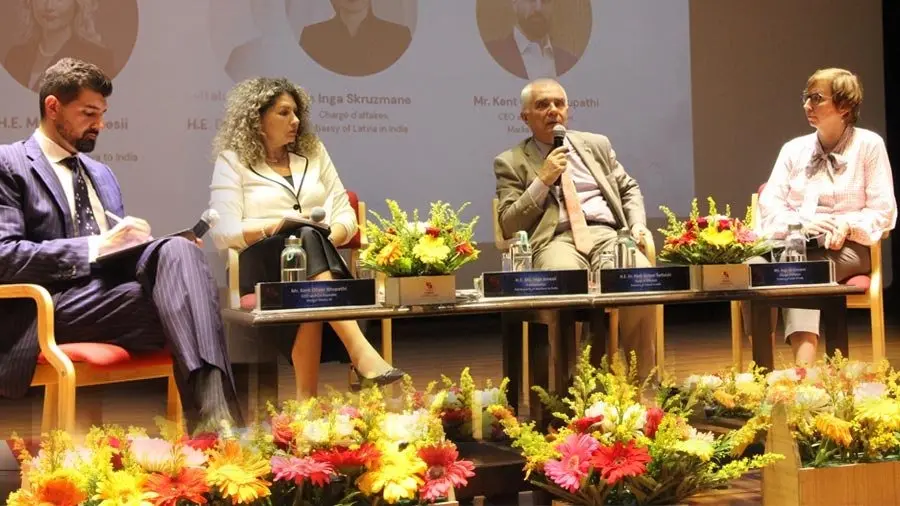
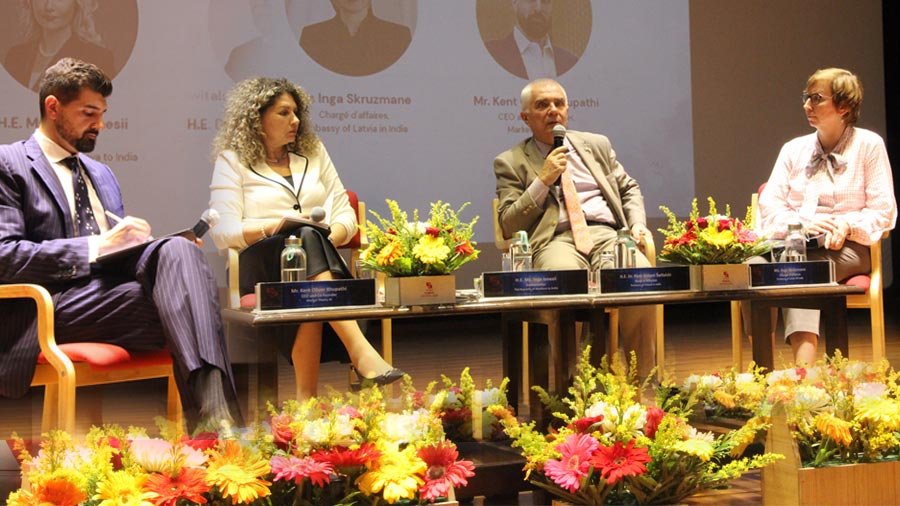
This pressing question took center stage at the India-EU Diplomatic Dialogue, organized by Diplomatist Magazine at Symbiosis International (Deemed University). Against the backdrop of an evolving global economy, diplomats representing Moldova, Poland, and Latvia gathered to examine how the landmark trade pact could successfully translate into accelerated investment, technological innovation, stronger logistical connectivity, and deeply rooted strategic engagement.
Moderated by Kent Oliver Bhupathi, CEO and co-founder of Market Theory AI, the panel discussion successfully bridged varied European geographical perspectives around a shared economic destiny. While Moldova offered vital lessons derived from its own path of economic integration with the European Union, Poland placed a strong emphasis on strategic cooperation, advanced technology, and resilient supply chain connectivity. Latvia, meanwhile, turned the spotlight onto critical tariff reductions, the empowering of smaller enterprises, and collaborative digital innovation.
What India Can Learn from Moldova’s Trade Experience
Opening the substantive dialogue, Kent Oliver Bhupathi posed a foundational question to H.E. Inga Ionesii, Ambassador of the Republic of Moldova to India: What crucial lessons does Moldova’s extensive journey of negotiating and implementing a trade agreement with the European Union hold for New Delhi?
Ambassador Ionesii responded by emphasizing that the primary lesson lies in clearly recognizing the sheer scale of economic opportunity unlocked by gaining unfettered access to a much larger, highly regulated market. Drawing directly from Moldova’s practical experiences under the Deep and Comprehensive Free Trade Area (DCFTA), she explained that closer structural and economic integration acts as a powerful catalyst. It encourages domestic businesses to drastically elevate their operational standards, systematically diversify their export portfolios, and expand their overall production capacities to meet international benchmarks.
Furthermore, the Ambassador stressed that such comprehensive agreements provide vital institutional support for cross-border investment and technology exchange. This dynamic empowers both participating economies to continuously upgrade their indigenous economic capabilities and institutional frameworks.
However, her detailed response also served as an important, pragmatic qualification to the widespread enthusiasm surrounding trade liberalisation. She noted that the ultimate success and tangible benefits of any such pact will not happen automatically; rather, they depend heavily on how proactively businesses and national institutions leverage the available mechanisms.
Bridging Strategic Ties: The Next Phase of India-Poland Relations
Shifting the geographical focus to Central Europe, Bhupathi asked Dr Piotr Antoni Świtalski, chargé d’affaires a.i. of the Republic of Poland in India, how both nations can effectively build upon their bilateral strategic partnership—established originally in 2024—to foster deeper, more practical cooperation.
Dr Świtalski asserted that stronger bilateral ties between New Delhi and Warsaw would inherently reinforce the broader, overarching relationship between India and the European Union. Expressing optimism that recent high-level political exchanges would inject fresh momentum into economic collaboration, he shared an ambitious goal: to double the current bilateral trade volume, which currently stands at approximately US$6 billion, well before the arrival of 2030.
To achieve this target, Dr Świtalski identified critical priority sectors, including defense, space exploration, artificial intelligence, high-technology manufacturing, and the rapidly expanding green economy. Crucially, he made a point to highlight that Polish corporations are not merely looking to treat India as a destination for simple export sales; instead, they are genuinely eager to forge deep, collaborative partnerships with Indian industrial counterparts.
Expanding the conversation to smaller enterprises, Bhupathi asked Ms Inga Skrūzmane, Chargé d’affaires at the Embassy of Latvia in India, what practical measures—beyond standard tariff reductions—are required to help Indian and Latvian small and medium-sized enterprises (SMEs) maximize the benefits of the new agreement.
Ms Skrūzmane pointed directly to the vital need for verified information and direct commercial contacts. She explained that smaller businesses often struggle because they lack a clear understanding of regulatory conditions, local market dynamics, and the distinct commercial cultures of potential foreign partners. To overcome these hurdles, she strongly encouraged companies to actively participate in international trade exhibitions and invest time in building direct business-to-business relationships, asserting that true commercial trust is earned primarily through direct personal and corporate engagement.
Her insights underscored a persistent practical challenge in international trade: even when formal regulatory barriers and tariffs are dismantled, smaller firms frequently remain sidelined unless they are equipped with the knowledge of where to find reliable partners and how to navigate unfamiliar foreign markets.
Connectivity: The Essential Infrastructure Behind Trade
Adding another critical layer to the dialogue, Dr Świtalski introduced the indispensable element of physical and digital connectivity. He argued passionately that the ultimate competitiveness of any trade agreement relies just as heavily on the reliability, speed, and efficiency of transport infrastructure as it does on favorable tariff schedules.
Pointing to recent commercial disruptions and geopolitical tensions in West Asia, Dr Świtalski highlighted how unexpected shipping route diversions can drastically inflate delivery times, drive up logistics costs, and complicate delicate supply chains. In response, he called for international stakeholders to pay much closer attention to strategic initiatives such as the India-Middle East-Europe Economic Corridor (IMEC). He suggested that future planning should actively consider potential extensions reaching toward the Baltic and Nordic regions, as well as Moldova.
In addition to maritime and land corridors, Dr Świtalski emphasized the vital necessity of robust aviation connectivity. He suggested that establishing stronger, direct passenger and cargo flight links would significantly facilitate crucial business travel and accelerate commercial networking. His intervention successfully broadened the panel’s scope, reminding the audience that trade rules require resilient physical infrastructure to truly function as intended.
Can Traditional Products Find New Markets?
The diplomatic dialogue also dove into sector-specific opportunities, examining how traditional, culturally rooted products can successfully break into new, competitive consumer environments.
Directing his inquiry back to the Moldovan Ambassador, Bhupathi asked how Moldova intends to successfully promote its centuries-old winemaking tradition within the vast and diverse Indian consumer market. Ambassador Ionesii acknowledged that high import duties currently present a tangible commercial hurdle for Moldovan wines. Nevertheless, she outlined proactive promotional strategies, detailing how Moldovan producers have been actively working to introduce their distinctive products to key Indian distributors by participating in specialized trade exhibitions.
Citing a recent exhibition in Mumbai, she confirmed that Moldovan companies are fully committed to maintaining their presence in the region, continuously showcasing their offerings and engaging directly with prospective Indian partners. This collaborative exchange vividly illustrated how market access, targeted cultural promotion, and strong distributor relationships must operate in close harmony for niche agricultural products to establish a sustainable, long-term footprint in a new geographic territory.
Green Technology: Evolving from Exports to Joint Ventures
Turning toward the urgent global transition to clean energy, Bhupathi asked Dr Świtalski to pinpoint specific areas where India and Poland can deepen their cooperation in green technologies and renewable energy systems.
Dr Świtalski pointed to specialized Polish enterprises already making strides in green hydrogen, green ammonia, and advanced battery recycling technologies. These companies, he noted, are actively seeking meaningful investment opportunities and collaborative joint ventures with Indian industry leaders. Beyond clean energy, he also spotlighted promising avenues for bilateral cooperation in cutting-edge space technology and advanced medical equipment, drawing special attention to the potential for AI-enabled diagnostic tools.
His concrete examples effectively reinforced the qualitative distinction between traditional, transactional trade exports and deep, transformative technological collaboration. Such bilateral partnerships allow innovative companies to combine complementary intellectual and industrial capabilities, jointly develop pioneering solutions, and actively participate in each other’s domestic innovation ecosystems.
Digital Cooperation and the Promise of Artificial Intelligence
In the final thematic segment of the panel, Bhupathi invited Ms Skrūzmane to identify the most compelling digital opportunities emerging between India and Latvia.
Expressing deep admiration for India’s digital public infrastructure, Ms Skrūzmane highlighted the Unified Payments Interface (UPI) as an exceptionally impressive technological innovation. She went on to identify artificial intelligence and broad-scale digitalization as ripe fields for enhanced bilateral cooperation. To illustrate the existing potential of cross-border tech ties, she referenced a successful software enterprise founded in Latvia that currently operates within India, successfully providing digital services to more than 10,000 Indian businesses.
This tangible example demonstrated that modern bilateral cooperation is by no means restricted to the physical movement of manufactured goods across borders. Advanced digital services and nimble software businesses are increasingly capable of establishing seamless cross-border operations, weaving commercial and technological links that far surpass the scope of traditional trade models.
At the same time, Ms Skrūzmane candidly acknowledged that the rapid evolution of artificial intelligence introduces sensitive regulatory and ethical questions that demand careful international cooperation, rendering it an ideal domain for robust cross-border dialogue and shared governance.
A Partnership Built on Implementation
As the comprehensive panel discussion drew to a close, a powerful, consistent theme resonated across all contributions: while the conclusion of the India-EU free trade agreement marks an extraordinary foundation, the true measure of its success will ultimately depend upon the deliberate, concerted actions that follow.
Ambassador Ionesii reiterated the indispensable role of sustained economic reform and strengthened institutional capacity. Dr Świtalski advocated passionately for enhanced supply chain connectivity, intensified strategic engagement, and ambitious technological partnerships. Meanwhile, Ms Skrūzmane consistently underscored the vital necessity of reliable market information, direct business contacts, and targeted support systems tailored for smaller enterprises.
Taken together, the diplomats’ insights suggested that the upcoming chapter of India-Europe relations will demand proactive, coordinated effort across multiple fronts: helping diverse businesses navigate unfamiliar regulatory landscapes, modernizing vital transport corridors, fostering foreign investment, and cementing technological alliances in green energy, digital services, and advanced manufacturing.
Furthermore, the diplomatic dialogue powerfully demonstrated the intrinsic value of examining the broader India-EU relationship through the distinct economic lenses of individual European nations. Though their domestic economies and national priorities vary significantly, each country brings a unique, practical perspective on how closer international cooperation can be successfully realized on the ground.
The primary challenge moving forward is to deliberately convert the immense promise of trade liberalisation into enduring, productive relationships spanning institutions, corporations, and everyday citizens. Within that pivotal transition from diplomatic agreement to tangible implementation lies the extraordinary opportunity to render the India-EU partnership considerably more resilient, innovative, and globally consequential.