By Kanchi Batra
As the global trade landscape enters a new era following the historic conclusion of negotiations on the India-European Union Free Trade Agreement in January 2026, the international community has shifted its collective focus from high-level political bargaining to the intricate, ground-level work of implementation. This vital transition formed the core thesis of the India–EU Diplomatic Dialogue, an event organized by Diplomatist Magazine and hosted at Symbiosis International (Deemed University).
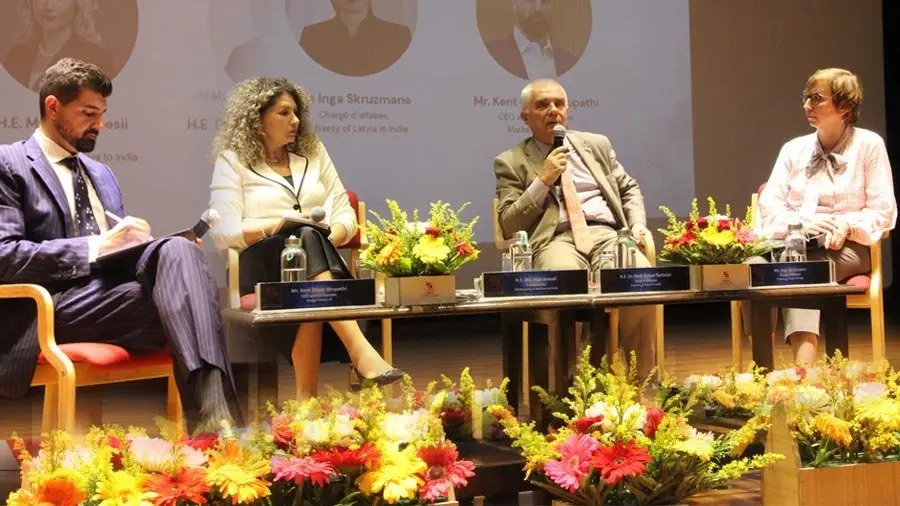
Gathering at the university campus, a distinguished panel of European diplomats—representing Moldova, Poland, and Latvia—convened to examine how trade liberalisation can be successfully translated into sustainable investment, technological innovation, enhanced regional connectivity, and deeper strategic engagement between India and the nations of Europe.
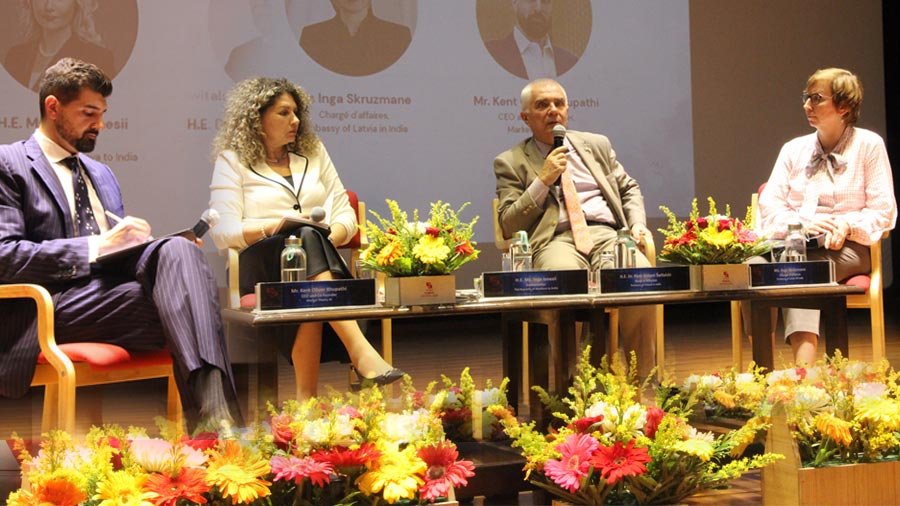
The panel discussion was skillfully moderated by Kent Oliver Bhupathi, CEO and co-founder of Market Theory AI. Under his guidance, the dialogue brought together three distinct European vantage points: H.E. Inga Ionesii, Ambassador of the Republic of Moldova to India; Dr. Piotr Antoni Świtalski, Chargé d’Affaires a.i. of the Republic of Poland in India; and Ms. Inga Skrīūzmane, Chargé d’Affaires at the Embassy of Latvia in India. Each diplomat brought unique regional insights to the table, with Moldova offering valuable lessons on economic integration with the EU; Poland underscoring the pillars of strategic cooperation, advanced technology, and vital transport corridors; and Latvia concentrating on the realities of tariff reductions, digital innovation, and the empowerment of small and medium-sized enterprises (SMEs).
Learning from Moldova’s Integration Experience
Opening the substantive portion of the dialogue, moderator Kent Oliver Bhupathi directed his first question to Ambassador Inga Ionesii, asking what foundational lessons India might draw from Moldova’s extensive experience in negotiating and implementing trade agreements with the European Union.
Ambassador Ionesii responded by emphasizing that the principal lesson lies in clearly recognizing the sheer scale of opportunity that emerges when a national economy gains access to a vastly larger market. Drawing directly from Moldova’s hands-on experience under the Deep and Comprehensive Free Trade Area (DCFTA), she explained that closer economic integration acts as a powerful catalyst. It encourages domestic businesses to elevate their quality standards, actively diversify their export baskets, and systematically expand their industrial production capabilities.
Furthermore, Ionesii stressed that such trade frameworks can significantly support foreign direct investment and vital technology exchanges, ultimately empowering both trading partners to strengthen their economic and institutional capabilities over the long term. Her remarks offered a pragmatic qualification to the widespread enthusiasm surrounding trade liberalisation: the true benefits of any agreement will never be automatic; rather, they depend entirely on how proactively businesses and public institutions utilize the available avenues for growth.
Deepening the India-Poland Strategic Partnership
Turning the conversation toward Central Europe, Bhupathi asked Dr. Piotr Antoni Świtalski what immediate steps should be taken to translate the multifaceted India-Poland strategic partnership—originally established in 2024—into tangible, practical cooperation on the ground.
Dr. Świtalski asserted that stronger bilateral ties between Warsaw and New Delhi will inherently reinforce the broader, overarching relationship between India and the entire European Union. Expressing optimism that heightened high-level political engagement will infuse fresh momentum into economic exchanges, he revealed his ambitious goal to double the current bilateral trade volume, which he estimated at approximately US$6 billion, well before the year 2030.
To achieve this ambitious target, Dr. Świtalski identified several priority sectors ripe for collaboration, including defense, space exploration, artificial intelligence, high-technology manufacturing, and the burgeoning green economy. Crucially, he emphasized a qualitative shift in mindset: Polish enterprises are not merely looking to sell goods into the vast Indian consumer market, but are keenly interested in forging genuine, equitable partnerships with Indian industrial counterparts.
The discussion then naturally gravitated toward the challenges and opportunities facing smaller commercial players. Addressing Ms. Inga Skrīūzmane, Bhupathi asked what measures—beyond standard tariff reductions—are necessary to help Indian and Latvian small and medium-sized enterprises maximize the benefits of the free trade framework.
Ms. Skrīūzmane pointed to access to verified information and the establishment of direct commercial contacts as foundational prerequisites. She noted that smaller businesses often struggle simply because they lack a clear understanding of complex regulatory conditions, local market dynamics, and the distinct commercial cultures of potential foreign partners. To bridge this gap, she strongly encouraged companies to actively participate in international trade exhibitions and proactively build business-to-business networks, arguing that enduring commercial trust is ultimately forged through direct, face-to-face engagement.
Her intervention brought to light a persistent practical challenge in international trade: even when formal government-imposed trade barriers are dismantled, smaller firms frequently remain sidelined unless they are equipped with the knowledge of where to find reliable partners and how to navigate unfamiliar foreign markets.
Connectivity: The Infrastructure Behind Trade
Expanding the scope of the dialogue, Dr. Świtalski introduced another critical dimension to the trade debate: the indispensable role of physical and digital connectivity. He argued compellingly that the global competitiveness of any commercial exchange relies just as heavily on the reliability, speed, and efficiency of transport routes as it does on favorable tariff schedules.
Citing recent geopolitical disruptions and logistical bottlenecks in West Asia, Dr. Świtalski illustrated how lengthened shipping routes can severely delay delivery timelines and complicate delicate commercial relationships. In response to these vulnerabilities, he called for renewed international attention and investment directed toward the India-Middle East-Europe Economic Corridor (IMEC), alongside potential future extensions reaching northward toward the Baltic and Nordic regions, as well as Moldova.
In addition to maritime and land corridors, Dr. Świtalski highlighted the vital importance of robust air connectivity. He suggested that establishing stronger, direct flight links between India and key European hubs would significantly facilitate essential business travel, thereby fostering closer and more responsive commercial partnerships. This intervention successfully broadened the panel’s focus from abstract trade rules to the hard infrastructure required to make those rules functionally effective.
Finding New Markets for Traditional Products
Moving from macroeconomic corridors to sector-specific commercial opportunities, the dialogue examined how traditional industries can successfully cross international borders.
Bhupathi asked Ambassador Ionesii how Moldova intends to promote its renowned winemaking heritage within the uniquely diverse Indian market. Acknowledging the hurdle presented by high Indian import duties, Ionesii outlined targeted promotional efforts aimed at introducing Moldovan wines directly to Indian distributors through active participation in specialized trade exhibitions. She cited recent commercial showcases in Mumbai where Moldovan enterprises engaged directly with potential Indian partners, demonstrating that market access, proactive promotion, and distributor relationships must operate in tandem to establish a sustainable product presence.
Green Technology and Digital Cooperation
The transition from conventional trade to deep technological collaboration was further explored when Bhupathi asked Dr. Świtalski to pinpoint areas where India and Poland can deepen cooperation in clean energy and green technologies.
Pointing to the cutting-edge work being done by Polish firms in the fields of hydrogen energy, green ammonia, and advanced battery recycling, Dr. Świtalski reiterated their keen interest in joint investments and technological partnerships with Indian entities. He also drew attention to promising collaborative opportunities in space technology and medical equipment, particularly AI-enabled diagnostic tools. These examples underscored the reality that modern economic cooperation extends far beyond traditional commodity exports, allowing nations to pool complementary capabilities and innovate together.
Concluding the panel’s round of inquiries, Ms. Skrīūzmane addressed the vast potential of digital cooperation between India and Latvia. She expressed deep admiration for India’s Unified Payments Interface (UPI) digital payments ecosystem, pointing to artificial intelligence and widespread digitalisation as prime arenas for future bilateral initiatives. She also shared a practical success story, noting that a Latvian-founded software enterprise is currently operating successfully in India, providing essential technological services to more than 10,000 Indian businesses.
This cross-border success demonstrated that contemporary bilateral cooperation is not constrained by the physical movement of goods across borders. Instead, digital services and technology-driven enterprises can seamlessly establish international operations, creating robust commercial bonds that endure well beyond standard trade frameworks. At the same time, Ms. Skrīūzmane acknowledged that the rapid advancement of artificial intelligence introduces sensitive regulatory questions that require careful, cooperative governance, making international partnership all the more vital.
A Partnership Built on Implementation
Throughout the comprehensive discussions at Symbiosis International University, a clear and consistent consensus emerged among the diplomats: while the conclusion of the India–EU Free Trade Agreement provides an indispensable legal and economic foundation, the true measure of its success will ultimately rest upon the concrete actions taken in its wake.
Ambassador Ionesii reiterated the foundational necessity of domestic economic reforms and institutional capacity-building; Dr. Świtalski championed the development of secure transport connectivity, strategic alignment, and technological joint ventures; and Ms. Skrīūzmane emphasized the critical need for accessible market information, SME support, and direct business-to-business engagement.
Together, the perspectives offered by Moldova, Poland, and Latvia underscored that the upcoming chapter of India–EU relations will demand concerted effort across multiple domains. Policymakers and business leaders must actively help enterprises navigate unfamiliar regulatory landscapes, upgrade physical and digital transport corridors, encourage mutual investment, and foster joint innovation in green energy, digital services, and advanced manufacturing.
By examining the broader India–Europe relationship through the distinct economic lenses of individual nations, the dialogue illuminated the practical pathways through which bilateral cooperation can thrive despite differing national priorities. The central challenge moving forward lies in converting the immense promise of trade liberalisation into enduring, resilient relationships connecting institutions, corporations, and citizens across both regions.