NEW DELHI — With the landmark negotiations on the India–European Union free trade agreement successfully concluded in January 2026, the diplomatic and economic focus is shifting rapidly from high-level policy formulation to ground-level implementation. Translating broad trade liberalisation into tangible opportunities for businesses, investors, and ordinary citizens took center stage at the recent India–EU Diplomatic Dialogue.
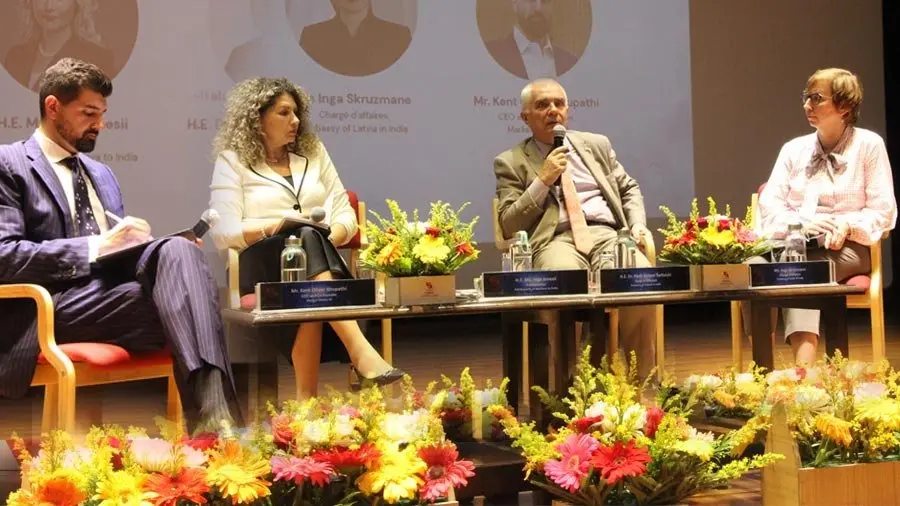
Organized by Diplomatist Magazine and hosted at Symbiosis International (Deemed University), the high-profile forum brought together diplomats from Moldova, Poland, and Latvia. Together, they examined how the historic trade pact can be leveraged to spur direct investment, drive technological innovation, strengthen vital connectivity corridors, and deepen strategic engagement between India and European nations.
The panel discussion was moderated by Kent Oliver Bhupathi, CEO and co-founder of Market Theory AI. It featured H.E. Inga Ionesii, Ambassador of the Republic of Moldova to India; Dr Piotr Antoni Świtalski, chargé d’affaires a.i. of the Republic of Poland in India; and Ms Inga Skrūzkmane, Chargé d’affaires at the Embassy of Latvia in India.
Each diplomat brought a distinct regional perspective to the table: Moldova shared valuable lessons from its ongoing economic integration with the EU; Poland underscored the importance of strategic cooperation, advanced technology, and multimodal connectivity; and Latvia focused on tariff reductions, the empowerment of small and medium-sized enterprises (SMEs), and digital innovation.
What Can India Learn from Moldova’s Trade Experience?
Opening the substantive segment of the dialogue, moderator Kent Oliver Bhupathi asked Ambassador Ionesii what insights India might glean from Moldova’s extensive experience in negotiating and implementing a major trade agreement with the European Union.
Ambassador Ionesii responded that the principal lesson lies in fully recognizing the sheer scale of opportunity generated by unhindered access to a larger, highly regulated market. Drawing directly from Moldova’s frontline experience under the Deep and Comprehensive Free Trade Area (DCFTA), she explained that closer economic integration acts as a powerful catalyst. It encourages domestic businesses to elevate their quality standards, diversify their export baskets, and significantly expand their overall production capacities.
Furthermore, she stressed that such a sweeping agreement can actively support vital capital investment and robust technology exchanges, thereby enabling both trading partners to systematically upgrade their economic and institutional capabilities.
However, her response offered a vital and pragmatic qualification to the widespread enthusiasm surrounding trade liberalisation. She noted that the true dividends of any pact do not flow automatically; rather, they depend entirely on how proactively businesses and public institutions utilise the newly available mechanisms.
How Can India–Poland Strategic Ties Become More Practical?
Shifting the conversation toward Central Europe, Bhupathi asked Dr Piotr Antoni Świtalski what the next logical steps should be in translating the burgeoning India–Poland strategic partnership—originally established in 2024—into deeply ingrained, practical cooperation.
Dr Świtalski asserted that stronger bilateral ties between New Delhi and Warsaw would serve to reinforce the broader, overarching India–EU relationship. Expressing optimism that high-level political engagement would inject fresh momentum into economic cooperation, he revealed an ambitious target: he wants to see bilateral trade, which currently hovers at approximately US$6 billion, double well before the year 2030.
To achieve this goal, Dr Świtalski identified several priority sectors, including defense, space exploration, artificial intelligence, high-technology manufacturing, and the rapidly expanding green economy. Crucially, he emphasized a collaborative philosophy, noting that Polish companies are keenly interested in forging genuine partnerships and joint ventures with Indian counterparts rather than merely treating India as a destination for finished exports.
The conversation subsequently pivoted toward the specific needs of smaller commercial entities. When Bhupathi asked Ms Inga Skrūzkmane what, beyond basic tariff reductions, could help Indian and Latvian SMEs make the most of the bilateral framework, she pointed directly to the fundamentals of market entry.
Ms Skrūzkmane identified verified market information and direct commercial contacts as absolute prerequisites. She noted that smaller businesses must navigate complex regulatory conditions, understand local market dynamics, and appreciate the unique commercial culture of potential partners. To overcome these hurdles, she strongly encouraged enterprises to participate actively in international trade exhibitions and proactively cultivate business-to-business relationships, arguing that enduring commercial trust is built primarily through direct, face-to-face engagement.
Her remarks highlighted a persistent structural challenge in international trade: even when formal government-imposed barriers are dismantled, smaller firms often remain unable to capitalize on new horizons unless they are equipped with actionable intelligence on how to find reliable partners and navigate unfamiliar foreign markets.
Connectivity: The Infrastructure Behind Trade
Adding a critical physical dimension to the policy discussion, Dr Świtalski emphasized that the ultimate competitiveness of international trade relies just as heavily on the reliability, speed, and efficiency of physical transport corridors as it does on favorable tariff schedules.
Citing recent disruptions across West Asia, he observed how unexpected bottlenecks and longer shipping routes can drastically inflate delivery times, escalate logistics costs, and complicate delicate commercial relationships. In response, he called for heightened international focus on the proposed India–Middle East–Europe Economic Corridor (IMEC), alongside potential extensions reaching toward the Baltic and Nordic regions, as well as Moldova.
In addition to maritime and land routes, Dr Świtalski underscored the vital importance of robust air connectivity. He suggested that establishing stronger direct flight corridors would directly facilitate essential business travel, foster closer interpersonal ties, and underpin sustained commercial engagement.
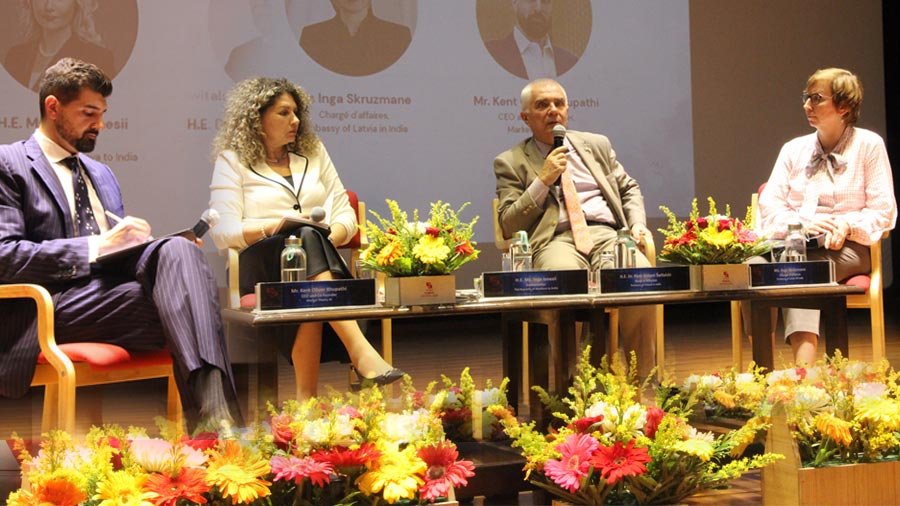
This intervention successfully broadened the panel’s analytical scope, moving the conversation beyond legal trade rules to confront the concrete infrastructure required to make those rules practically effective.
Can Traditional Products Find New Markets?
The dialogue also delved into sector-specific opportunities, examining how culturally distinct and traditional goods can successfully carve out space in competitive new markets.
Addressing Ambassador Ionesii, Bhupathi inquired how Moldova intends to promote its renowned winemaking heritage within the vast and diverse Indian market. Acknowledging the reality on the ground, the Ambassador explained that high Indian import duties currently present a tangible commercial challenge for Moldovan wines.
To overcome these hurdles, she detailed ongoing promotional efforts aimed at introducing Moldovan vintages directly to key Indian distributors through active participation in specialized trade exhibitions. She noted that Moldovan companies have already participated in exhibitions in Mumbai and intend to maintain a steady presence, engaging continuously with prospective Indian partners to build long-term brand awareness.
This exchange illustrated the intricate interplay required in modern international commerce, demonstrating that market access, proactive promotion, and dedicated distributor relationships must work in tandem if traditional products are to establish a sustainable, long-lasting presence in a new demographic.
Green Technology: From Exports to Joint Ventures
Turning to the green transition, Bhupathi asked Dr Świtalski to pinpoint where India and Poland can most effectively deepen their collaboration in clean energy and advanced environmental technologies.
Pointing to specific industrial capacities, Dr Świtalski highlighted Polish companies actively engaged in hydrogen energy production, green ammonia development, and advanced battery recycling. He explained that these firms are eager to pursue direct investments and deep-seated partnerships with Indian enterprises. Beyond clean energy, he also spotlighted lucrative opportunities for joint cooperation in space technology and advanced medical equipment, particularly AI-enabled diagnostic tools.
His examples reinforced a central theme of the dialogue: the critical distinction between conventional transactional exports and deeper technological collaboration. By pooling resources and expertise through joint ventures, companies from both regions can successfully combine their respective capabilities, co-develop innovative solutions, and actively participate in each other’s domestic innovation ecosystems.
Digital Cooperation and the Promise of AI
In the final thematic inquiry of the panel, Bhupathi invited Ms Skrūzkmane to identify the most promising digital frontiers for collaboration between India and Latvia.
Expressing clear admiration for India’s technological advancements, Ms Skrūzkmane singled out the Unified Payments Interface (UPI) digital payments system as a remarkable innovation. She identified artificial intelligence and broad-scale digitalisation as prime arenas for future bilateral cooperation. Furthermore, she pointed to a prominent Latvian-founded software enterprise currently operating successfully within India, where it provides critical technological services to more than 10,000 Indian businesses.
This real-world example demonstrated conclusively that bilateral economic cooperation need not be restricted to physical goods crossing traditional borders. Modern digital services and technology-driven enterprises are fully capable of establishing robust cross-border operations, weaving commercial links that endure far beyond standard trade metrics.
At the same time, Ms Skrūzkmane acknowledged that artificial intelligence introduces sensitive regulatory and ethical questions that demand careful international cooperation, rendering it an area where multilateral partnerships can prove exceptionally valuable.
A Partnership Built on Implementation
Throughout the comprehensive dialogue, a consistent and unifying theme emerged: while the conclusion of the India–EU free trade agreement represents an essential foundational milestone, the ultimate success and wider impact of the pact will be determined entirely by the actions that follow.
Ambassador Ionesii reiterated the indispensable role of continued domestic economic reforms and strengthened institutional capacity. Dr Świtalski advocated for enhanced physical connectivity, active strategic engagement, and targeted technological alliances. Ms Skrūzkmane reinforced the necessity of accessible market information, reliable business contacts, and dedicated support systems for smaller enterprises.
Together, the perspectives shared by the European diplomats suggested that the upcoming chapter of India–EU relations will demand concerted effort across multiple fronts. This includes helping enterprises navigate unfamiliar regulatory landscapes, upgrading vital transport and logistics corridors, encouraging foreign direct investment, and building resilient partnerships in green technology, digital services, and advanced manufacturing.
The Symbiosis International dialogue underscored the immense value of examining the broader India–Europe relationship through the distinct lenses of individual nations. Though their domestic economies and immediate priorities vary widely, each country offers a pragmatic, grounded perspective on how closer international cooperation can be successfully operationalized.
The core challenge facing policymakers, business leaders, and institutions alike is to convert the immense promise of trade liberalisation into enduring, productive relationships. Through that vital transition from signed agreement to practical implementation lies the opportunity to make the India–EU partnership profoundly more resilient, innovative, and consequential in the years ahead.