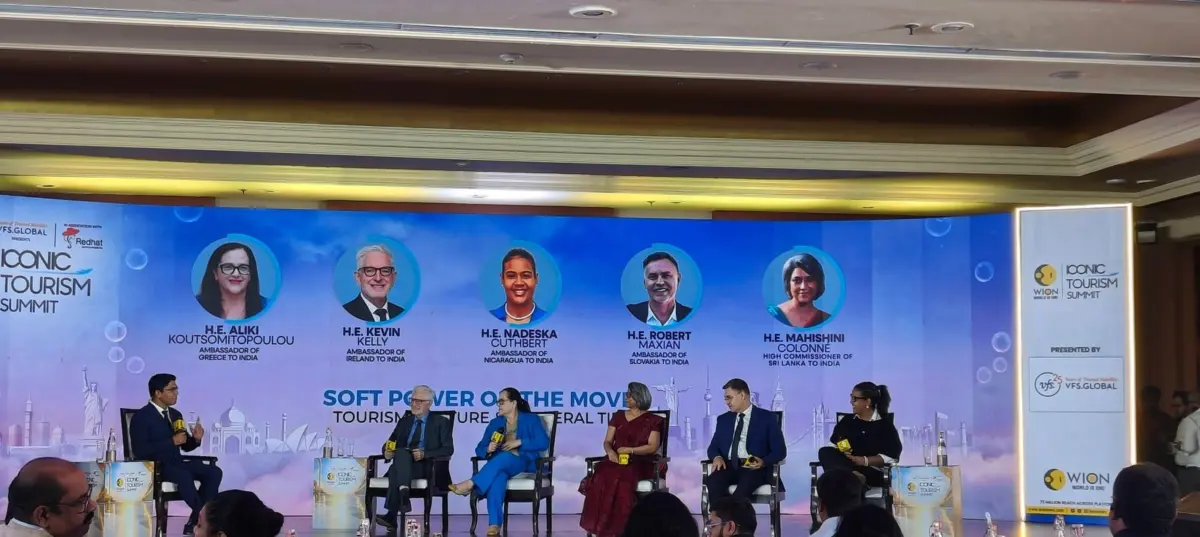
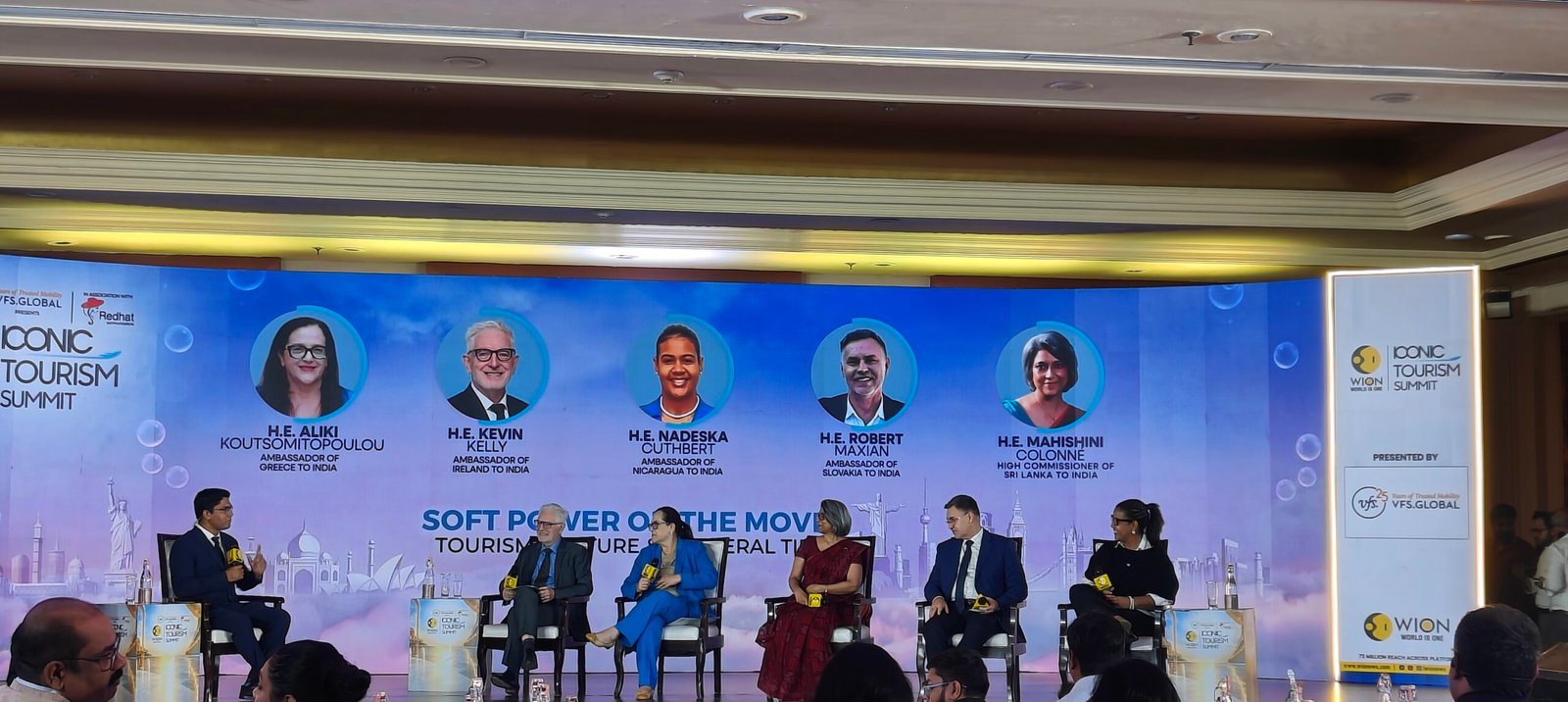
NEW DELHI — As outbound tourism from India continues to experience an unprecedented boom, diplomatic missions are increasingly shifting their focus from traditional mass-market destinations to niche experiences, improved visa frameworks, and enhanced connectivity. This evolving global tourism landscape took center stage at the WION Iconic Tourism Summit in New Delhi on September 23, where a panel of ambassadors and high commissioners gathered to chart the future of international travel for Indian citizens.
Moderated by Sidhant Sibal, Foreign Affairs Editor at WION, the panel featured high-ranking diplomats representing Ireland, Greece, Sri Lanka, Slovakia, and Nicaragua. The wide-ranging discussion explored how these diverse nations are positioning themselves to capture the imagination of a modern, highly discerning generation of Indian travellers. Rather than relying solely on iconic, heavily saturated postcard locations, the envoys emphasized the growing importance of culture, adventure, wellness, sustainability, and seamless logistical connectivity.
The conversation moved fluidly from must-visit regional highlights to crucial practical considerations, including airline routes, visa processing, and the integration of digital payment systems. Throughout the summit, the underlying message remained clear: the modern Indian traveller is looking to venture off the beaten path, seeking deeper cultural immersion, diverse geographical landscapes, and frictionless travel experiences.
Beyond Dublin: Discovering Ireland’s West Coast and Compact Geography
When the discussion turned to specific destinations and hidden gems, H.E. Kevin Kelly, Ambassador of Ireland to India, urged prospective visitors to look far beyond the urban boundaries of Dublin and venture toward the wild and spectacular landscapes of Ireland’s west coast.
Ambassador Kelly drew special attention to the dramatic scenery surrounding Skellig Michael, a celebrated UNESCO World Heritage Site that gained a massive global following after featuring prominently in the Star Wars film franchise. He also recommended the vibrant city of Galway, adding a personal and cultural touch by referencing its famous association with the popular traditional tune Galway Girl.
For Ambassador Kelly, one of Ireland’s primary selling points for international tourists is its remarkably compact geography. Visitors can seamlessly experience bustling city life, rugged mountain ranges, and dramatic coastal vistas within a relatively short travel distance, making it an ideal destination for travellers seeking variety without enduring long, exhausting transit legs between regions.
H.E. Aliki Koutsomitopoulou, Ambassador of Greece to India, echoed a remarkably similar sentiment regarding her own country, encouraging Indian tourists to look beyond universally recognized island hotspots like Santorini. While acknowledging the undeniable global appeal of the Aegean islands, Ambassador Koutsomitopoulou strongly recommended exploring the diverse wonders of mainland Greece.
She focused particularly on the southern region and her personal hometown of Kalamata, which is globally renowned for its exceptional olives, breathtaking natural landscapes, and distinct local character. Her central message to the audience was clear: travelers should discover a richer, more varied Greece that extends far beyond the familiar seasonal combination of sun, sand, and crowded beaches.
For H.E. High Commissioner Mahishini Colonne of Sri Lanka, the island nation’s distinct allure lies in its harmonious combination of ancient heritage and lush biodiversity. High Commissioner Colonne highlighted Sri Lanka’s numerous UNESCO World Heritage sites and rich ecological treasures, while specifically recommending active experiences such as the Pekoe Trail. This ambitious long-distance hiking route winds through the scenic central highlands and sprawling tea country, offering travellers an entirely different perspective of the island.
Meanwhile, H.E. Róbert Maxián, Ambassador of Slovakia to India, directed attention toward the dramatic peaks of the High Tatras and the Carpathian mountain ranges, alongside Slovakia’s remarkably well-preserved historic towns, medieval castles, therapeutic thermal spas, and rich portfolio of UNESCO heritage sites. Ambassador Maxián emphasized that Slovakia’s relatively small size allows visitors to experience multiple facets of European history, nature, and culture within a remarkably short period.
Rounding out the regional presentations, H.E. Nadeska Imara Cuthbert Carlson, Ambassador of Nicaragua to India, proposed an itinerary beginning in the historic colonial city of Granada, followed by Ometepe Island with its twin majestic volcanoes, and concluding in the coastal hub of San Juan del Sur. Ambassador Carlson noted that Nicaragua successfully combines pristine beaches, rugged mountains, towering volcanoes, deep history, and vibrant culture, all while placing an increasingly firm emphasis on ecotourism and sustainable travel initiatives.
Connectivity: The Key to Unlocking Indian Tourism Growth
As the conversation shifted toward the logistical frameworks required to sustain this tourism growth, the panel addressed the critical role of airline connectivity and the rapidly expanding strategic importance of the Indian outbound market.
Discussing bilateral travel between India and Ireland, Ambassador Kelly noted that India has officially been designated as a priority market for Tourism Ireland, which has actively established a physical presence in Mumbai to tap into the booming region. He pointed to strong people-to-people links driven by family travel, corporate business tourism, and a thriving local Indian community residing in Ireland.
With approximately 100,000 people of Indian origin living in a nation of fewer than five million residents, these personal connections serve as a vital engine for travel. Furthermore, Ambassador Kelly highlighted the rapid expansion of MICE (Meetings, Incentives, Conferences, and Exhibitions) tourism, noting that business visitors are increasingly inclined to combine professional corporate trips with extended leisure travel.
Ambassador Kelly also underscored Ireland’s strategic accessibility from the United Kingdom, drawing attention to the British-Irish Visa Scheme. Under this cooperative arrangement, eligible Indian travellers holding a qualifying visa for one country are permitted to visit the other, significantly streamlining cross-border European travel itineraries.
For Greece, Ambassador Koutsomitopoulou emphasized the indispensable role of direct air connectivity. She noted that the establishment of direct flight connections between India and Greece has acted as a direct catalyst for the exceptionally strong growth in Indian tourist arrivals in recent years.
However, she reiterated that Greece should not be pigeonholed exclusively as a summer-only destination. She encouraged Indian visitors to explore the country across different seasons, venture out to lesser-known islands, and discover the rugged beauty of the Greek mountains and mainland. The overarching objective, she explained, is not merely to draw first-time sightseers, but to cultivate repeat travellers who return to discover an entirely different side of the nation.
Making Travel Easier Through Digital Innovation and Civilisational Links
For Sri Lanka, the dialogue centered heavily on practical measures designed to reduce friction in travelling and spending. High Commissioner Colonne highlighted the efficiency of the country’s Electronic Travel Authorisation (ETA) system and the expanding adoption of digital payment solutions for international visitors.
A notable milestone in bilateral convenience is the UPI-LankaQR system, which became operational in 2024 and allows Indian tourists to make seamless digital payments at participating Sri Lankan merchant locations using their familiar Unified Payments Interface (UPI) applications. High Commissioner Colonne stated that the immediate priority moving forward is to onboard a larger network of merchants into the system, ensuring that this payment convenience is extended to an even broader segment of Indian tourists.
In addition to digital convenience, Colonne underscored the profound civilisational links binding India and Sri Lanka together. She pointed to the Ramayana Trail as a premier tourism offering that allows visitors to explore sacred sites associated with the ancient epic, noting that both nations share a much broader, deeply intertwined religious and cultural heritage. As a prime example of these enduring bonds, she referenced the sacred Bodhi tree in Sri Lanka, which is a direct historical descendant of the original sacred Bodhi tree in India.
Addressing Slovakia’s unique value proposition within the broader European travel market, Ambassador Maxián reiterated the distinct advantages of the country’s compact geography and accessibility. Slovakia can be navigated with ease, allowing travellers to traverse the entire country within a matter of a few hours. Furthermore, Maxián noted that Indian tourists frequently combine their Slovakian itineraries with visits to neighbouring Central European destinations such as Hungary, the Czech Republic, and Poland.
Ambassador Maxián also drew attention to Slovakia’s booming wellness tourism sector, particularly its mineral-rich thermal spas, which complement the nation’s historic castles, local wine culture, distinct gastronomy, and pristine natural reserves. Demonstrating the growing people-to-people exchange, Maxián observed that approximately 11,000 Indian nationals currently live and work in Slovakia, alongside a steady upward trajectory in leisure tourist arrivals.
Concluding the summit’s regional focus, Ambassador Carlson addressed Nicaragua’s potential to integrate smoothly into a wider, multi-country Latin American journey. She encouraged Indian travellers to think beyond isolated destinations and view Latin America and the Caribbean as an interconnected regional tapestry. Nicaragua, she suggested, can be easily combined with neighbouring nations like Costa Rica and Honduras, given their shared ecological wealth and regional transit corridors.
Ambassador Carlson stressed that Nicaragua’s unique tourism appeal extends far beyond its physical landscapes, noting that the warmth of its people, the richness of its local culture, and its distinctive gastronomy are vital components of the visitor experience. While acknowledging that the current absence of direct flights from India poses logistical challenges—requiring travellers to connect through major international aviation hubs—she emphasized that Nicaragua remains deeply committed to advancing sustainable ecotourism. The country offers a diverse array of experiences ranging from surfing and active volcano expeditions to rugged mountains, tranquil beaches, and the vibrant Caribbean coastline.