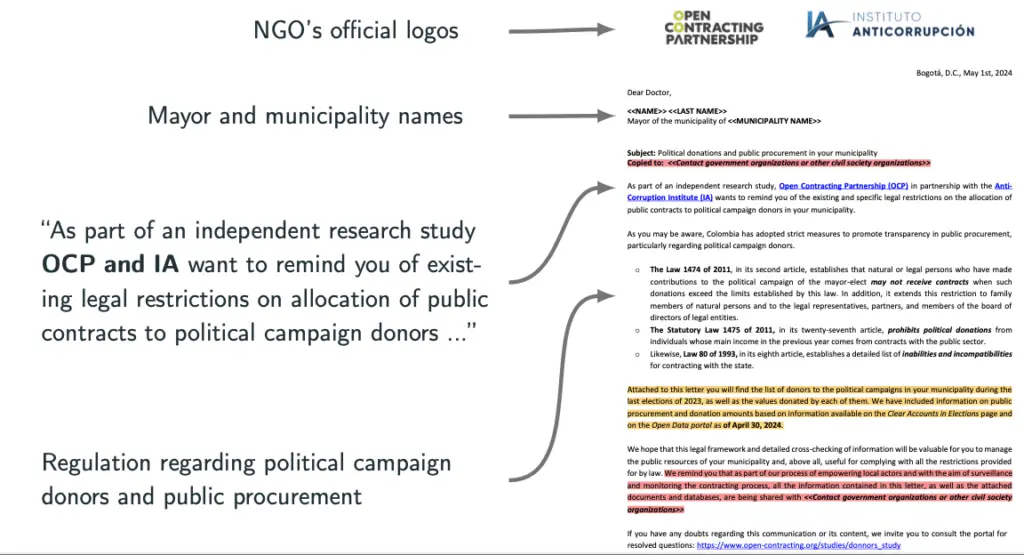
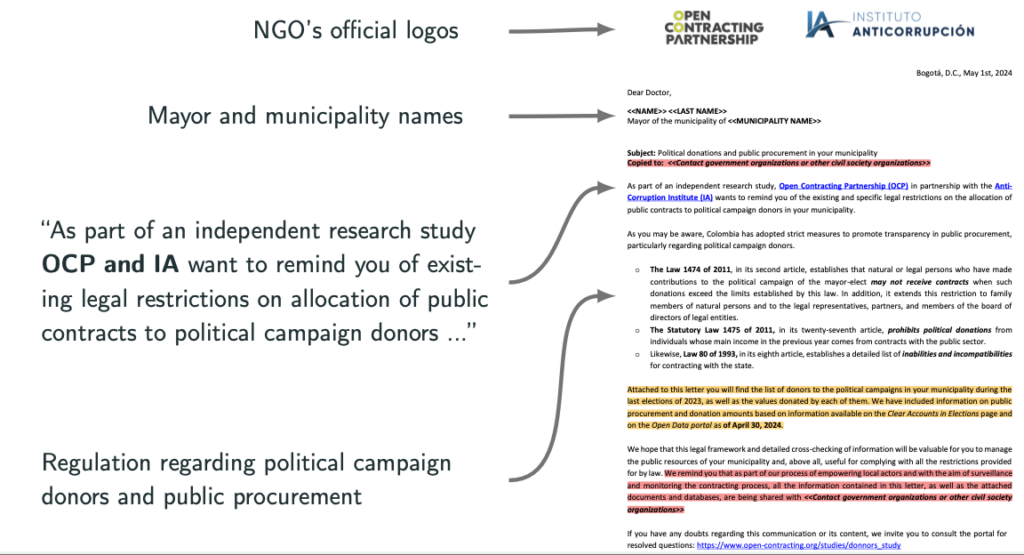
In May 2024, an unprecedented administrative initiative unfolded across Colombia. Letters were dispatched to more than 800 newly elected municipal mayors carrying a blunt and direct reminder of the nation’s electoral laws: major campaign donors are legally barred from securing public procurement contracts from the very administrations they helped bring to power. While some of these missives were delivered strictly on a direct-to-mayor basis, others were marked with copies sent proactively to investigative journalists and the Office of the Inspector General of Colombia, known locally as the Procuraduría General de la Nación. Crucially, a specific subset of these letters included a meticulously detailed annex. This document cross-referenced the names of every individual and corporate entity that had financed the mayor’s electoral campaign against the registry of public contracts those very donors had already managed to secure.
Over the subsequent nine months, tracking data revealed that only one precise configuration of this intervention achieved a statistically significant and substantial behavioral shift. In municipalities where the warning letter was accompanied by the comprehensive donor-contract annex and sent with a formal copy to the Procuraduría, campaign donors faced an estimated 30 percent reduction in their probability of winning public contracts. By contrast, any other permutation—such as generic reminders without data or warnings lacking the backing of the oversight agency—produced no measurable deterrent effect whatsoever.
This striking finding emerges from a nationwide randomized controlled experiment. The initiative was collaboratively designed and implemented by the Open Contracting Partnership (OCP) alongside the Procuraduría General de la Nación, the Anti-Corruption Institute (Instituto Anticorrupción), independent investigative journalists, and academic researchers from Georgetown University, the University of Notre Dame, and Stockholm University.
Across the globe, voters frequently voice deep frustrations regarding the outsized and often corrosive influence of money in politics. Nowhere is this dynamic easier to study than in Colombia, largely due to the robust availability of public data. Yet, the underlying pattern remains a familiar reality in democracies worldwide: an individual or corporation finances a politician’s electoral campaign. Once the candidate ascends to public office, they channel lucrative government contracts back toward those financial backers, allied businesses, or close associates. When this transactional loop becomes institutionalized routine, public procurement ceases to function as a mechanism for delivering essential public goods and services. Instead, it mutates into a rewards system for political loyalists. The same political networks manage to entrench themselves in power election after election, self-funded by the very contracts they award. Meanwhile, public infrastructure projects such as schools, local clinics, and municipal roads face severe delays, experience massive cost overruns, or, in the worst-case scenarios, are never built at all.
While governments across the globe remain inherently vulnerable to these systemic dynamics, measuring them and managing them has historically proved exceptionally difficult. Until recently, empirical evidence identifying precisely what interventions work to curb these conflicts of interest was remarkably scarce.
Campaign Donations Yield Exceptionally High Returns on Investment
In Colombia, two public digital platforms—SECOP for public procurement and Cuentas Claras for campaign finance tracking—provide researchers and ordinary citizens with an exceptionally transparent window into who funds political campaigns and who ultimately captures state funds. Very few nations across Latin America possess this dual infrastructure of open data. Recognizing this unique advantage, the Open Contracting Partnership and various civil society organizations have spent years collaborating with Colombian public institutions to preserve and maintain open, fully functional access to these data systems.
The financial stakes involved in public purchasing are immense. In Colombia, public procurement spending reached approximately 200 trillion pesos in 2025, which translates to roughly 50 billion United States dollars. Approximately 70 percent of this massive expenditure occurs at the subnational level, distributed across departments and municipalities where local mayors and governors hold broad discretionary power over procurement decisions. In fact, official figures indicate that 81 percent of all municipal-level contracts are awarded through non-competitive procedures.
To understand the scale of political favoritism, researchers cross-referenced approximately 7 million municipal contracts signed between 2012 and 2024 with mandatory campaign finance disclosure reports spanning three distinct electoral cycles. The resulting pattern is both striking and remarkably consistent. Following local elections, individuals and corporate entities that donated funds to a winning mayoral campaign enjoyed, on average, a 28 percent higher probability of securing government contracts compared to non-donors. Furthermore, the contracts awarded to these donors were valued at roughly 17 percent more. These politically aligned contracts also demonstrated markedly inferior performance metrics: they were 5 percent more likely to experience reported cost overruns, and those overruns averaged 9 percent higher in value.

Crucially, this preferential advantage extends far beyond the active tenure of the individual mayor. Financial donors continue to capture a disproportionately large share of municipal contracting up to eight years after the specific election they originally financed.
Economic modeling by the study’s authors suggests that at least 750 million dollars in subnational procurement funds flow directly to political donors in Colombia every single year. The true figure is widely suspected to be significantly higher due to well-documented underreporting within the national political financing system, which leaves unrecorded donors automatically categorized as non-donors within the dataset.
Enforcing Electoral Law Through Actionable, Data-Driven Insights
Private contributions to electoral campaigns are an entirely legal and legitimate component of political life in Colombia. The primary objective of the research initiative was never to outlaw campaign donations, but rather to ensure that existing statutory rules are practically enforceable. The goal was to provide every stakeholder in the democratic ecosystem—including mayors, oversight bodies, and the general citizenry—with the precise information required to hold public officials accountable.
Under Colombian electoral law, any individual or entity contributing more than two percent of a candidate’s legal spending limit is strictly prohibited from receiving public contracts from that specific administration. Additional statutory restrictions apply to public contractors who attempt to make political donations, relatives of major contributors, and corporate entities facing active disciplinary sanctions.
Despite these clear legal prohibitions, enforcement has historically remained deficient. Part of this challenge stems from the sheer administrative volume of local governance. Colombian municipalities execute hundreds of thousands of individual contracts every year. No oversight institution, regardless of its resource allocation, possesses the manpower to audit every single transaction manually. Consequently, the only viable pathway for effective enforcement involves utilizing data to prioritize oversight: systematically matching donor registries against procurement awards, isolating high-risk cases where statutory violations are most probable, and delivering that targeted intelligence directly to authorities capable of taking enforcement action. This methodology served as the core design principle for the intervention.
Six months after taking office, newly elected mayors across 876 municipalities received formal notifications. Every letter reminded municipal leaders of the legal restrictions governing contract awards to campaign donors and carried the official insignia of the Open Contracting Partnership and the Anti-Corruption Institute. The core variable across the letters lay in who else received copies and what specific documentation was attached.
While certain mayors received standard advisory notices, others had copies routed to investigative journalists or directly to the Procuraduría General de la Nación. Within these categories, some letters arrived accompanied by an exhaustive annex detailing the complete list of campaign contributors for that specific municipality, cross-referenced with public contracts already awarded to them, while others received only partial listings. Every donor list utilized for the study was compiled exclusively from public data drawn directly from SECOP and Cuentas Claras.
Researchers subsequently tracked every municipal contract executed over the subsequent nine months, comparing outcomes across the various treatment groups against a control group that received no communication.
Coordinated Fiscal Oversight Transforms Mayoral Behavior
The empirical results demonstrated that only one specific institutional combination altered executive behavior. Mayors who received letters explicitly copying the Procuraduría and containing the comprehensive donor registry exhibited an approximate 30 percent reduction in contract awards to their campaign financiers relative to the control group. Furthermore, the total monetary value of contracts awarded to donors in those municipalities dropped by 4.3 percent, while project cost overruns associated with those donors fell by 6 percent. These positive behavioral changes remained stable throughout the entire nine-month monitoring window.
Conversely, letters that simply reminded mayors of existing laws without involving the Procuraduría failed to generate any measurable change in contracting practices. Local executives altered their administrative behavior exclusively when an enforcement authority capable of imposing sanctions provided them with specific, actionable intelligence.
Researchers characterize this phenomenon as "credible oversight." Experience across multiple international jurisdictions confirms that reform coalitions achieve meaningful progress only when coordinated actions bridge the gap between internal government actors and external watchdogs, with each group contributing unique institutional strengths. In the Colombian intervention, civil society organizations, the OCP, and the Anti-Corruption Institute supplied the underlying data processing, cross-verification, and public accountability. Meanwhile, the Procuraduría General de la Nación provided the indispensable legal authority that transformed administrative warnings into a credible deterrent. Neither approach succeeded independently. Operating in tandem, the coalition successfully diverted millions of dollars away from politically connected vendors in less than a year, achieving these results at a fraction of the financial cost of a traditional government audit.
Building Lasting Systems for Sustained Accountability
While targeted data interventions demonstrate immediate utility, systemic reform requires addressing deeper structural vulnerabilities within Colombia’s political financing architecture. Civil society groups, including Transparency International’s Colombian chapter, Transparencia por Colombia, have spent years advocating for comprehensive legislative overhauls. These long-term structural reforms—which aim to address insufficient public campaign financing and weak enforcement mechanisms against illegal contributions—require sustained political capital and time.
In the interim, significant governance gains can be unlocked by building permanent institutional mechanisms that leverage existing public data to detect statutory deviations automatically. The recent intervention proves that structured data-sharing fundamentally alters executive incentives. Institutionalizing this workflow within the routine operations of oversight bodies could permanently reshape how public procurement and political financing interact.
The ultimate vision shared by the project organizers is to transform coordinated oversight between administrative watchdog agencies and civil society from a temporary academic experiment into a permanent operational standard. This entails continuous monitoring across the entirety of the political cycle.
Sustaining this momentum requires that civil society organizations remain actively engaged even after oversight bodies acquire the analytical tools necessary for independent monitoring. The empirical findings underscore that civil society and investigative researchers provide critical data infrastructure, independent legitimacy, and the public willingness to illuminate uncomfortable political patterns, while state control authorities supply the statutory mandates that enforce legal consequences. Neither sector can absorb the responsibilities of the other, and neither functions effectively in isolation. Securing long-term accountability demands an institutionalized commitment to sustained collaboration across successive electoral cycles.
The practice of purchasing access to state contracts need not remain an entrenched feature of modern democracies. These systemic distortions persist largely because the institutions and watchdogs capable of countering them have historically operated in parallel rather than in coordination. Oversight bodies, civil society networks, investigative journalists, and academic researchers share a common objective: ensuring that public funds reach the public services they were appropriated to support. The results achieved in Colombia illustrate the tangible impact generated when these actors align their capabilities around a shared purpose, proving that when governance systems work in unison, public officials alter their behavior, procurement integrity improves, and the public infrastructure communities need is finally delivered.