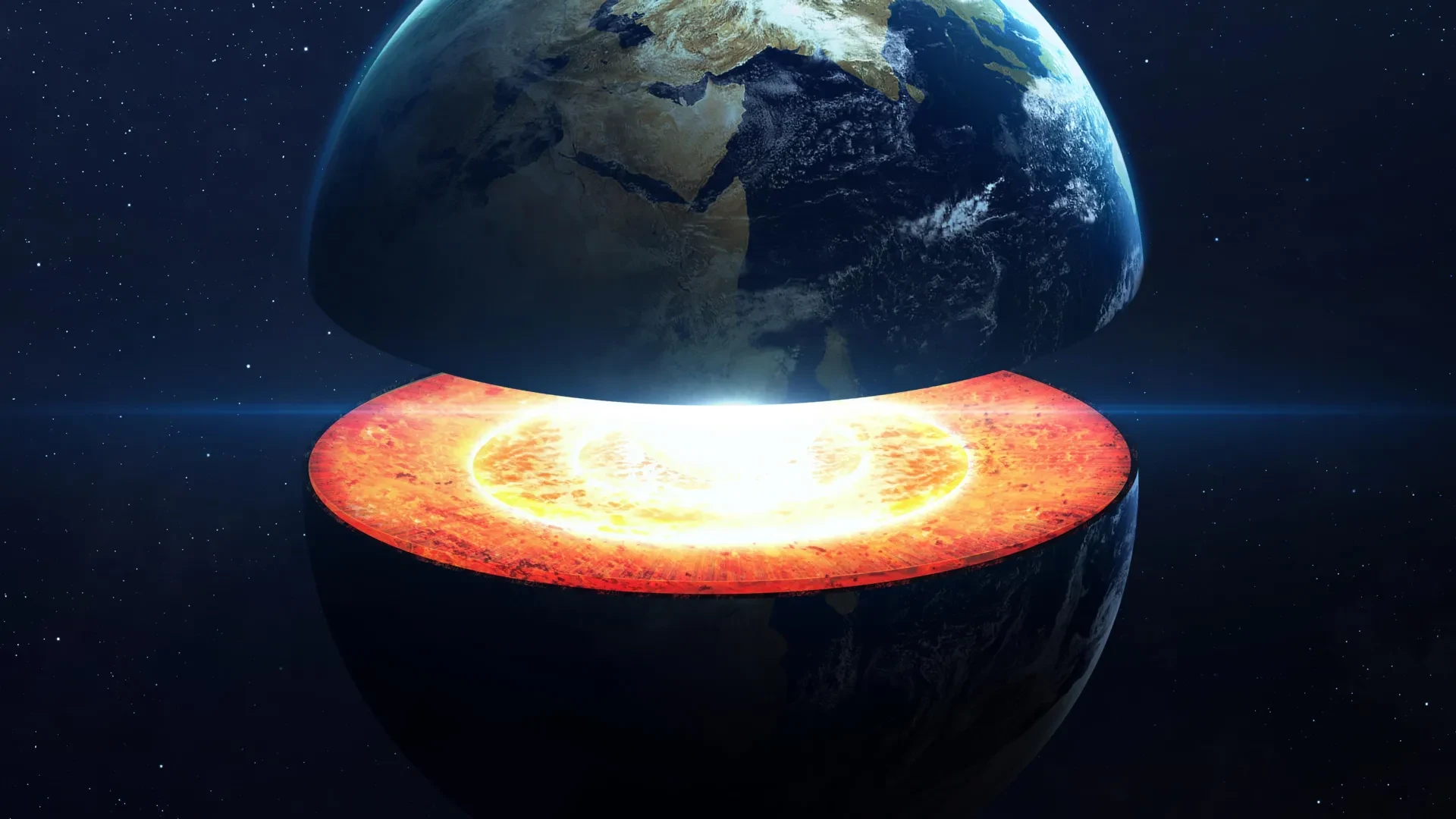
A remarkable rock discovered in the rugged terrain of Papua New Guinea has revealed an unexpected temperature pattern deep beneath Earth’s surface, challenging scientists’ long-held understanding of how tectonic plates move into the planet’s interior. The discovery provides a rare window into the volatile and complex dynamics of subduction zones—regions where the colossal plates that form Earth’s outer shell collide and plunge downward.
An international research team led by the University of Göttingen found that the rock traveled more than 90 kilometers, or 56 miles, underground about four million years ago. Along its arduous subterranean journey, it experienced unusually high temperatures at shallower depths before eventually entering conditions associated with a relatively cooler type of subduction.
The unexpected findings raise fresh, fundamental questions about how heat is distributed inside the Earth and how tectonic plates behave as they descend into the mantle. The detailed results of the study have been published in the scientific journal Nature Geoscience, shedding new light on the hidden thermodynamic processes that drive our planet’s geology.
A Strange Discovery Deep Beneath Earth’s Surface
To understand the significance of the discovery, geoscientists look to the mechanics of Earth’s outer shell, which is broken into enormous, shifting tectonic plates. These slabs of crust slowly glide across the globe over millions of years. When two plates converge, one is frequently forced beneath the other, plunging deep into the Earth’s interior in a geological process known as subduction.
These convergence zones play a foundational role in shaping our planet’s surface and interior environment. Subduction zones are notoriously associated with some of the most powerful earthquakes and most violent volcanic activity known to humanity. At the same time, they act as planetary regulators, helping to control Earth’s climate over geological timescales by recycling vital materials—such as carbon dioxide—deep into the interior and venting them back out through volcanic arcs.
The immense pressures found within these subduction zones can radically transform ordinary rocks into exotic metamorphic materials. One such transformation yields a dense, colorful material known as "eclogite," which is characterized by its distinct red and green mineral composition. Researchers examined one of these specialized eclogite rocks originating from Papua New Guinea, deploying several advanced analytical techniques to read its microscopic history.
Deep inside the heart of the rock, the scientists made a critical discovery: tiny, trapped crystals of coesite. Coesite is an ultra-high-pressure polymorph of silica that can form only under the crushing conditions found deep underground. As the rock underwent metamorphosis and formed its new mineral structure, these microscopic crystals became permanently encapsulated within another mineral host, effectively sealing in and preserving pristine evidence of the extreme pressures and temperatures the rock had endured.
By meticulously studying these microscopic clues, the research team determined that the rock had descended to a depth of at least 90 kilometers beneath the Earth’s surface. At that maximum depth, ambient temperatures reached approximately 800 degrees Celsius, or roughly 1,472 degrees Fahrenheit.
However, it was not the conditions at the bottom of the journey that shocked the researchers, but rather what they uncovered about the rock’s earlier transit.
An Unexpected Shift From Hot to Cold Subduction
When the researchers reconstructed the comprehensive temperature history of the rock, they uncovered a baffling thermal trajectory. At a depth of approximately 45 kilometers, which is roughly 28 miles down, the rock had already reached temperatures of around 700 degrees Celsius, or 1,292 degrees Fahrenheit.
This revelation meant that the rock was only about 100 degrees Celsius cooler at half its maximum depth, even though it still had another 45 kilometers of downward travel ahead of it before reaching its ultimate destination.
This thermal profile flatly contradicted existing geological expectations. Conventional models of subduction zones predict a much more gradual and predictable distribution of heat as rocks sink into the Earth. Instead, the Papua New Guinea rock appears to have experienced unusually hot conditions at relatively shallower depths, before transitioning into an environment characterized by a much cooler temperature pattern farther down.
While the rock’s absolute temperature did increase as it traveled deeper, the actual rate of warming was significantly smaller than scientists would normally anticipate for a descending slab.
Dr. Jan Schönig, a researcher at the Geoscience Center of the University of Göttingen, highlighted the unusual nature of the findings. "Finding this change from hot to cold subduction was unexpected as this contradicts our current thermal models of subduction zones," Schönig explained.
While geoscientists have occasionally discovered other rocks containing evidence of unexpectedly high temperatures in the past, this study marks a significant milestone. It is the first time researchers have been able to reconstruct such a clear, definitive transition between two entirely different thermal conditions as a rock migrated continuously from shallower depths to much greater subterranean realms.
What Could Explain Earth’s Hidden Heat Mystery?
Faced with a thermal puzzle that defies conventional textbook wisdom, the research team has begun exploring several plausible hypotheses to explain the rock’s unusual history.
One leading possibility is that tectonic plates generate substantially more heat at relatively shallow depths than scientists previously understood. As massive plates grind and slide past one another within the Earth’s crust, intense frictional and shearing forces could produce concentrated pockets of additional heating along their boundaries, warming the adjacent rocks long before they reach the deeper mantle.
Another potential explanation is temporal: the subduction zone itself may have been relatively young at the time, meaning it simply had not existed long enough to develop the steady-state, cooler temperature profiles predicted by conventional models. Alternatively, the researchers note that both frictional heating and young subduction dynamics may have worked in tandem to shape the rock’s unusual thermal signature.
Unraveling these temperature disparities is far from a purely academic exercise. Subduction zones drive some of the most powerful and consequential geological processes on Earth, affecting everything from regional seismic hazards to long-term planetary evolution.
By refining our understanding of how heat behaves within these descending environments, geoscientists hope to construct more accurate models that could eventually help evaluate the volatile conditions linked to major earthquakes and volcanic eruptions.
Furthermore, these insights could significantly improve our comprehension of major geochemical cycles. In particular, a clearer picture of subduction dynamics aids the study of the long-term carbon cycle, which helps regulate Earth’s climate by moving carbon back and forth between the surface and the planet’s deep interior.
By illuminating the hidden shifts that occur as tectonic plates descend into the Earth, the discovery provides researchers with a powerful new lens through which to investigate how subduction has operated over millions and billions of years, and how these powerful subterranean engines continue to shape the surface of our planet today.
The research was supported and funded by the German Research Foundation, known as the DFG.