A profound shift is quietly taking place within the global software development community, signaling what many industry observers believe is the beginning of a fundamental transformation in how applications are conceptualized, built, and distributed. Developers have long moved past the initial phase of simply generating basic websites, simple utility dashboards, and straightforward applications using conversational AI assistants. Today, a growing segment of independent developers is attempting something far more ambitious: the recreation of entire, complex commercial software suites, including industry-standard applications like Adobe Creative Cloud and Microsoft Office.
Perhaps the most remarkable aspect of this emerging wave is that many of these ambitious projects are not being engineered by massive corporate teams with millions of dollars in venture capital funding. Instead, they are being built by individual developers leveraging the power of advanced AI coding agents. Two particular names have rapidly captured the attention of the tech world: Reverse Engineer Anything, widely known as REA, and the ArtCraft ecosystem. This movement is shedding light on a persistent bottleneck in the software market that has historically protected legacy monopolies from disruptive competition.
For decades, the software ecosystem has featured free, open-source alternatives to dominant commercial products. Applications like GIMP have long offered free alternatives to Adobe Photoshop, Inkscape has provided vector graphics editing capabilities, and LibreOffice has served as a widely adopted substitute for proprietary word processors and spreadsheet software. Yet, these traditional alternatives have consistently struggled against a formidable economic and psychological barrier known as switching costs.
Most established alternative applications come with distinct interfaces, non-standard keyboard shortcuts, and unfamiliar workflows. A professional creative who has spent a decade mastering the intricate toolsets of Photoshop often finds that transitioning to a different interface feels less like a simple app switch and more like learning an entirely foreign operating system. The new generation of AI-built software clones, however, is approaching this long-standing dilemma from a completely different strategic angle.
Rather than reinventing the digital workspace or forcing users to learn novel workflows, these developers are attempting to closely mimic familiar layouts, intuitive menus, standard keyboard shortcuts, and core functionalities. The theoretical promise is compelling: a user could open a free, independently developed alternative to a major commercial program and immediately know where every tool and panel is located. This approach aims to eliminate extensive tutorial viewing, eradicate unfamiliar operational friction, and potentially bypass expensive, recurring subscription models. Nevertheless, experts note that the actual performance, feature parity, and overall software stability of these early experimental clones still vary quite significantly.
REA Is Making Reverse Engineering More Accessible
At the vanguard of this movement is Reverse Engineer Anything, commonly abbreviated as REA, an AI-powered toolkit designed to streamline the complex process of software reverse engineering. In a remarkably short span of time, the project has garnered extraordinary attention within the developer community, attracting more than 130,000 stars on GitHub and capturing the imagination of programmers worldwide.
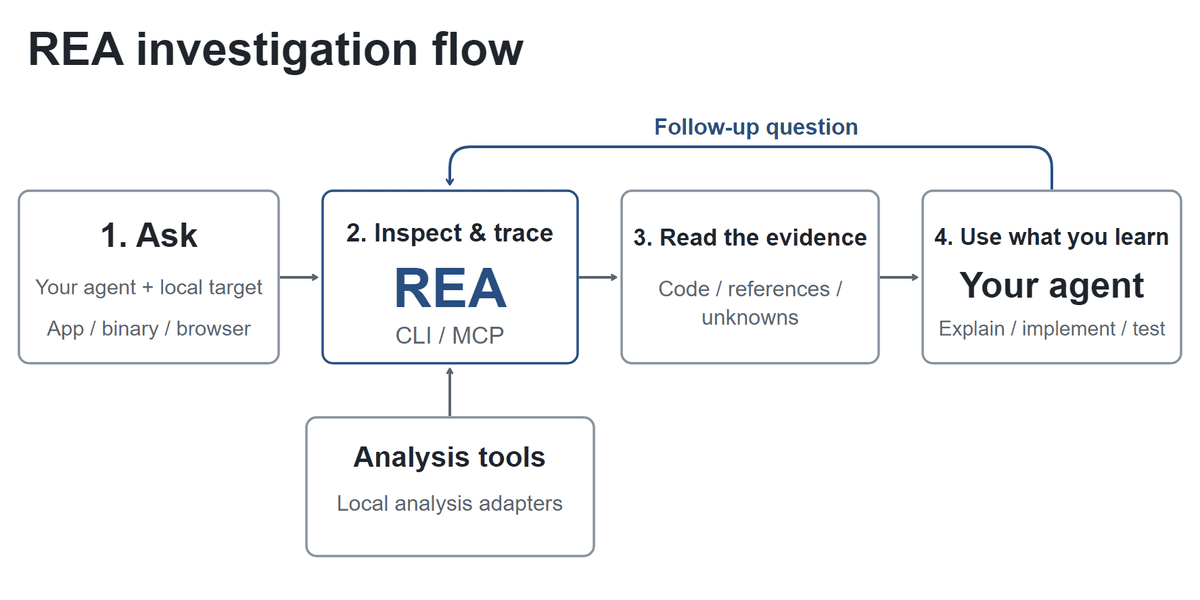
Historically, reverse engineering has been considered a highly specialized discipline requiring years of expert training, deep knowledge of assembly language, complicated technical utilities, and countless hours of tedious manual analysis. REA alters this dynamic by serving as a bridge, connecting modern AI coding agents such as Claude Code, Codex, and Cursor directly with established binary analysis utilities like Ghidra, Hopper, and IDA.
The underlying premise is straightforward. A developer provides an application’s compiled binary file to the system, allowing the integrated AI coding agent to analyze its underlying functions, map out dependencies, examine architectural patterns, and evaluate internal behaviors without requiring direct access to the original source code. The insights gathered from this deep analysis can then be leveraged to reconstruct specific features or inspire the creation of independent, alternative implementations.
Early adopters and independent developers are already experimenting extensively with this workflow. Demonstrations of REA capabilities have included successfully reconstructing complex features such as Notion’s internal clipboard functionality, recreating accurate sound calculations from classic games like DX-Ball, and recovering intricate mathematical routines from older PC-98 architecture software.
The implications for modern software development are vast. By applying similar analytical techniques to expensive commercial software suites, independent developers can theoretically isolate useful features, understand proprietary structures, and share newly developed, open-source alternatives with the broader community. While REA does not magically automate the creation of a flawless, drop-in commercial clone overnight, it dramatically lowers the barrier to understanding existing software architectures, fueling the current viral excitement.
ArtCraft Is Already Recreating Adobe and Microsoft Software
Beyond the foundational tooling provided by projects like REA, individual developers are actively pushing the boundaries of what is possible with direct application cloning. Software developer Brandon Thomas has drawn widespread industry attention for spearheading a collection of Adobe-inspired applications built primarily using the Rust programming language and the Claude AI assistant.
This growing ecosystem includes projects such as PhotoCraft, intended as a lightweight, Photoshop-style image editor; VectorCraft, designed for Illustrator-style vector graphics manipulation; and FilmCraft, aimed at replicating the core interface and editing environment of Premiere. When these projects were first introduced, the developer set an aggressively ambitious target of achieving comprehensive Adobe feature parity within the span of a single month—a timeline that naturally invited considerable skepticism from veteran software engineers.
Yet, the scope of these independent initiatives has quickly expanded beyond the creative domains of Adobe, extending directly into productivity software traditionally dominated by Microsoft. The broader ArtCraft ecosystem has begun experimenting with parallel projects mirroring the functionality of Microsoft Office utilities, demonstrating a sweeping vision for replacing mainstream productivity software.
Industry observers remain fascinated not necessarily by the immediate market viability of these nascent applications, but by the sheer velocity of production. The fact that an individual developer can independently attempt to design, architect, and code multiple complex desktop applications within such a compressed timeframe highlights a fundamental acceleration in software engineering capabilities driven by artificial intelligence.
What Are People Saying About This?
As news of these projects has spread across social media platforms, developer forums, and technical newsletters, public reaction has been sharply divided between intense excitement and pragmatic skepticism. Many software engineers express profound astonishment that individual creators can now rapidly prototype and recreate complex commercial software architectures that previously demanded large engineering teams and years of dedicated development. For everyday creators and budget-conscious professionals, the prospect of utilizing affordable or free alternatives that closely replicate the look, feel, and functionality of premium tools represents an enticing proposition.
At the same time, critics and seasoned software architects raise valid concerns regarding whether these rapidly assembled applications can genuinely match the ironclad reliability, high-performance rendering, and comprehensive edge-case handling of mature software giants like Adobe Photoshop or Microsoft Excel. Early software testers have documented numerous bugs, incomplete feature sets, and occasional performance bottlenecks inherent to code heavily generated by AI agents.
Despite these technical hurdles, the overarching enthusiasm within the developer community remains palpable. The broader conversation has shifted toward questioning the long-term sustainability of expensive subscription models if AI-assisted development tools continue to evolve at their current pace, eventually offering comparable user experiences at a fraction of the cost.
Final Thoughts and Industry Implications
The speed at which this trend has captured public attention is perhaps its most striking characteristic. Projects like REA gained viral momentum in a matter of days, quickly accumulating over 130,000 GitHub stars—an extraordinary milestone for a specialized reverse-engineering utility. This rapid adoption underscores a deep-seated appetite among developers for tools that democratize access to complex software mechanics.
By utilizing AI to investigate expensive commercial programs, isolate desired features, and distribute open-source alternatives, developers are opening up new pathways for software accessibility. Furthermore, this phenomenon extends well beyond any single repository; ArtCraft and similar initiatives point toward a broader industry movement where small teams and solo developers accomplish feats that once required institutional resources.
This dynamic suggests a potential long-term evolution in software ownership and consumption. Rather than remaining permanently tethered to restrictive, recurring subscription models, end users may increasingly find themselves able to run, modify, and maintain software tailored to their exact needs. While significant challenges remain regarding reliability, platform compatibility, and intellectual property compliance, the ultimate disruption may not come from traditional corporate competitors. Instead, the most formidable challenge to established software monopolies could arise from familiar-looking, AI-built applications that leave users with fewer reasons to maintain expensive software subscriptions.