Artificial intelligence has officially transitioned from a peripheral experimental initiative into a core, real-time force shaping modern enterprise data strategy. However, as organizations race to implement predictive, generative, and Agentic AI solutions, a newly published industry study reveals a profound disconnect between executive confidence and operational reality.
According to the 2026 State of Data Integrity and AI Readiness report—published by Precisely in partnership with the Center for Applied AI and Business Analytics at Drexel University’s LeBow College of Business—more than half of data leaders, or 52%, now view artificial intelligence as the primary force influencing their organizational data programs.
While the momentum behind AI integration is undeniable, the comprehensive report uncovers deep structural challenges hidden beneath the surface. As predictive, generative, and Agentic AI technologies move rapidly from experimentation to baseline enterprise expectation, data leaders are discovering that high executive optimism is frequently outrunning actual operational preparedness. This divergence between how confident leaders feel and how prepared their underlying systems and teams actually are has created a critical vulnerability across the global corporate landscape.
The findings indicate that while organizations are heavily invested in the theoretical promise of artificial intelligence, they are struggling to bridge the gap between initial pilot projects and sustainable, scalable production environments. Consequently, industry experts are warning that unless enterprises address these foundational issues directly, the structural weaknesses will ultimately undermine the strategic business outcomes expected from their AI investments.
The Confidence-Reality Disconnect in AI Readiness
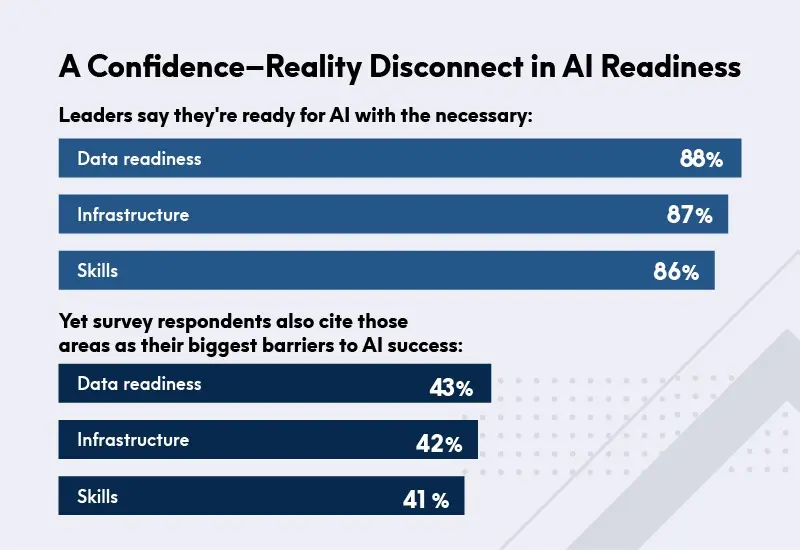
On the surface, corporate readiness appears exceptionally high. When surveyed about their organizational capabilities, 88% of enterprise leaders report that they possess the necessary data readiness to support AI initiatives. Furthermore, 87% claim they have adequate technological infrastructure, and 86% believe their workforce possesses the requisite technical skills.
Yet, in a striking paradox, those exact same three categories are simultaneously cited by the very same leaders as their primary obstacles to achieving long-term AI success. Data readiness is flagged as a major barrier by 43% of respondents, infrastructure constraints by 42%, and workforce skill gaps by 41%.

This striking contradiction points to a systemic issue of measuring organizational readiness at the wrong altitude. At a macro, strategic level, many enterprises genuinely appear ready. They have successfully secured substantial budgets, deployed modern technology platforms, and launched high-profile internal pilots. On paper, artificial intelligence initiatives are tightly aligned with overarching corporate priorities, with 71% of leaders confirming that their AI strategy aligns with general business goals.
However, a closer examination reveals that this alignment rarely translates into rigorous operational measurement. Only 31% of organizations have established formal metrics tied directly to tangible business key performance indicators, such as measurable revenue growth, significant cost reduction, or enhanced customer satisfaction.
This oversight becomes painfully evident when initiatives attempt to transition out of controlled sandbox environments. Pilots frequently succeed in environments where data is meticulously curated, feedback loops are exceptionally tight, and expectations are carefully managed. Once those same models move into full production across disparate corporate functions, complex legacy systems, and varied internal stakeholders, the underlying operational immaturity is exposed all at once. Without clearly defined business alignment, corporate prioritization becomes fuzzy, funding streams become unstable, and promising prototypes frequently stall out before ever maturing into durable, enterprise-grade capabilities.
Skills: The Hidden Multiplier and Risk Amplifier
The persistent talent shortage represents another cornerstone finding of the 2026 report, though the underlying problem is far more complex than a simple lack of available engineering talent. More than half of surveyed leaders, totaling 51%, cite workforce skills as their top requirement for achieving true AI readiness. Yet, only 38% feel genuinely prepared with the appropriate staff skills and comprehensive training programs currently in place.
Significantly, the data indicates that no single skill gap dominates the landscape. Instead, the challenge is systemic, reflecting how deeply interconnected the underlying capabilities of enterprise-grade artificial intelligence truly are. Scaling AI successfully requires a broad array of specialized skill sets working in synchronized harmony across the entire organization, spanning data engineering, rigorous governance frameworks, and executive business translation.
"The skills gap isn’t about a lack of talent in one area; it’s about the need for professionals who can operate across data, business strategy, and AI governance simultaneously," explains Murugan Anandarajan, PhD, Professor and Academic Director at Drexel LeBow’s Center for Applied AI and Business Analytics. "That reality has major implications for how organizations and universities prepare those entering the workforce for the era of Agentic AI."
Among the most severely underestimated competencies in the modern enterprise is the ability to connect abstract business intent directly to complex technical implementation, while simultaneously explaining artificial intelligence outcomes in terms that executive leadership can actually act upon rather than merely admire. Without this translation layer, models tend to operate in dangerous isolation. Without comprehensive governance, operational risks compound rapidly over time. And without rigorous measurement frameworks, return on investment remains an aspirational concept rather than a verifiable business reality.
Navigating the Path from Momentum to Maturity
The report outlines a clear developmental progression for organizations attempting to close the persistent gap between theoretical readiness and tangible business outcomes, noting that the appropriate remedy depends heavily on an enterprise’s current level of alignment.
For organizations reporting low AI alignment—those rating their success in achieving strategic objectives as "not at all" or "not well"—the primary challenge is rarely a deficiency in modern tools or raw technical talent. Rather, the root cause is a distinct lack of executive direction and clarity. Leaders in these struggling organizations often mistakenly assume that infrastructure limitations or technical skill shortages are the primary culprits. However, the data demonstrates that an absence of a clear executive mandate is what truly stalls progress, leaving investments fragmented and unable to gain necessary enterprise traction.
Meanwhile, mid-tier performers—defined as those achieving their artificial intelligence goals "somewhat"—generally understand what operational success looks like, but continually struggle with resource allocation. These organizations most frequently cite financial investment and workforce skills as their most formidable barriers. For these companies, sustained progress depends heavily on simultaneously building out robust technical infrastructure and cultivating the workforce required to operationalize AI across broader business units.
For high-performing enterprises that already report achieving strong alignment, rating their goal achievement as "well" or "very well," the strategic focus shifts decisively from initial experimentation to enterprise-wide scale. These advanced teams have already established clear direction and early operational success. However, maintaining that momentum requires a continuous evolution of both underlying infrastructure and staff capabilities. Even among this elite group, nearly half of their strategic focus remains dedicated to strengthening these foundational capabilities, proving that AI maturity is an ongoing discipline rather than a definitive finish line.
Ultimately, the data reveals a high degree of organizational optimism, with 32% of leaders anticipating a positive return on investment from their artificial intelligence initiatives within the next six to eleven months, despite persistent, acknowledged gaps in governance, specialized skills, and performance measurement. Industry experts emphasize that while optimism is a vital driver of innovation, optimism unsupported by rigorous operational foundations remains fragile—particularly as corporate expectations soar and external scrutiny intensifies.
Achieving genuine readiness requires an integrated operating model that successfully unifies technical infrastructure, data integrity, workforce capabilities, and executive governance. Organizations that invest in these fundamental disciplines today are positioned to unlock the most scalable and sustainable value from artificial intelligence tomorrow.