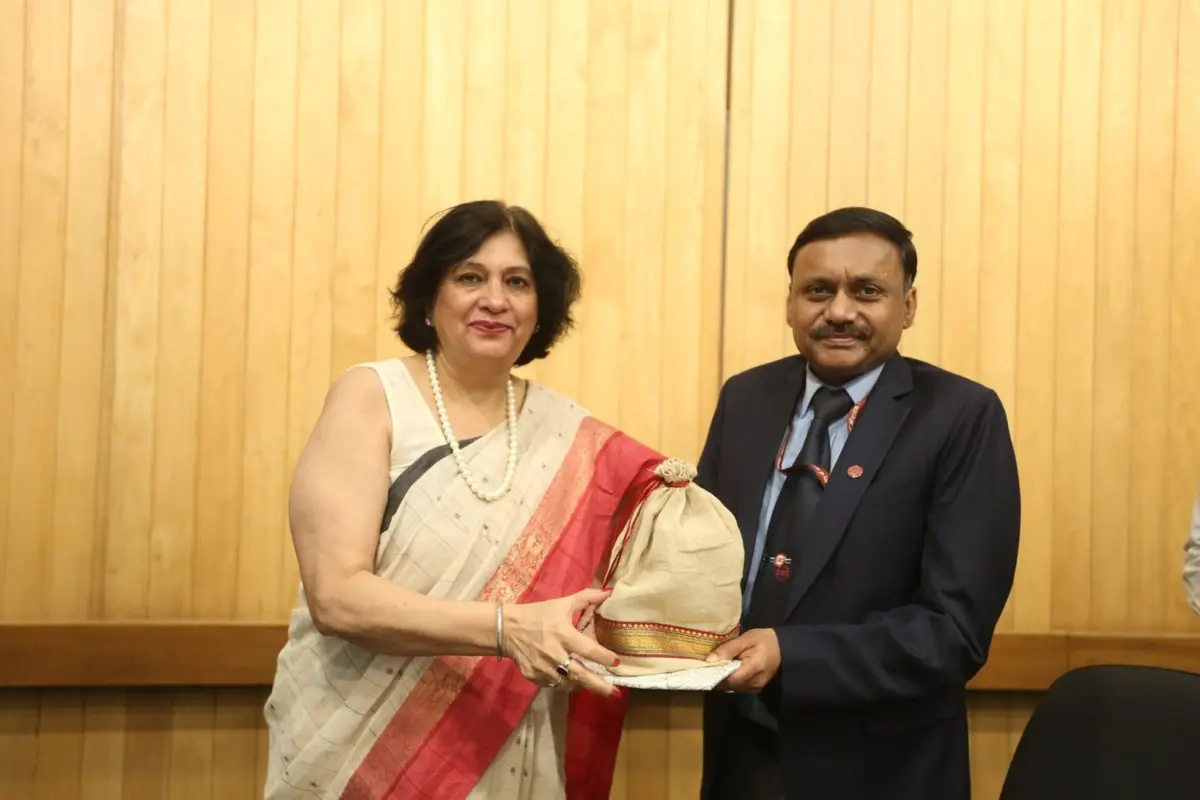
NEW DELHI — As India grapples with the concurrent crises of choking urban air pollution and escalating national energy demands, the pivot toward electric mobility has rapidly transitioned from an environmental talking point into an urgent strategic necessity. Yet, according to Dr. Amit Kumar Jain, Director of Operations and Services at the Delhi Metro Rail Corporation (DMRC), viewing this monumental shift merely through the narrow lens of replacing internal-combustion engine vehicles with electric ones misses the larger economic, structural, and environmental opportunity.
Addressing an attentive audience in the capital during the TERI–India Habitat Centre Lecture and Discussion Series on Sustainable Development, Dr. Jain delivered a comprehensive address centered on the theme “Beyond Tailpipe: Electric Mobility at the Intersection of Air Quality and Energy Security.” Speaking on September 21, he cautioned policymakers, urban planners, and environmental experts that electrification in isolation cannot resolve the complex structural pressures facing India’s rapidly urbanizing landscape. Instead, he argued for a paradigm shift—one that inextricably connects private vehicles, expansive mass transit networks, robust physical infrastructure, evolving power grids, and the everyday commuting habits of millions of citizens.
The core of Dr. Jain’s argument challenges the prevailing commercial narrative surrounding the green transition. “The question is not simply whether we can replace internal-combustion vehicles with electric vehicles,” Dr. Jain told the gathering. “The question is whether we can create an integrated mobility system that addresses air pollution, energy security and the growing demand for transportation.”
The Scale of India’s Urban Transport Challenge
The urgency underlining Dr. Jain’s remarks is anchored in hard statistical realities regarding India’s energy consumption and carbon footprint. The nation’s transportation sector remains inextricably bound to petroleum consumption and imported crude oil, draining national economic reserves while leaving cities vulnerable to global supply shocks. Concurrently, road transport bears the brunt of transport-related ecological degradation.
Background research compiled by The Energy and Resources Institute (TERI) for the lecture highlights that the transport sector is responsible for approximately 13 percent of India’s total greenhouse gas emissions, with road transport alone accounting for a staggering 90 percent of that share. Complementing these figures, data from the Bureau of Energy Efficiency (BEE) indicates that transportation consumes about 18 percent of India’s overall energy supply, with motorized road vehicles serving as the primary driver behind spiraling carbon dioxide emissions.
In this high-stakes environment, mass public transport emerges not merely as a supplementary transit option, but as a critical backbone for any viable long-term environmental strategy.
The Power of Moving Millions Together
To contextualize what high-capacity electric mobility can achieve when deployed at an institutional scale, Dr. Jain pointed directly to the operational footprint of the Delhi Metro. Currently, the DMRC network spans an impressive 416 kilometers, servicing 303 stations across 12 operational corridors—including the high-speed Airport Express line. On any given workday, this vast network facilitates approximately seven million passenger journeys.
These numbers illustrate a profound proposition: the most substantial environmental and efficiency dividends of electrification may stem less from tinkering with the propulsion technology of individual cars and more from the sheer mathematical efficiency of moving massive crowds collectively.
“If each of these passengers were to make the same journey in an individual vehicle, imagine the additional pressure that would place on our roads, our energy consumption and our air quality,” Dr. Jain noted.
By taking millions of individual vehicle trips off the road daily, mass transit systems, suburban rail networks, and electric buses prove that urban mobility can be scaled sustainably while systematically decoupling transport growth from private, fossil-fuel-dependent automobile ownership.
Electric Mobility Is Not a New Phenomenon
While modern public discourse frequently treats the electric vehicle transition as an unprecedented technological disruption, Dr. Jain offered a valuable historical corrective. Far from being a recent invention, electric traction has quietly formed the backbone of India’s heavy rail infrastructure for an entire century.
India’s pioneering electric train journey took place in 1925, running between Bombay Victoria Terminus and Kurla. Over the decades, Indian Railways has methodically expanded upon this legacy. According to data released by the Ministry of Railways, approximately 99.4 percent of the broad-gauge railway network across the country had been fully electrified by February 2026.
“The idea that electric mobility is something new is not correct,” Dr. Jain observed. “Electric traction has been part of our railway system for almost a hundred years.”
The century-long journey of the nation’s railways also offers a crucial technical lesson for modern urban planners: the ecological benefits of electric traction are fundamentally tied upstream to how electricity is generated, and downstream to how efficiently the entire transit apparatus operates.
Efficiency Beyond the Tailpipe
Delving deeper into system-wide optimization, Dr. Jain spotlighted advanced engineering solutions already integrated into modern metro operations, such as regenerative braking. This technology captures the kinetic energy generated when a heavy train decelerates, converting it back into usable electrical energy rather than letting it dissipate wastefully as thermal heat into tunnels and stations.
DMRC has long relied on regenerative braking as a cornerstone of its comprehensive energy-efficiency framework. Internal sustainability documentation reveals that regenerative braking captures between 30 and 40 percent of the total traction energy consumed by the system. Government technical assessments corroborate these findings, recording substantial energy recycling across the Delhi Metro network.
“When brakes are applied, the mechanical energy of the moving train can be converted back into electrical energy,” Dr. Jain explained. “That energy can then be used by another accelerating train.”
This mechanism exemplifies a broader philosophy that should guide urban transit policy: the ultimate objective must extend beyond mere vehicle electrification to encompass the radical enhancement of total system-wide energy efficiency.
From Park-and-Ride to Park-and-Charge
Another vital pillar of an integrated transport strategy involves seamless multi-modal connectivity—bridging the gap between private choices and public networks. Dr. Jain detailed ongoing initiatives by the DMRC to transform metro stations into multi-functional mobility hubs complete with charging infrastructure and innovative "park-and-charge" business models.
This infrastructure allows urban commuters to utilize private electric two-wheelers or cars for the initial leg of their journey, securely dock and charge their vehicles at the metro station, and complete the longer portion of their commute via the high-capacity rail network.
A prominent example of this concept in action is the dedicated charging facility developed at Noida City Centre under a cooperative "Park and Charge" framework. Commuters can leave their electric vehicles to replenish their batteries while they traverse the city underground or above ground via the metro.
“The idea is that you can come to the metro station, park and charge your vehicle, use the metro for your journey and collect your vehicle when you return,” Dr. Jain said.
By embedding charging stations into existing transit nodes rather than treating them as isolated retail or fuel stations, cities can alleviate one of the most persistent bottlenecks plaguing EV adoption: consumer anxiety over charging convenience and availability.
The Solution Lies in Integration
Ultimately, Dr. Jain emphasized that India’s policy framework must avoid treating electric mobility as a series of disconnected product categories. The future demands a cohesive strategy that knits together electric cars, commercial electric buses, two-wheelers, last-mile micro-mobility options, metro lines, and mainline railway systems.
Furthermore, this symbiotic network requires concurrent advancements in clean energy generation to green the grid, alongside urban planning policies that deliberately incentivize shared, efficient public transport over private automobile dependency.
“We should not look at electric mobility in isolation,” Dr. Jain asserted. “We need an integrated approach, e-buses, e-bikes, last-mile connectivity, metro systems and railway networks all working together.”
The distinction carries profound implications for urban design. Simply swapping every conventional internal-combustion vehicle on Indian roads for a battery-powered equivalent would curb localized tailpipe emissions, but it would leave unaddressed structural crises like chronic traffic congestion, severe spatial constraints on public roads, escalating aggregate energy demands, and the inherent inefficiencies of single-occupancy travel.
“The solution is not only moving from diesel to electric,” Dr. Jain summarized. “It is about creating an integrated electric mobility ecosystem.”
The Road Ahead
As India’s metropolitan centers expand at an unprecedented pace, the coming decades will generate an exponential surge in urban travel demand. The defining challenge for policymakers will be satisfying this mobility appetite without locking burgeoning cities into cycles of permanent gridlock, hazardous smog, and heavy dependence on imported petroleum.
The operational blueprint forged by the Delhi Metro offers a viable template: combining mass transit scale with advanced energy efficiency, digital integration, and comprehensive first- and last-mile connectivity.
For a rapidly developing nation striving to balance soaring economic aspirations with cleaner air and long-term energy sovereignty, the path forward requires looking past the individual vehicle. As Dr. Jain’s insights suggest, the true measure of success will not be found simply in how effectively a country can electrify its cars, but in how intelligently it can electrify mobility itself.