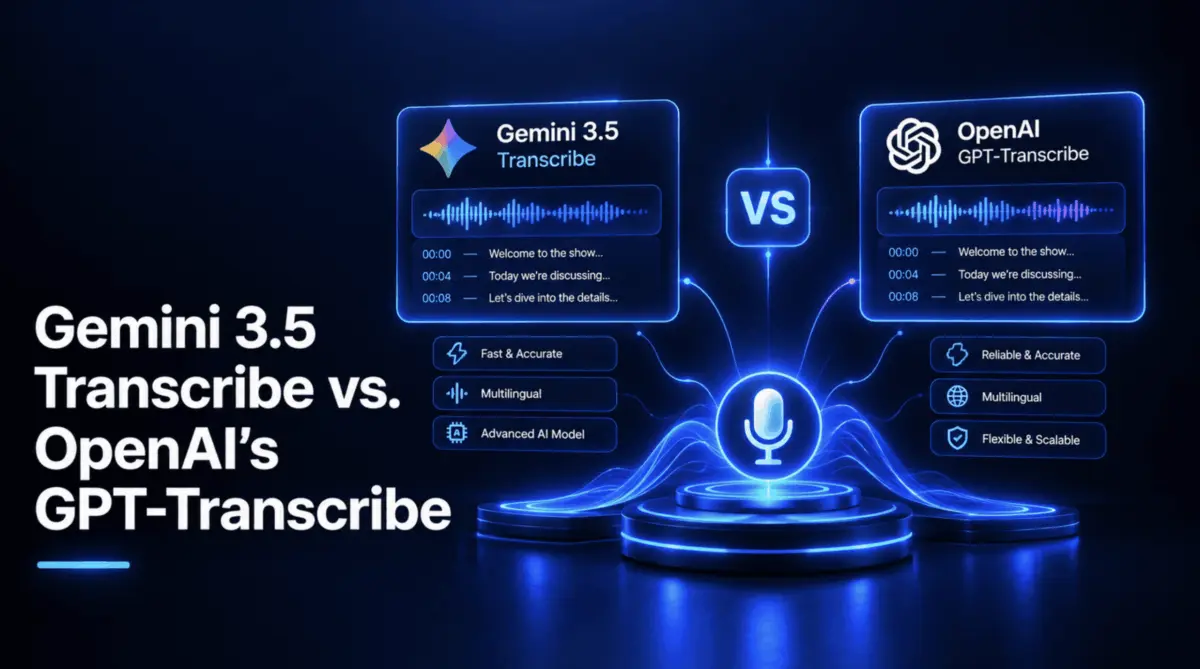
The race for supremacy in artificial intelligence speech recognition has entered a new phase as tech giants roll out high-performance transcription architectures within weeks of each other. Google officially shipped Gemini 3.5 Transcribe on August 26, 2026, setting the stage for a direct and timely market comparison with OpenAI. Just four weeks earlier, on July 28, 2026, OpenAI released its own current flagship speech-to-text model, GPT-Transcribe. Because both labs launched their latest generation transcription engines in such close temporal proximity, industry analysts finally have a true apples-to-apples baseline rather than having to stack models from completely different technological eras against one another.
Interestingly, both companies have split their respective commercial offerings down the exact same architectural lines. Each lab provides one specialized model engineered specifically for real-time streaming audio and another built for processing pre-recorded files. This dual-track approach by both Google and OpenAI underscores how modern AI infrastructure must simultaneously cater to two distinct use cases: ultra-low-latency live applications like real-time captioning or voice assistants, and high-accuracy, asynchronous batch processing for multi-speaker meetings, legal depositions, and extensive corporate call logs.
Google’s introduction of Gemini 3.5 Transcribe marks a major evolution over its predecessor, Chirp 3. In its public documentation and launch materials, Google heavily emphasizes raw speed, reporting a dramatic 70 percent improvement in time-to-final-transcription when compared directly to Chirp 3, alongside significant leaps in general linguistic accuracy. Rather than routing all audio through a single, monolithic endpoint, Google has divided the new system into distinct model identifiers. Developers working with continuous, sub-second latency streaming can tap into gemini-3.5-transcribe-live via the Live API. Meanwhile, operations involving pre-recorded audio, multi-party business meetings, and customer support call logs are directed to gemini-3.5-transcribe through the Interactions API.
Independent benchmark metrics highlight the performance of Google’s new architecture. According to evaluations conducted by Artificial Analysis and cited directly in Google’s official release, Gemini 3.5 Transcribe achieves a 4.0 percent word error rate for streaming use cases and drops to an impressive 2.6 percent for non-streaming file transcription. When evaluated on the significantly harder FLEURS multilingual benchmark, Google reports a word error rate of 5.50 percent for streaming and 5.04 percent for non-streaming workflows.
Beyond raw transcription accuracy, the pre-recorded iteration of Gemini 3.5 Transcribe includes native multi-speaker attribution out of the box. The model can reliably distinguish up to three distinct speakers without requiring a separate speaker diarization pipeline, with support for larger group settings currently listed as experimental. Furthermore, it delivers word-level timestamps natively, supports more than 85 languages, handles custom user vocabulary, and possesses the capability to delegate downstream tasks—such as image generation or deep file analysis—to other Gemini models through function calling. This capability is already active within the Gemini application ecosystem on macOS.
OpenAI’s GPT-Transcribe
OpenAI has its own rich lineage in speech recognition, having initially disrupted the market with its open Whisper architecture. Whisper was eventually superseded in March 2025 by gpt-4o-transcribe, which marked OpenAI’s first transcription model built directly upon the advanced GPT-4o architecture rather than the older Whisper framework. GPT-Transcribe, which rolled out on July 28, 2026, represents the next logical evolution in that lineage. OpenAI now officially recommends GPT-Transcribe over older iterations like whisper-1, gpt-4o-transcribe, and gpt-4o-mini-transcribe for general recorded speech in its original language. Mirroring Google’s structural strategy, OpenAI also offers a dedicated streaming sibling named gpt-live-transcribe for continuous, low-latency conversational sessions.
Performance benchmarks published by OpenAI demonstrate substantial gains over older technologies. When evaluated against Common Voice across a diverse set of 22 languages, GPT-Transcribe roughly cuts the word error rate of the original whisper-1 in half, plummeting from 40.37 percent down to 19.27 percent, while simultaneously operating at a 25 percent reduction in cost per minute compared to its immediate predecessor. Commercial pricing for the OpenAI stack sits at $0.0045 per minute for standard file transcription, while the streaming variant bills at $0.017 per minute of session audio.
The model natively accepts specialized keyword hints and multi-language hints to assist with complex domain-specific terminology and code-switching scenarios, while also providing metadata indicating which languages it detected in the audio feed. However, an operational gap remains evident in the standard OpenAI offering: plain GPT-Transcribe does not natively perform speaker diarization or output word-level timestamps in a single pass. Developers requiring speaker separation must still route audio through a separate model, such as gpt-4o-transcribe-diarize, while retrieving precise timestamps often necessitates falling back to the legacy whisper-1 model.
Analyzing Real-World Use Cases
Examining how these models perform in practical scenarios reveals where their architectural differences matter most. Consider the task of transcribing a recorded three-person corporate meeting where identifying who said what is just as important as capturing the words themselves. In this scenario, Google’s built-in diarization eliminates the need for complex, multi-step processing pipelines. Developers can pass raw audio bytes alongside a simple natural language prompt to the file transcription endpoint, receiving an output that automatically segments the dialogue by speaker labels and timestamps. This streamlined output can flow directly into downstream post-call analytics pipelines without requiring secondary model invocations.
On the other end of the spectrum, live event streaming and real-time captioning prioritize speed and continuous connectivity above speaker attribution. For these applications, OpenAI’s streaming setup through a persistent WebSocket connection provides a clear framework. Rather than uploading static audio files after a recording concludes, applications can continuously append streaming audio buffers to a persistent session. The gpt-live-transcribe model returns incremental text updates—delivered as delta events—the moment the model builds enough confidence to commit to the text. This real-time incremental delivery is precisely what live-captioning displays require to remain synchronized with a live speaker.
Weighing the Technical Trade-Offs
Both models bring distinct strategic advantages to enterprise developers and software engineers building voice-enabled applications. Gemini 3.5 Transcribe’s integration of native speaker diarization and word-level timestamps within its primary file endpoint makes it a particularly compelling choice for collaborative business environments, meetings, and call logging applications. By bypassing the need for secondary model calls to parse multiple speakers, Google reduces pipeline complexity and infrastructure overhead for multi-party audio recordings.
Conversely, OpenAI’s GPT-Transcribe maintains a strong position for straightforward, single-speaker transcription workflows and real-time live captioning where speaker attribution is unnecessary. Its competitive pricing structure, extensive keyword hinting capabilities, and reliable streaming latency make it an efficient option for high-volume deployments. As both Google and OpenAI continue to refine their respective speech architectures, developers must weigh these nuanced trade-offs in accuracy, cost, latency, and native feature sets to select the optimal transcription engine for their specific engineering requirements.