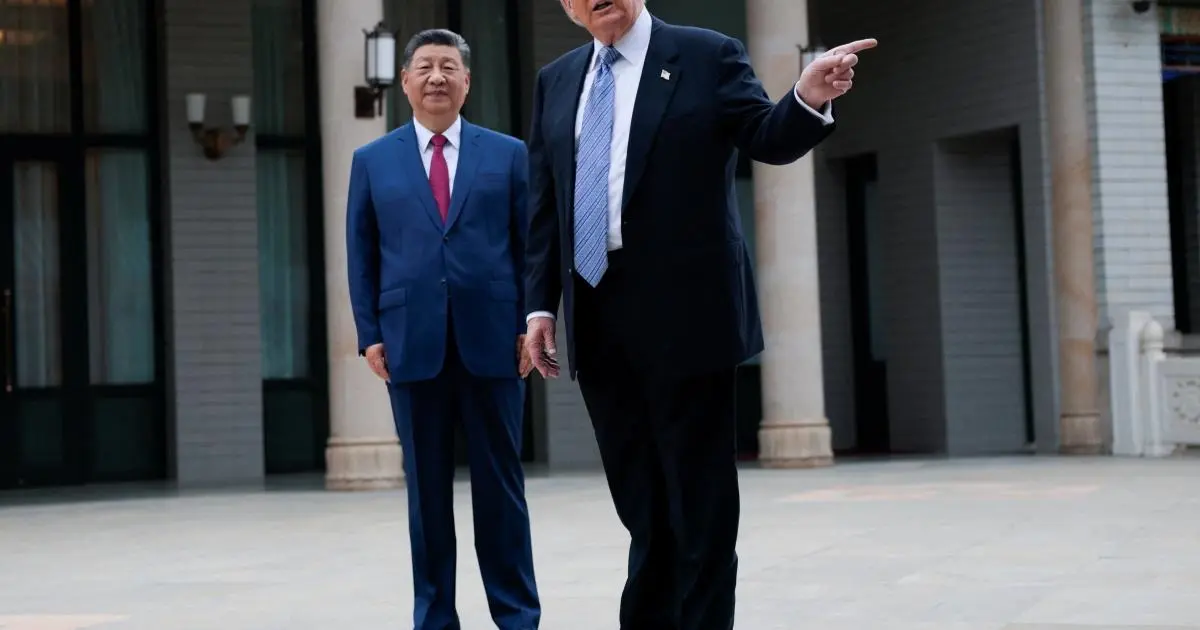
The United States has long harbored an almost mythic faith in the power of presidential summitry. Twentieth-century successes in diplomacy set dangerously high expectations across generations of American leaders. From the unconditional surrenders of Germany and Japan in 1945 and the creation of NATO in 1949, to John F. Kennedy resolving the Cuban Missile Crisis through secret channels in 1962, and Ronald Reagan and Mikhail Gorbachev winding down the Cold War via landmark arms-control agreements in the 1980s, history taught Americans that skilled leaders could break seemingly intractable political deadlocks through decisive, personal interventions.
This hope runs especially deep among China watchers. Their understanding of optimal U.S.-China diplomacy was forged during the game-changing week in 1972 when President Richard Nixon and National Security Adviser Henry Kissinger traveled to Beijing to meet with Chairman Mao Zedong and Premier Zhou Enlai, effectively transforming the Cold War from a bipolar contest into a triangular one. That momentum continued in 1979 when President Jimmy Carter welcomed paramount leader Deng Xiaoping to the White House with grand theatricality, officially restoring formal diplomatic relations between Washington and Beijing.
Today, as bilateral relations spiral into an increasingly adversarial state, the longing for another breakthrough delivered by "great men" has grown acute. President Donald Trump has actively fed that desire, boastfully insisting that he alone can cut the necessary deals through sheer force of personality. Even seasoned foreign policy realists have occasionally fallen prey to these visions. When a Beijing summit between Trump and Xi Jinping was announced, it was sanguinely billed in foreign policy circles as a "geopolitical heavyweight matchup" capable of changing the course of the U.S.-China competition.
Yet no such breakthrough materialized. The May summit in Beijing, attended by members of the press corps, sustained a cryptic peace—a "constructive strategic stability," as Xi euphemistically termed it—but failed to alter the fundamentally adversarial nature of the relationship. The two superpowers remain locked in strategic ambiguity, defined by endless bouts of punitive "chokehold" diplomacy as each exploits its control over critical supply chains to pressure the other.
As another Trump-Xi summit looms in Washington, yearnings for a conclusive breakthrough are resurfacing once more. They should be firmly tempered. The same structural and personal limitations that crimped the May summit will constrain the upcoming meetings. The problem extends beyond mere ideological and political differences; neither leader is temperamentally suited to the give-and-take bargaining that their current rivalry demands. Xi equates compromise with weakness, struggling with the core logic of diplomacy, while Trump remains so contradictory and impetuous that his pandering, "tech-bro" persona sits in uncomfortable tension with his belligerent instincts, rendering effective, sustained diplomacy nearly impossible.
In the past, Washington and Beijing achieved breakthroughs when geopolitical conditions aligned and leaders possessed genuine diplomatic acuity. Today’s circumstances are far less favorable. Despite Trump’s performative camaraderie, he and Xi lack the symmetries required to build the genuine fraternity and trust needed to resolve deep-seated structural problems. As long as these two men lead their respective nations, their summits will, at best, manage the rivalry on the margins, and at worst, exacerbate it by letting friction turn into a direct collision.
The Trust Factor
Historically, successful U.S.-Chinese summits have relied on a leader’s ability to transcend deep-seated distrust. The superficial flattery and bonhomie at which Trump excels when trying to court foreign counterparts fail to generate the deeper confidence that once reassured Chinese leaders. Establishing trust has never been easy for Washington and Beijing, given that Chinese leadership remains steeped in historical anxieties regarding Western ambitions of regime change targeting communist systems.
Nixon understood this psychological reality. Before traveling to China, he laid the conceptual groundwork by declaring it time to welcome Beijing into "the family of nations," signaling a willingness to accept China’s political system for the sake of opposing Soviet expansionism. To build transparency, Nixon dispatched Kissinger and Winston Lord to meet secretly with Zhou Enlai. Kissinger ultimately developed a profound intellectual and personal respect for Zhou, praising him as one of the most impressive figures he had ever encountered. This mutual respect signaled the kind of parity that Marxist-Leninist leaders historically craved from the West. Unlike Trump, who praised Xi as a "great leader" and called it an "honor" to be his "friend," Kissinger’s diplomatic appreciation was anchored in substantive engagement.
Zhou, in turn, fostered rapport through self-aware humor, welcoming Kissinger in 1971 by joking that the Chinese Communist Party did not possess three heads and six arms, but was instead composed of rational interlocutors.
When Carter and Deng met in 1979, they recreated this summitry magic. Despite Carter’s willingness to abandon Taiwan and transfer diplomatic recognition to Beijing, the two leaders interacted with a relaxed, mutual congeniality that signaled to both American and Chinese publics—through the first live overseas satellite broadcast in Chinese state television history—that former adversaries could move past past grievances.
A similar moment of high-level fraternity unfolded in 1998 when President Bill Clinton met with Chinese Communist Party General Secretary Jiang Zemin in Beijing. Despite the lingering shadow of the 1989 Tiananmen Square crackdown, the two leaders walked together into the Great Hall of the People following a full military honors ceremony. Jiang subsequently ordered state television to broadcast their joint press conference live, giving propagandists no opportunity to censor remarks that touched on routine trade and nonproliferation alongside sensitive topics like human rights and the Dalai Lama, signaling a genuine post-Cold War era of engagement.
The Art of Indifference
The dynamic during the May summit in Beijing stood in stark contrast to these historical precedents. While Trump proclaimed that he and Xi "had a fantastic relationship" and boasted of solving problems others could not, his courtship was notably one-sided. Xi remained aloof, offering minimal displays of rapport.
Substantive indicators of a cool reception were apparent from the moment Air Force One touched down. Trump was met not by Xi, but by Vice President Han Zheng, who ranks eighth in the party hierarchy. Furthermore, the absence of a joint press conference and the omission of a public address at a university—staples of previous presidential visits—stripped the summit of vital goodwill-building exercises. Neither leader was willing to risk unscripted moments.
Instead, Xi staged a tightly choreographed, substantively thin visit to Zhongnanhai, the walled compound near the Forbidden City where top leaders reside. When Trump asked if other global leaders were brought there, Xi noted it was extremely rare before mentioning Vladimir Putin—conveniently omitting that Nixon, George W. Bush, and Barack Obama had also been hosted there.
Shortly after Trump’s departure, clear signals of Beijing’s broader geopolitical alignments were visible on the tarmac at the Beijing airport, where a Russian Ilyushin II-76 transport plane arrived from Moscow laden with armored limousines and communications equipment for Putin’s own upcoming visit—his 25th in 26 years in power. The imagery underscored that China maintained powerful alternative partners and was no longer tethered to Washington’s good graces.
Impervious by Design
Trump’s eagerness to secure a grand deal through personal flattery fundamentally misread Xi’s strategic calculus. While Xi may have welcomed the praise as evidence that "the East is rising and the West is declining," he remains deeply suspicious of Washington’s long-term intentions. Throughout Trump’s two terms, U.S. policy toward China has oscillated wildly between conciliation and confrontation, leaving little coherent groundwork for diplomats to build upon.
At the same time, Xi’s personal traits and Leninist governance style actively hinder effective negotiation. Cultivating an image of disciplined, unyielding strength, Xi avoids unscripted interactions that might expose awkwardness, thereby shutting down the exact moments of vulnerability where traditional diplomacy often succeeds.
Rather than adopting American approaches to personalized diplomacy, Xi draws from the ancient Chinese tradition of legalism. Championed by third-century BC thinkers like Han Fei—whom Xi has explicitly quoted in recent speeches—legalism emphasizes a ruthless, top-down form of statecraft where law serves as an instrument of absolute state power rather than a restraint upon it. Han Fei counseled leaders to remain aloof, emotionless, and hidden from the governed to avoid projecting vulnerability. Xi’s guarded public demeanor and history of domestic political purges embody this legalist philosophy, making him far more akin to Mao Zedong than to any modern reformer.
The Dangers of Disappointment
Observers approaching the upcoming Washington summit must calibrate their expectations accordingly. Trump’s belief that he can mold Xi into a collaborative partner through persistent flattery or personal blandishments ignores the deep-seated psychological armor of a leader schooled in suspicion and absolute control.
For administration officials, guarding against Trump’s potential frustration is critical. Sensitive to suggestions that foreign strongmen have rebuffed his appeals, Trump may react to Xi’s inevitable impassivity with sudden shifts toward retaliation. Previous patterns suggest that a lack of diplomatic return can quickly prompt a return to hawkish measures, such as new tariffs or politically charged accusations regarding trade and labor practices. Without realistic expectations, the upcoming summit risks exacerbating tensions rather than resolving them.