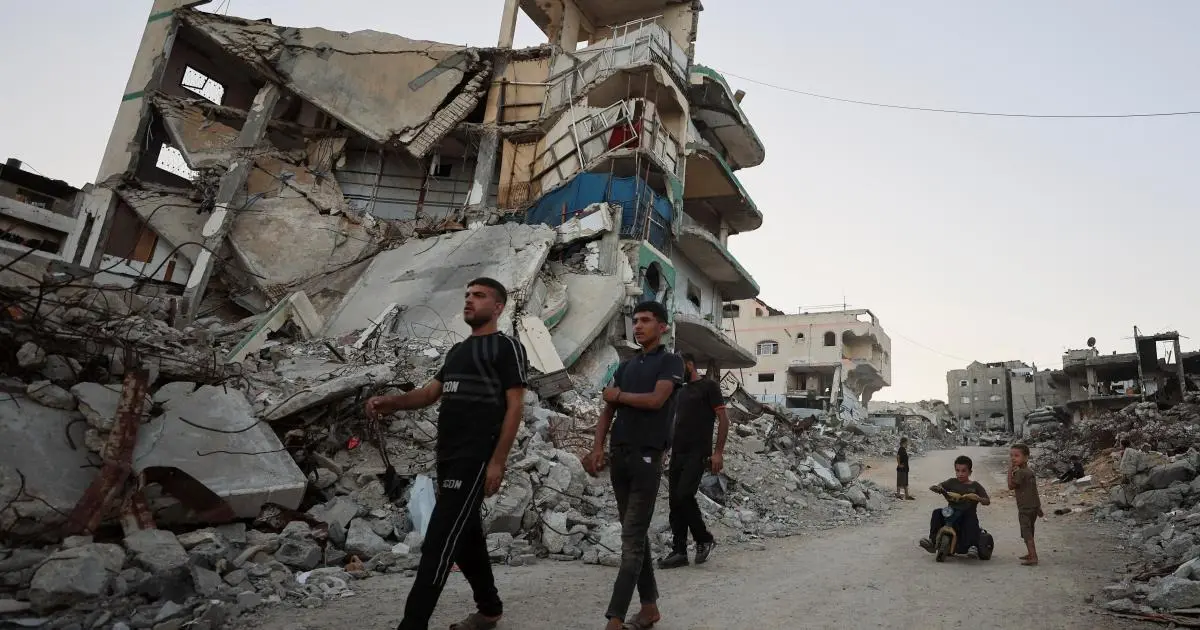
In September 2025, U.S. President Donald Trump unveiled an ambitious peace initiative designed to bring a definitive end to the devastating war in Gaza. Promising not only the comprehensive physical reconstruction of the ruined enclave but also the dawn of "eternal peace in the Middle East," the proposal generated global attention and cautious optimism. Yet, one year later, that vision has stalled significantly across multiple fronts.
Hamas has steadfastly refused to disarm, and the Israeli military continues to maintain operational control over more than 60 percent of the Gaza Strip. Meanwhile, the transitional technocratic government and international security force promised under the framework have failed to materialize. Large-scale reconstruction remains barely underway, leaving the vast majority of ordinary Gazans to struggle daily for basic survival needs, including adequate food, clean water, and stable shelter.
As Israel approaches a pivotal national election in October, Prime Minister Benjamin Netanyahu has adopted an increasingly hard-line stance, explicitly rejecting a U.S.-backed disarmament deal. Although the 25-country Board of Peace—the international implementation mechanism established by Trump—unveiled a more detailed reconstruction program this week, high-level officials have informed media outlets such as the Times of Israel that the group has paused active pressure on Netanyahu to comply with the plan, largely deferring to the political dynamics of the upcoming domestic vote.
This uncompromising posture strongly resonates with the majority of the Israeli electorate, who harbor deep skepticism regarding Palestinian willingness to engage in genuine diplomacy or negotiations. Consecutive public opinion surveys over recent years have consistently shown that an overwhelming percentage of Israelis believe Palestinians hold no interest in peace, leading to the prevailing domestic consensus that Israel lacks a credible negotiating partner. For instance, a poll conducted in July by Tel Aviv University asked Jewish Israelis to assess Palestinian intentions. Seventy-two percent of respondents stated they believed Palestinians were "moderately or very opposed" to any form of peace negotiations, while over 80 percent expressed the conviction that a lasting peace with Israel was entirely unachievable.
However, this pervasive public perception starkly contrasts with the documented realities of what most Palestinians believe and declare themselves prepared to accept. For two decades, Arab Barometer—a prominent, long-running public opinion survey project—has conducted comprehensive, scientific polling across both the West Bank and Gaza. Their most recent broad-scale survey, fielded in October 2025, revealed that a clear majority of Palestinians regard diplomatic negotiations, rather than armed resistance, as the most viable path to resolve the Israeli-Palestinian conflict permanently. These findings have remained remarkably consistent, reinforced further by polling questions posed last August by the Ramallah-based Palestinian Center for Policy and Survey Research (PCPSR), a key regional partner of Arab Barometer.
In reality, a significant portion of the Palestinian population maintains a clear and pragmatic vision for the future. Support for a two-state solution outpaces any other proposed political resolution by a wide margin. Remarkably, residents of the Gaza Strip—despite having endured the most catastrophic destruction over the past three years—tend to exhibit the highest degree of pragmatism. An even greater proportion of Gazans are open to a two-state framework compared to Palestinians living in the West Bank. Furthermore, half of all Gazans indicate a willingness to support Arab states normalizing diplomatic relations with Israel, provided the diplomatic process includes tangible, binding steps toward Palestinian self-determination.
At the same time, public confidence in both Hamas and the Palestinian Authority (PA) has eroded to historic lows. Palestinians widely judge that neither faction has succeeded in securing their physical safety or meaningfully improving their daily standard of living, creating an urgent public demand for structural political renewal. Strikingly, despite the apocalyptic devastation surrounding them, the majority of Gazans express a profound desire to remain in their homeland to help rebuild rather than permanently emigrate.
The immediate humanitarian situation across the territories remains profoundly bleak. Conditions for Palestinians residing in the West Bank are also deteriorating at an alarming pace. The status quo is fundamentally unsustainable, even as a clear resolution to the broader conflict remains elusive. Yet, the expressed views of the Palestinian public offer unexpected glimmers of hope. As Israeli voters prepare to head to the ballot boxes, an opportunity exists to elect a government more genuinely committed to diplomatic engagement. Should such a leadership transition occur alongside robust international backing—treating Palestinian statehood as a central pillar of negotiations while addressing foundational security concerns—both Gazans and West Bank residents demonstrate a clear readiness to compromise and construct a new, credible political order.
Palestinian Realism and Crisis on the Ground
The Arab Barometer survey conducted last October painted a vivid portrait of desperation across Gaza and the West Bank, highlighting a multi-dimensional security, economic, and humanitarian crisis that has seen little meaningful relief since. Researchers conducted face-to-face interviews with 855 individuals inside Gaza—locating respondents within homes, makeshift shelters, and encampments—alongside 800 face-to-face interviews across the West Bank.
The Gaza survey launched on the exact day a formal cease-fire was announced, capturing a detailed snapshot of the immense challenges facing the strip’s recovery. Because of the critical timing, researchers prioritized urgent humanitarian inquiries over broader domestic political questions typically posed in other Middle Eastern nations. Given the restricted flow of humanitarian aid and the Board of Peace’s failure to advance past the initial phase of the cease-fire, the scale of human suffering documented in that poll remains largely unchanged.
The survey data underscored the staggering toll of the war: 85 percent of Gazans reported being displaced at least once since early October 2023. Among those uprooted, 70 percent had been forced to flee three or more times. Economically, 61 percent of Gazans stated that at least one household member had lost employment due to the conflict. Fewer than half reported having access to food every day over the preceding week, and slightly more than one in five had gone all or most of the past seven days without eating anything.
Educational infrastructure has also suffered catastrophic disruption. Among households with school-age children, 31 percent reported that none of their children currently had access to formal education. Essential municipal services remain critically restricted; only nine percent of Gazans reported reliable access to electricity, and a mere six percent had access to fuel or cooking gas. These acute shortages have persisted indefinitely. In early September, the United Nations Office for the Coordination of Humanitarian Affairs reported a "near-total absence of reliable electricity" across the strip, with previous reports indicating residents were forced to burn household trash simply to cook basic meals.
Meanwhile, residents of the West Bank experienced somewhat broader access to basic municipal services, but reported a rapid and severe deterioration in public security. Only 58 percent of West Bank Palestinians described their local neighborhoods as safe, representing a dramatic 16-point decline compared to the Arab Barometer poll completed in October 2023. Two-thirds of respondents rated the security performance of the Palestinian Authority as "bad" or "very bad," and 24 percent revealed they had actively considered emigrating. When asked in their own words why they wished to leave, 38 percent cited security concerns, 37 percent pointed to political factors, and 71 percent emphasized severe economic motivations—a stark contrast to typical emigration patterns globally, where economic drivers are rarely accompanied by such high levels of security and political distress.
The economic crisis across the West Bank has deepened markedly. Fully 92 percent of respondents categorized the regional economic situation as "bad" or "very bad," marking a 21-point increase from polling conducted two years prior. Food insecurity has likewise emerged as a major domestic challenge. Fifty-one percent of West Bank Palestinians agreed that the statement "the food that we bought did not last and we did not have money to get more" applied to them often or sometimes over the preceding 30 days. Additionally, 41 percent reported having to skip meals entirely due to a lack of financial resources over the past year.
Despite these horrific circumstances, Gazans have not succumbed to fatalism. A majority told surveyors that neither they nor their immediate households would choose to leave Gaza immediately, even if given the opportunity. The 41 percent who expressed a desire to leave the strip mirrored emigration consideration rates found in vastly more stable and peaceful societies polled by Arab Barometer during the same period, such as Jordan at 44 percent and Tunisia at 41 percent. Amid unimaginable devastation, the prevailing sentiment among Gazans is a steadfast commitment to stay and rebuild.
Conventional assumptions might suggest that the scale of destruction in Gaza and rising settler violence in the West Bank would severely diminish support for a negotiated diplomatic settlement. However, polling data demonstrates the exact opposite. When West Bank respondents were asked to select their preferred mechanism to end the conflict—choosing between two states, a single unified state, a confederation, or other options—56 percent selected a two-state solution, marking a seven-point increase from 2023.
In Gaza, support for a two-state solution climbed even more dramatically over the two years of conflict, rising from 54 percent in October 2023 to 64 percent in October 2025. Over the same timeframe, backing for a confederation grew by ten points in Gaza to reach 20 percent, while support for a single-state framework dropped four points to five percent. Support for "other" options—a category frequently associated with a preference for armed resistance—plummeted in Gaza from 20 percent down to seven percent.
This surge in support for a negotiated twoete settlement was particularly pronounced among younger Palestinians. In 2023, individuals aged 18 to 29 were nine points less likely to support a two-state solution than those aged 30 and older. By the fall of 2025, that generational gap had entirely closed, with youth showing equal enthusiasm for the two-state outcome. Furthermore, among young Palestinians, support for alternative or violent approaches was cut in half, falling to 14 percent.
Subsequent polling confirms the durability of these views. An early August survey of 440 Gazans conducted by the PCPSR found that 61 percent preferred a two-state solution based on the 1967 borders over alternatives like a single binational state. Furthermore, 65 percent of Gazans agreed that armed resistance had failed to protect the Palestinian population, serving instead to invite catastrophic destruction.
This underlying pragmatism is further highlighted by shifting attitudes toward regional diplomacy. In the October 2025 Arab Barometer survey, when asked whether they supported Arab nations normalizing diplomatic relations with Israel, only 11 percent of all Palestinians agreed. However, support was notably higher in Gaza, where nearly one in five favored normalization—up from ten percent in October 2023, compared to just five percent in the West Bank. When posed with conditional normalization linked directly to the establishment of an independent Palestinian state—a benchmark strongly insisted upon by countries like Saudi Arabia—fully half of all Gazans and over a quarter of West Bank residents expressed approval.
The data clearly indicates that a majority of Gazans prioritize securing political independence and statehood over pursuing violent confrontation or revenge against Israel. The primary driver of Palestinian opposition to regional normalization remains the lingering fear that such diplomatic breakthroughs will proceed without achieving Palestinian independence. When genuine self-determination is explicitly added to the equation, public backing for regional engagement increases dramatically.
Out With the Old Leadership
Palestinians remain firmly united in the conviction that their long-standing political leadership has profoundly failed them. For decades, Palestinian politics have remained dominated by two primary factions: Fatah, which controls the Palestinian Authority, and Hamas. External analysts have often assumed that declining public support for one faction automatically translates into political gains for the other. However, current polling reveals a different reality: most Palestinians no longer support either Hamas or the PA.
In the October 2025 Arab Barometer survey, when West Bank Palestinians were asked which political party they felt closest to, 24 percent named Hamas and 18 percent named Fatah, while a commanding 51 percent indicated no party affiliation, answered "don’t know," or refused to respond. Only 23 percent expressed confidence in the governance of the Palestinian Authority, representing a negligible improvement from the 19 percent recorded in 2023. Trust in PA President Mahmoud Abbas sat even lower, at just 19 percent.
In the 2023 survey, only 29 percent of Gazans expressed confidence in their Hamas-led government, while 72 percent openly criticized widespread institutional corruption. Although subsequent surveys in Gaza focused heavily on immediate humanitarian necessities, it was evident that Hamas’s October 7 attack and the ensuing war failed to secure long-term public endorsement. In the October 2025 poll, only about a third of Gazans expressed confidence in the remnants of the territory’s Hamas-administered governance.
When presented with a hypothetical legislative ballot featuring the exact factions that competed in the 2006 elections, 16 percent of Palestinians across both territories selected Fatah, and 19 percent chose Hamas’s Change and Reform list. A striking 55 percent stated they would either abstain from voting entirely or refuse to support any of the historical parties. Consequently, the largest political bloc in Palestinian society is not Fatah or Hamas, but a deeply alienated and politically homeless electorate.
The August PCPSR survey underscored this sentiment by revealing that nearly 40 percent of Palestinians favor Marwan Barghouti—a prominent leader of the first intifada who has been imprisoned by Israel since 2002 and convicted of murder in 2004—as their preferred presidential candidate. This figure is more than double the support garnered by any other political figure. However, Israeli authorities have consistently refused to include him in prisoner exchanges, and recent reports indicate his health has severely deteriorated.
Returning the Palestinian Authority to administrative control over Gaza, even following nominal administrative reforms, will not restore institutional legitimacy. Majorities of West Bank Palestinians express deep distrust toward the PA-led National Security Forces and the official police apparatus. One potential transitional path involves establishing an interim technocratic government to oversee stabilization and rebuilding efforts in Gaza. According to the August PCPSR survey, 43 percent of respondents in Gaza prefer a technocratic National Committee proposed by the Board of Peace to manage the strip in the near term, while 34 percent favor immediate general elections. In the West Bank, backing for both options stands lower at 24 percent each.
While a technocratic administration may serve as a necessary initial step to stabilize Gaza and facilitate the influx of aid and reconstruction materials, long-term reliance on such a model risks permanently institutionalizing the administrative separation of Gaza from the West Bank. As former Palestinian Prime Minister Salam Fayyad noted in a recent interview with Foreign Affairs, establishing a unified, nonfactional transitional government spanning both territories remains essential.
Although West Bank support for democracy as the "best system" of governance remained steady between 2023 (78 percent) and 2025 (77 percent), backing for a strong leader willing to "bend the rules if necessary to get things done" rose by ten points to reach 51 percent. Furthermore, two-thirds of respondents agreed that as long as a government successfully resolves the nation’s economic problems, the specific form of government is secondary.
Given the destruction in Gaza and the security crises in the West Bank, this sentiment reflects profound political exhaustion and vulnerability rather than an outright rejection of democratic principles. Palestinians continue to value democratic ideals, but they ultimately demand effective results and tangible stability from their governing institutions.
Charting a Credible Path Forward
The expressed preferences of the Palestinian public provide clear, actionable direction for international efforts aimed at ending the Gaza conflict and planning structural reconstruction. Any viable rebuilding initiative must honor these local priorities. The erosion of public faith in the Palestinian Authority stems not only from documented institutional corruption, but also from the perception that the PA prioritized Israeli security demands while turning a blind eye to the rapid expansion of West Bank settlements. The growing public impression that the PA functioned essentially as an administrative arm of the Israeli occupation—rather than a vehicle for authentic national self-expression—directly fueled the rise of Hamas during the mid-2000s. International actors must avoid repeating this foundational mistake.
Simply inserting the Palestinian Authority back into Gaza without addressing its severe legitimacy deficit will not produce stability. Similarly, any proposal premised on the forced or mass displacement of Gazans prior to reconstruction—such as a plan unveiled in September by Israeli National Security Minister Itamar Ben-Gvir—remains fundamentally misguided. Gazans have made it clear they intend to stay, transform their homeland on their own terms, and live securely alongside the state of Israel.
Broadly speaking, survey data demonstrates that while Palestinians have distanced themselves from traditional political factions, they remain deeply engaged with policy outcomes. They possess a clear vision for the future and remain willing to compromise. However, despite their profound exhaustion, they will not accept any diplomatic arrangement that merely halts active fighting while leaving their political future in indefinite limbo.
The future of the Gaza Strip cannot be artificially separated from the West Bank. Stabilizing Gaza will prove immensely challenging in a vacuum, and virtually impossible if settlement expansion and settler violence continue unchecked in the West Bank. Palestinians emphasize that any near-term diplomatic solution must include a credible, irreversible pathway toward independent statehood, rather than treating statehood as a distant reward at the conclusion of an uncertain peace process. When Palestinians are granted genuine prospects for self-determination, they show a far greater willingness to accept Israel’s integration into the broader region through normalization with Arab states.
Seeking a Partner for Peace
The population of Gaza and the broader Palestinian territories has endured profound trauma. Years, if not decades, of arduous rebuilding lie ahead. Yet, the comprehensive findings of the Arab Barometer soundly contradict any characterization of Palestinian politics as rigidly ideological, driven by revenge, or inherently tied to violence. To the contrary, Palestinians display remarkable pragmatism—particularly within the Gaza Strip, where outside observers might most anticipate radicalization.
They have not abandoned the pursuit of a peaceful settlement alongside Israel. Despite widespread disillusionment with the Palestinian Authority, they are not turning en masse toward Hamas or embracing permanent militant resistance. A clear majority now supports a two-state solution, yearning for capable, responsible leadership equipped to address their basic needs and ensure public safety.
At present, the most formidable obstacles to compromise emanate from Israel, extending far beyond the fringe elements of its political spectrum. According to an October 2025 poll conducted by Tel Aviv University’s Institute for National Security Studies (INSS), nearly 70 percent of Jewish Israelis refuse to contemplate the creation of an independent Palestinian state "under any circumstances." Moreover, a broad cross-section of the Israeli public maintains the conviction that Palestinians harbor no interest in genuine compromise or peaceful coexistence.
Time is rapidly running out to improve the catastrophic humanitarian conditions on the ground. In Gaza, mounting rubble, severe malnutrition, poverty, communicable diseases, and a critical scarcity of clean water continue to threaten civilian survival, while West Bank Palestinians face ongoing displacement from their homes and lands by settlers, frequently aided by the military.
Yet, an alternative reality of peaceful coexistence remains theoretically possible. It is striking that Palestinians living under such severe conditions maintain their commitment to a two-state solution. This public readiness for territorial compromise and peace is not a recent invention; rather, its survival and growth over three years of unimaginable suffering underscore its deep roots within Palestinian society.
The public has demonstrated a clear desire and readiness for a definitive end to the conflict. The responsibility now rests heavily on the shoulders of Israel, the United States, and other members of the Board of Peace to take decisive, meaningful action. While Israeli citizens have likewise suffered immensely through decades of conflict, the central question is no longer whether Israel has a genuine partner for peace, but whether the Palestinians do. The outcome of Israel’s national election on October 27 may well provide a crucial answer to that historic question.