A vibrant deep-water coral ecosystem off the coast of Benin, long presumed dead by marine researchers for more than half a century, has been rediscovered in surprisingly healthy condition. The finding, which has astonished local scientists and international researchers alike, sheds new light on the hidden biodiversity thriving along the continental shelf of the Gulf of Guinea and prompts fresh questions about what other marine environments may have been overlooked or misidentified in the historical record.
The remarkable rediscovery is the result of a modern scientific expedition that revisited historical marine surveys conducted in the region during the 1960s. Those early surveys, primarily designed to map out and locate productive fishing grounds for commercial and economic development, had identified geological formations sitting more than 50 meters below the surface of the ocean. At the time, the researchers analyzing the data concluded that the features represented a deep-water coral reef that was likely dead, devoid of active biological growth or ecological function. For more than sixty years, that assessment stood as the accepted scientific record, consigning the mysterious underwater structures to the annals of forgotten marine history.
However, a team of modern researchers recently decided to take a fresh look at the decades-old archives, armed with advanced marine technology that was entirely unavailable to their predecessors. Led by Gérard Zinzindohoué of the Institut de Recherches Halieutiques et Océanologiques du Bénin, the scientific team set out to investigate whether the historical assumptions held true under modern scrutiny. Their findings, published in the scientific journal Frontiers in Marine Science, proved that the historical record had fundamentally misinterpreted the nature of the seafloor beneath them.
The expedition itself was far from straightforward. Conducting marine research in the region presented a series of formidable logistical and environmental challenges that tested the resolve of the scientific crew.
"It was not an easy field campaign," Zinzindohoué recounted, describing the arduous journey. "It was a mix of long days at sea, technical problems, and a lot of uncertainty. But then we saw structures on the sonar that looked like they could be reef signatures, which gave us hope that we were close."
Those initial sonar pings served as the turning point for the mission. Guided by the coordinates and descriptions left behind in the 1960s survey records, the research vessel scanned approximately 11.5 kilometers of the seabed. Eventually, the equipment picked up distinct acoustic signatures that strongly suggested the presence of hard, elevated structures rising from the otherwise flat continental shelf.
To determine what these signals actually represented, the team deployed advanced technological tools provided by the National Geographic Exploration Technology Lab, including an underwater drone and the high-tech Deep Sea Camera System. This equipment allowed the researchers to bypass the limitations of human divers working at potentially hazardous depths and stream high-definition visuals directly from the ocean floor.
"Next, we surveyed the structures with an underwater drone and the Deep Sea Camera System," Zinzindohoué said. "That was a big moment for us, because suddenly we could actually see the seafloor. I still remember seeing those first images. It was a mix of excitement and disbelief, because after all this time thinking about this reef, suddenly there was something real in front of us."
A Deep Coral Ecosystem Thought To Be Dead
The older surveys had originally placed the potential reef at a depth exceeding 50 meters beneath the ocean surface, flatly categorizing it as dead material. But Zinzindohoué and his colleagues suspected that the classification might have been premature or inaccurate from the start. They hypothesized that the site might actually harbor a mesophotic coral ecosystem—a unique and specialized marine habitat that researchers have only recently begun to understand in comprehensive detail.
"A mesophotic coral ecosystem lives deeper than the usual shallow coral reefs, in zones where light is much more limited," Zinzindohoué explained, clarifying the ecological nature of their target. "Unlike typical shallow reefs, it does not always form a single continuous reef structure. Instead, it can appear as patchy or scattered coral communities spread across the seafloor."
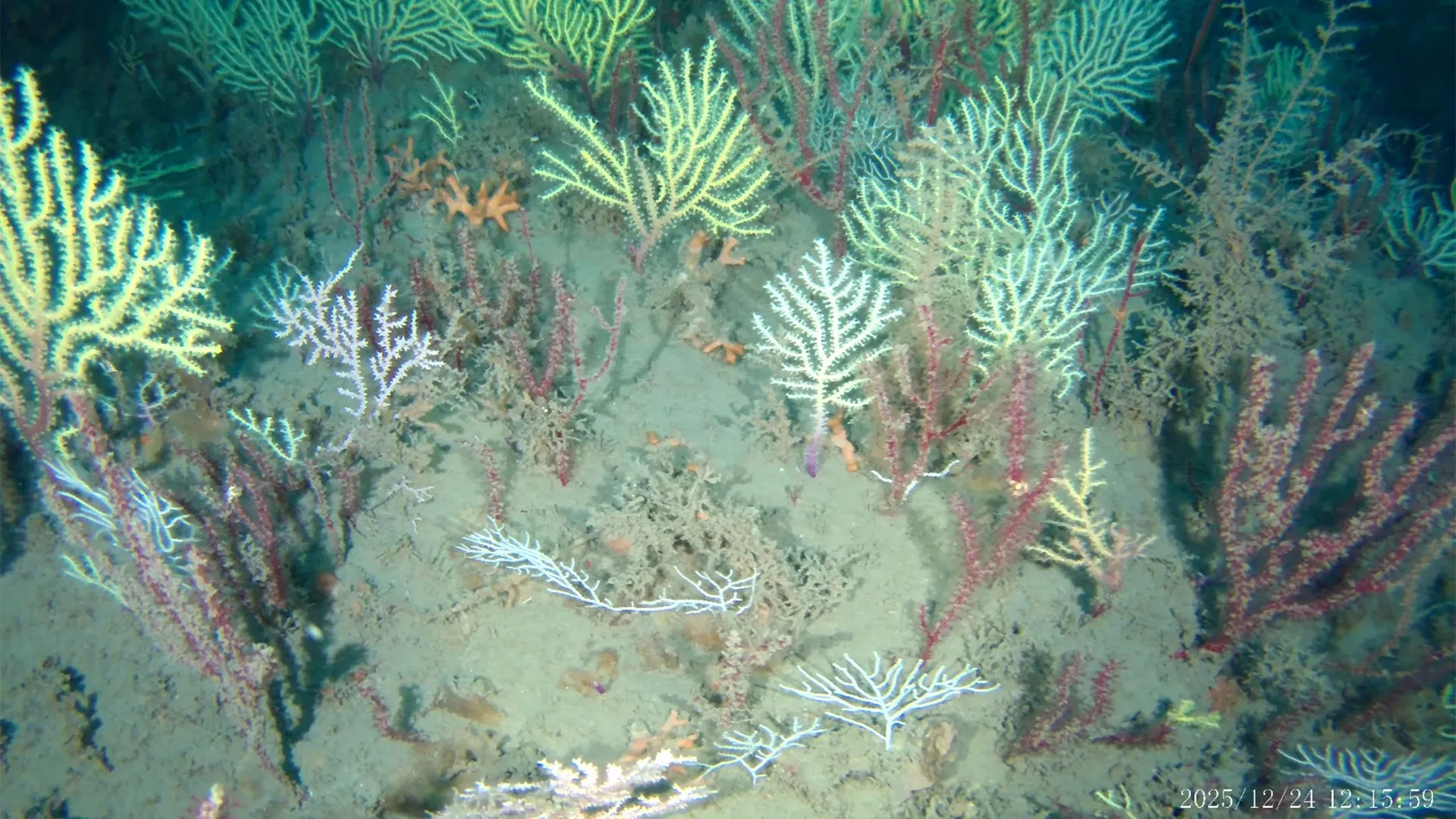
Armed with this hypothesis, the team scanned the 11.5 kilometers of seafloor, narrowing down the search until they identified two primary areas displaying promising, reef-like acoustic signatures. The subsequent deployment of the underwater drone and the Deep Sea Camera System—which functions much like a network of automated wildlife trail cameras placed discreetly beneath the ocean waves—provided the visual evidence needed to confirm their suspicions. The grainy, low-light photographs and video feeds did not show a barren, lifeless expanse of ancient stone. Instead, they revealed a thriving, active biological community clinging to the rocky substrate of the continental shelf.
Cameras Reveal Coral and Fish Life
The visual data captured by the deep-sea cameras provided marine biologists with a wealth of information regarding the biological composition of the newly rediscovered ecosystem. Researchers identified eight distinct types of coral living within the area, demonstrating a level of biodiversity that completely contradicted the 60-year-old assessment of a dead environment.
In addition to the coral colonies themselves, the cameras documented a vibrant array of marine life utilizing the structures for essential survival needs, including shelter from predators and areas for feeding. The documented fish species included golden African snappers, blackbar soldierfish, Guinean angelfish, West African goatfish, the Monrovia doctorfish, three-banded butterflyfish, and two separate species of damselfish.
Rather than forming one massive, unbroken wall of coral similar to the famous shallow-water reef systems found in tropical regions elsewhere in the world, the Benin reef appears to consist of fragmented, isolated coral patches. These colonies have established themselves on rocky outcrops of the seabed where local hydrodynamic and geological conditions provide a suitable habitat. Marine scientists point out that this patchy distribution suggests additional surveys in the broader surrounding region could very well reveal more undocumented reefs hiding in plain sight.
"To our knowledge, this is the first confirmed record of a living mesophotic coral ecosystem on the Gulf of Guinea continental shelf," Zinzindohoué noted. "However, I think what we found is probably not an exception. It is more likely a reflection of how little we still know about coastal regions in West Africa and elsewhere. If we were able to find this reef again after 60 years, how many others are still undocumented or simply forgotten? So yes, I do believe there are likely more coral systems out there that we have not documented yet. But we should not assume they are everywhere. Each discovery needs to be confirmed. Without going back into the field, we are really just guessing."
How Many More Reefs Could Be Hidden?
The unexpected discovery has profound implications for marine science in West Africa, raising the distinct possibility that numerous other deep-water coral ecosystems have been overlooked, miscataloged, or entirely forgotten by historical science. Because early oceanographic efforts in the region were overwhelmingly focused on commercial fisheries, navigation, or mineral extraction rather than pure ecological conservation, many unusual seafloor formations were likely dismissed if they did not fit immediate economic criteria.
At the same time, the researchers remain measured in their conclusions, emphasizing that the recent expedition represents only an initial, preliminary look at the site. Because the team has not yet collected physical samples of the corals using specialized robotic arms or manned submersibles, the preliminary identifications made from camera footage and photographs still require formal scientific verification in a laboratory setting.
Furthermore, scientists cannot yet definitively answer whether the corals observed in the 1960s were genuinely dead at the time and subsequently managed to recover over the decades, or if the original researchers simply misinterpreted the data due to the primitive nature of the sonar and sounding equipment available to them mid-century. Resolving these lingering questions will require targeted follow-up research involving both expanded underwater surveys and direct physical sampling of the marine organisms living at the site.
A Possible 40 Kilometer Coral System
The scope of the potential discovery extends far beyond the small area mapped during the recent campaign. Historical reports from the 1960s suggested that the geological formation under investigation might not be an isolated patch, but rather part of a massive, continuous coral reef barrier stretching roughly 40 kilometers parallel to the coastline of Benin.
Because the modern research team only managed to survey a small fraction of this expansive zone using a limited number of visual transects, the true extent of the living ecosystem remains an open question.
"This is still an initial exploration," Zinzindohoué said, emphasizing the need for future funding and sustained research efforts. "The historical reports suggested that this could be a continuous coral reef barrier extending roughly 40 kilometers parallel to the coast. We only surveyed a small section of this area, and we had a limited number of visual transects. If I had all the grant money in the world, the first thing I would do is return to the site with a proper scientific diving and sampling program. These are ecosystems that are still poorly known in this part of the world, and every additional piece of information matters."
For the researchers involved, the physical discovery of living coral is only the beginning of a much larger scientific journey. Beyond mapping the physical boundaries of the reef, the team hopes to unlock the environmental history encoded within the coral structures themselves, utilizing them as natural archives of how the Gulf of Guinea has evolved over centuries.
"For me, the most exciting part is about understanding the reef’s history, and what it can tell us about how the ocean in this region has changed over time," Zinzindohoué concluded. "It feels like we have only just started to read an archive that has been there for a very long time."