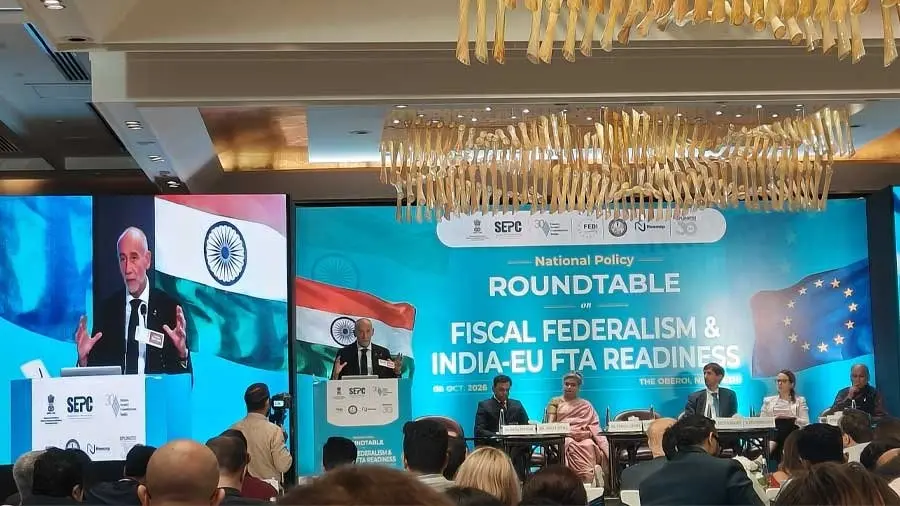
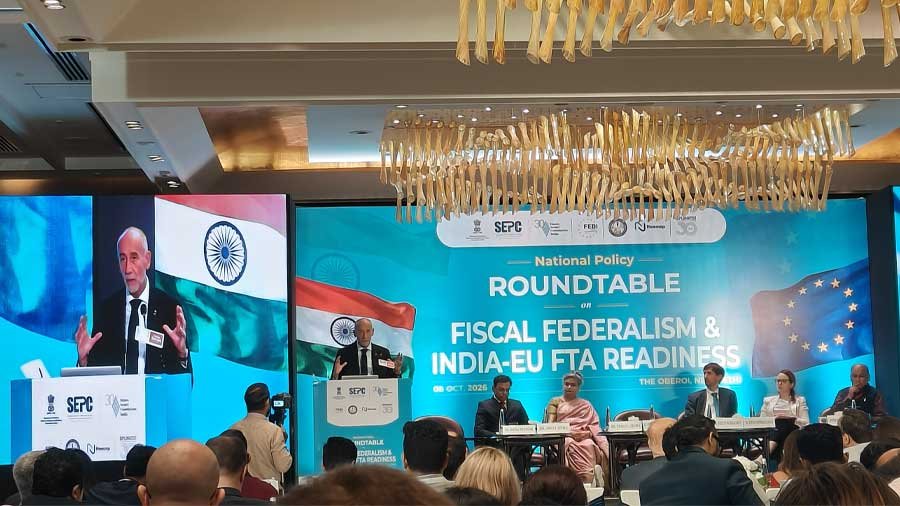
NEW DELHI — As the geopolitical landscape of global trade undergoes profound shifts, policymakers and business leaders are turning their attention to the next major frontier in international economic cooperation: the implementation of the landmark Free Trade Agreement between India and the European Union. At the National Policy Roundtable on Fiscal Federalism and India–EU FTA Readiness held in New Delhi, H.E. Jean-Eric Paquet, Ambassador of the European Union to India and Ambassador-designate to Bhutan, delivered a clear and forward-looking message. He emphasised that while concluding the negotiations for this historic trade pact is a monumental political achievement, the true measure of its success will ultimately depend on effective, coordinated implementation across central governments, regional states, local businesses, and diverse institutional frameworks.
The conclusion of the India–European Union Free Trade Agreement negotiations marks a watershed moment in the decades-long diplomatic and economic partnership between the South Asian powerhouse and the European bloc. Yet, addressing a gathering of key stakeholders on October 6, Ambassador Paquet underscored that the heavy lifting is far from over. The immediate challenge now facing both regions is transforming a complex legal and diplomatic framework into tangible, real-world opportunities for businesses, investors, skilled workers, and everyday consumers.
The high-level roundtable in New Delhi was organised by the Services Export Promotion Council (SEPC) in association with the Hanns Seidel Foundation India, the Federation of European Business in India, KMC, NEECOP, and The Diplomatist. The event served as a critical forum for policymakers, diplomats, and industry leaders to examine India’s institutional readiness for the upcoming phase of bilateral economic relations, particularly given the intricate federal structures present in both India and the European Union.
Reflecting on the arduous journey that led to this milestone, Ambassador Paquet acknowledged the intense diplomatic efforts and political will required to bridge longstanding gaps. Following years of fits and starts, the formal relaunch of trade talks in 2022 provided the necessary impetus, culminating in the historic announcement of the conclusion of negotiations in January 2026. The Government of India has consistently described the pact as a transformative pillar in one of its most strategic international relationships. Describing the achievement during his address, Ambassador Paquet noted that it stands out as a major political milestone in the shared trajectory of India and Europe, propelled by robust high-level engagement over the preceding two years that demonstrated both sides’ genuine commitment to a comprehensive deal.
However, Ambassador Paquet cautioned that an agreement of this sheer scale and magnitude cannot be treated as a matter for central governments alone. Given the vast geographic scope and the federal division of powers in both India and the EU, successful execution will require active participation from regional administrations, fiscal authorities, trade associations, and corporate entities across Indian states and Union territories, as well as among the individual member states of the European Union. This multi-level and federal dimension underscores the indispensable value of dialogues like the New Delhi roundtable. For Indian enterprises, navigating the multi-faceted European market demands sharp insights, while European firms must familiarize themselves with the diverse regulatory environments, infrastructural ecosystems, and commercial realities spanning India’s states.
From Negotiation to Execution
The economic architecture of the India–EU FTA offers unprecedented market access, promising to reshape commercial flows across multiple sectors. According to official data from the Government of India’s factsheet, the agreement’s tariff commitments are remarkably comprehensive. The EU has agreed to eliminate duties on almost 97 percent of tariff lines, which translates to covering more than 99 percent of India’s overall export value to the bloc. Crucially, immediate duty elimination accounts for 90.7 percent of India’s export value, with the remaining qualifying products set to undergo phased liberalisation over agreed timelines.
For Ambassador Paquet, while these macroeconomic statistics are impressive on paper, they will only translate into real economic growth if commercial actors are fully prepared to leverage the newly opened pathways. Emphasizing the need for proactive engagement, he noted that the vital process moving forward involves ensuring that all actors across every sector—spanning both goods and services—possess a comprehensive understanding of the agreement’s architecture so they can effectively anticipate and seize upcoming opportunities.
The scope of the pact is expected to unlock substantial gains across a wide array of industries. Indian exporters stand to capture significant advantages through improved market access in traditional, labour-intensive sectors such as textiles, leather, footwear, marine products, tea, coffee, spices, and gems and jewellery. Furthermore, the agreement incorporates robust provisions concerning services and professional mobility, which have long been key priorities for New Delhi. Concurrently, European businesses will secure deeper access to the fast-growing Indian market, allowing European technology, expertise, and investment to actively contribute to India’s ongoing economic modernization and industrial transformation.
Consequently, Ambassador Paquet urged stakeholders to view the FTA through a much wider lens than a traditional tariff-cutting exercise. Rather than a narrow trade pact, it should be regarded as an overarching framework capable of fostering deep, structural economic integration between two of the world’s most dynamic democratic markets.
Building a Common Economic Space
Placing the trade agreement within a broader geopolitical context, Ambassador Paquet highlighted its significance at a time when global trade patterns are increasingly fragmented and international supply chains are undergoing rigorous reassessment. He argued that the deepening partnership provides India and Europe with a timely opportunity to construct a more reliable, predictable, and resilient economic relationship, noting that the initiative encompasses far more than simple commerce.
The FTA is envisioned as a foundational stepping stone toward creating a broader common economic space that seamlessly links Indian and European markets, supply chains, logistics networks, investment flows, and technological innovations. In the ambassador’s view, trade and investment are intrinsically linked and cannot be treated as isolated phenomena. Enhanced market access inherently demands efficient logistics and dependable supply chains, while robust supply chains simultaneously rely on sustained investments in local infrastructure, advanced technology, and domestic production capacities.
This ambitious vision rests upon a remarkably substantial economic foundation already established between the two regions. Official government statistics indicate that merchandise trade between India and the European Union reached USD 136.54 billion during the 2024–2025 fiscal year, with Indian exports to the bloc accounting for USD 75.85 billion. Simultaneously, bilateral trade in services maintained strong momentum, standing at USD 83.10 billion in 2024, demonstrating the diverse and balanced nature of the economic partnership.
The States Will Matter
A central pillar of Ambassador Paquet’s analysis focused on the vital role that India’s states and Union territories will play in the practical realization of the agreement’s benefits. While trade treaties are inherently negotiated and ratified at the national level, their economic impact is felt at the local level where businesses actually operate, invest, and compete. Corporate entities function within state-specific regulatory environments, tax structures, infrastructural networks, and regional skill ecosystems.
This reality places fiscal federalism at the very heart of FTA implementation. Ambassador Paquet highlighted the absolute necessity of ensuring that domestic taxation policies and sub-national regulatory frameworks actively support, rather than hinder, the commercial advantages unlocked by international market access. He also pointed to the continuous need for open, transparent dialogue between regional administrations and the business community to identify and resolve practical bottlenecks well before they impede trade flows. He reiterated that the European Union remains fully committed to working alongside Indian institutions, state governments, and industry stakeholders as the agreement progresses toward full operationalization.
A Call to Businesses: Prepare Now
Perhaps the most urgent and direct takeaway from Ambassador Paquet’s address was aimed squarely at the private sector. Although the FTA requires various procedural steps, legal reviews, and formal ratification processes before formally entering into force following the conclusion of negotiations in January 2026, companies have been strongly advised not to delay their preparations.
Stressing the urgency of the moment, the ambassador urged business leaders to act immediately rather than waiting for the formal implementation date. He encouraged corporate decision-makers to proactively evaluate their supply chains, map out prospective European partners, explore new market segments, and thoroughly understand the compliance and quality requirements necessary to claim preferential access as soon as the agreement becomes active.
For policymakers and institutional leaders, the mandate is equally clear: they must work diligently to build the necessary administrative, digital, and physical infrastructure required to ensure that the landmark trade pact functions smoothly, efficiently, and to the maximum benefit of all citizens across India and the European Union.