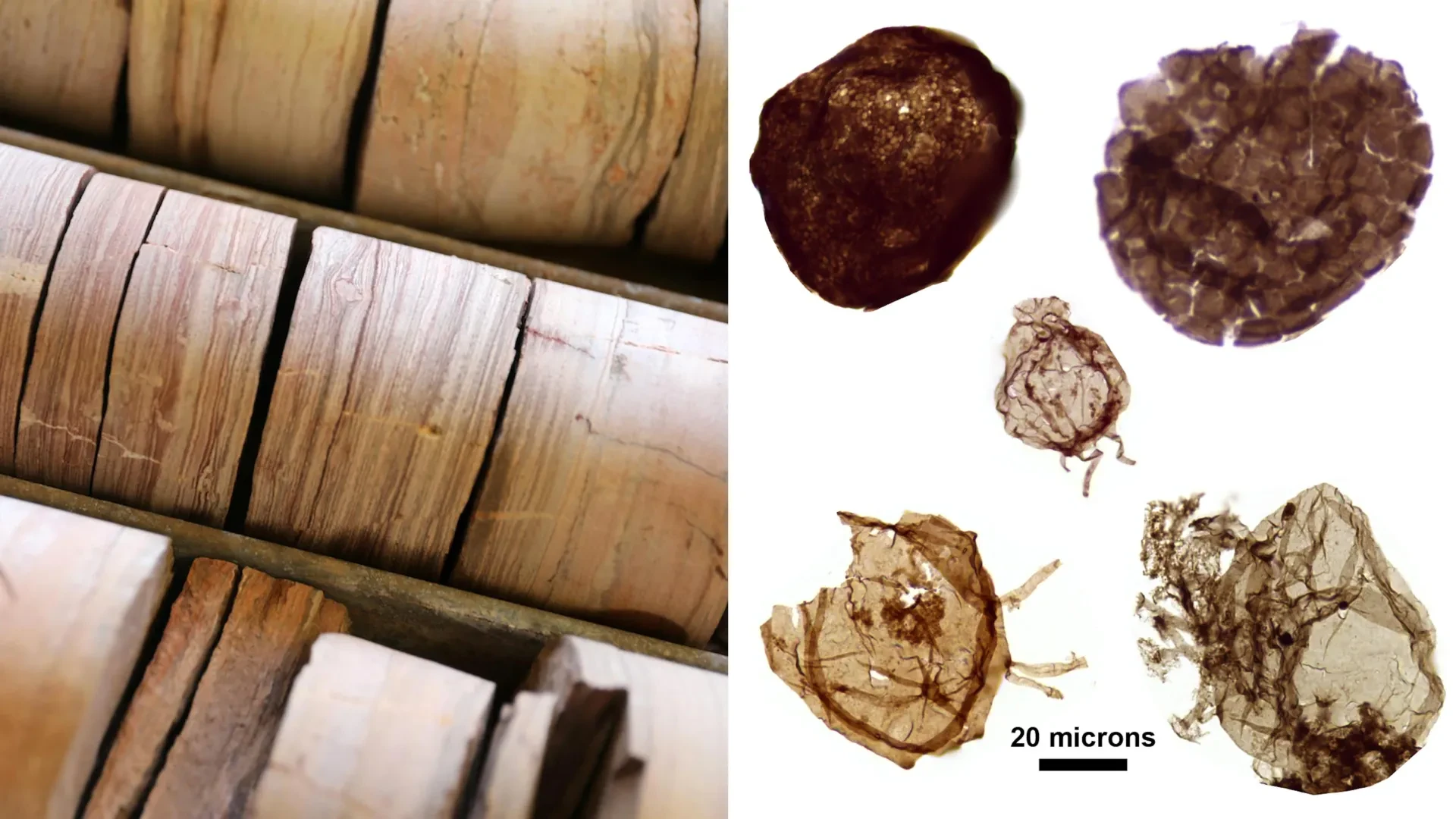
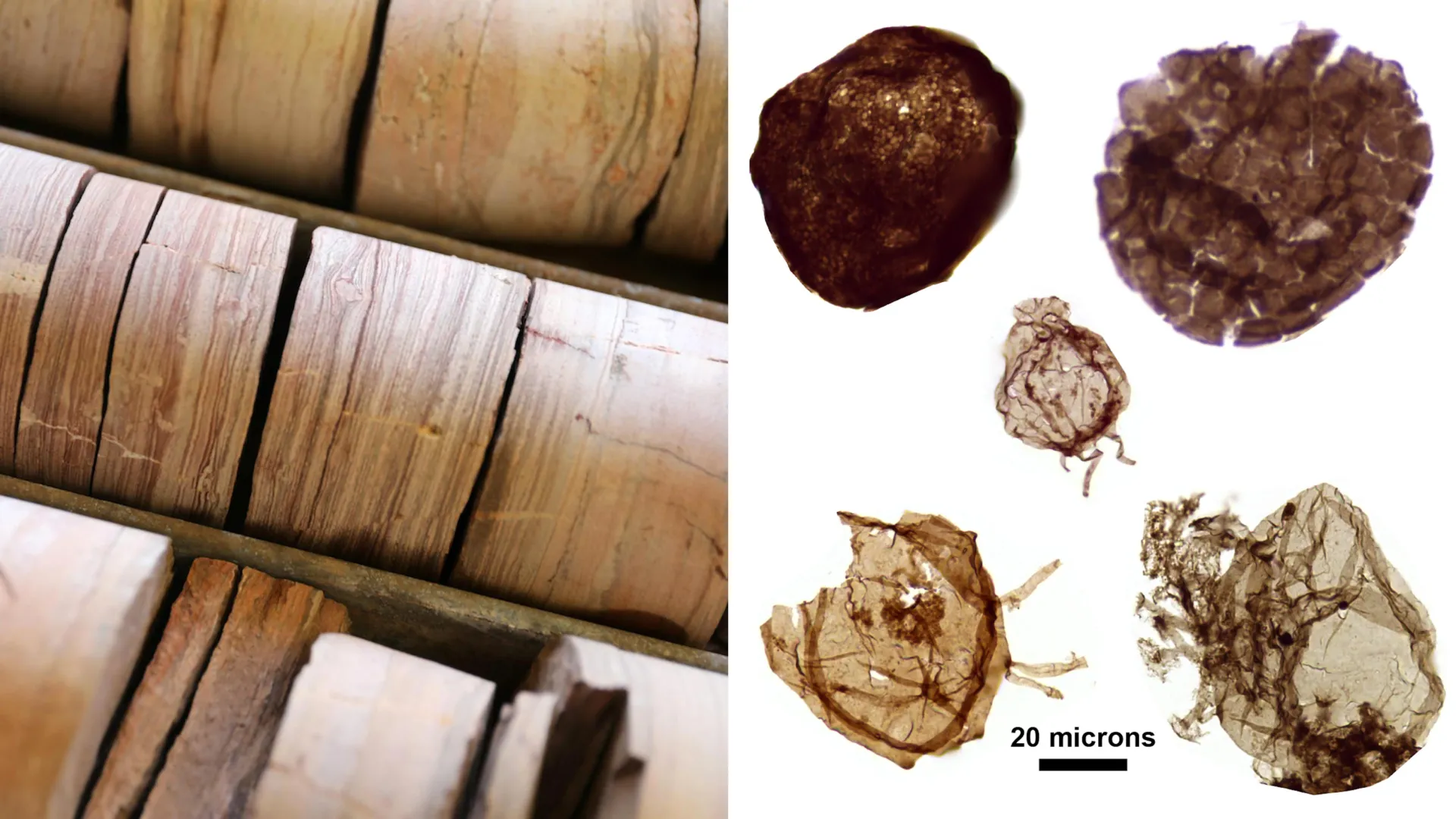
Stored securely within an open-air warehouse in the tropical climate of Darwin, Australia, lie rows upon rows of unassuming wooden and metal trays. Inside these trays rest cylindrical cores of rock, bored hundreds of metres beneath the Earth’s surface by mineral exploration companies decades ago. To the casual observer, these geological archives might look like ordinary industrial waste or forgotten construction debris. However, locked inside these stone cylinders is a microscopic window into the deepest chapters of Earth’s biological history.
Some of these geological cores, curated by the Northern Territory Geological Survey, are composed of mudstone—a fine-grained sedimentary rock formed from the hardened mud of ancient seabeds. When mining and exploration companies originally drilled into these formations decades ago, they were searching for valuable economic minerals and had no idea what treasures lay hidden within the matrix. Trapped inside these mudstones were the microscopic, carbonaceous fossils of single-celled organisms that once drifted through and settled upon the seafloor of a massive inland sea. This vast body of water covered large swathes of northern Australia more than 1.5 billion years ago, long before the first multi-cellular animals roamed the planet.
According to a new study published in the prestigious scientific journal Nature, these remarkably preserved microfossils are proving to be crucial for addressing one of the most enduring and complex puzzles in evolutionary biology: the origin of eukaryotes. Every living organism on Earth that possesses complex cells traces its lineage back to this foundational evolutionary leap, and the answers may have been sitting in storage in northern Australia all along.
Small but Complex
To understand the profound significance of the Darwin rock cores, scientists emphasize the fundamental divide that governs all life on Earth. Every living thing can be categorized into one of two primary cellular architectures, which are radically different at the microscopic level.
The first group, prokaryotes, encompasses bacteria and archaea. These organisms feature a relatively simple cellular organization and exist predominantly as single-celled entities devoid of internal membrane-bound compartments. Eukaryotes, on the other hand, represent a dramatic departure from this simplicity. This expansive domain includes all animals, plants, algae, and fungi. Eukaryotic cells are vastly more complicated, defined by the presence of a distinct nucleus that houses genetic material, alongside specialized internal structures known as organelles—such as mitochondria and chloroplasts—that perform specific biochemical jobs for the cell.
The emergence of the eukaryotic cell revolutionized the planet, ultimately paving the way for the rise of complex multicellular life, ecosystems, and eventually, human existence. Based on rigorous genetic observations and comparative genomics of modern living organisms, the scientific community widely agrees on the broad strokes of this transition. The last common ancestor of all living eukaryotes resulted from a symbiotic union between at least two distinct prokaryotic microbes: an archaeon and a bacterium. Through an ancient evolutionary merger, one microbe engulfed or integrated another, establishing a permanent and mutually beneficial partnership that altered the trajectory of biosphere evolution forever.
The earliest direct physical evidence for this monumental transition comes in the form of microfossils. These ancient remains of single-celled organisms display a level of structural complexity, intricate wall ornamentation, and overall size that is never observed among simple prokaryotes, yet remains entirely characteristic of early eukaryotic forms.
Fossilized remains of ancient eukaryotes have been unearthed by paleontologists and geobiologists in rock formations around the globe, with many specimens dating back at least 1.5 billion years. However, the sedimentary deposits of Australia’s Northern Territory hold a unique and prestigious record. The oldest among them date back an astonishing 1.75 billion years, making them the oldest currently known eukaryote fossils anywhere on Earth.
Despite this extraordinary record, the ancient planetary environment in which these pioneering eukaryotes first evolved remains shrouded in mystery. Many fundamental aspects regarding their exact metabolic nature, their immediate ecological niches, and the external pressures that shaped their development are still intensely debated within the scientific community.
Oxygen: Friend or Foe?
For decades, standard biological paradigms taught a straightforward narrative regarding atmospheric and dissolved oxygen. Many types of modern bacteria can thrive in entirely anoxic environments devoid of oxygen. Conversely, nearly all eukaryotes alive today are obligate aerobes, meaning they rely fundamentally on oxygen for survival. This dependency exists because aerobic respiration—the biological process of breaking down food molecules using oxygen—yields the vast amounts of cellular energy that complex life forms demand to power their metabolisms, growth, and tissue maintenance.
However, the neat assumption that oxygen has always been universally beneficial for all eukaryotes has come under heavy scrutiny in recent years. This paradigm shift was triggered by the surprising discovery of enigmatic, deep-branching eukaryotic lineages capable of thriving in extreme environments completely devoid of oxygen. These living oddities forced evolutionary biologists to reconsider the physiological constraints of early complex cells.
Simultaneously, mounting geochemical evidence from the global sedimentary record has revealed that when eukaryotes were first evolving, Earth’s atmosphere and oceans contained vastly lower concentrations of oxygen. During this critical window in deep time, oxygen-free marine habitats would have been the standard condition across the globe, rather than the exception. Collectively, these discoveries have called into question the long-held assumption that eukaryotes have been utterly dependent on oxygen since their very inception.
While genetic studies of modern, extremophilic microbes belonging to groups considered evolutionarily close to the ancestors of the first eukaryotes offer vital clues, they possess inherent limitations. Modern genetic sequencing can only analyze survivors; it cannot speak for long-extinct lineages that vanished millions of years ago. Only the physical fossil record can capture the true diversity of ancient life, and only the accompanying geology can provide a clear window into the actual chemical and physical conditions of the ancient world in which these organisms lived.
More than 12,000 Fossils Analyzed
To bridge the gap between ancient geology and early biology, the research team behind the new Nature study undertook a massive and meticulous analytical effort. Rather than merely observing the rock surfaces, the scientists processed core samples from the mudstone repositories in Darwin by crushing them into fine powders and dissolving the mineral matrix using powerful chemical acids.
By analyzing the microscopic organic residues left behind after the dissolution process, the researchers identified and cataloged more than 12,000 individual microfossils. This unprecedented dataset provided a statistically robust foundation for understanding the ancient populations.
Alongside the fossil counts, the team conducted detailed geochemical analyses of the mudstones themselves. This dual approach allowed them to reconstruct the ancient depositional environments, shedding light on the exact habitats where these pioneering eukaryotes lived and flourished. Furthermore, by evaluating the chemical signatures preserved within the mudstones, the researchers were able to reconstruct ancient ocean chemistry, determining with high precision whether dissolved oxygen was present in the seawater at the time the sediments settled.
The results of this exhaustive analysis revealed a striking pattern. While eukaryote fossils were discovered across a wide spectrum of depositional environments—ranging from shallow coastal mudflats to deeper open-marine settings—they were conspicuously present only in rock samples that had been deposited in oxygenated settings.
Conversely, samples originating from contemporaneous oxygen-free environments contained exclusively simple, prokaryotic forms. No complex eukaryotic microfossils were recovered from the anoxic layers.
This stark environmental segregation strongly suggests that even the oldest known eukaryotes, which inhabited Earth between 1.7 and 1.4 billion years ago, maintained a strict physiological dependence on oxygen. These empirical findings lend powerful support to a decades-old hypothesis within evolutionary biology: that the localized and episodic rise of oxygen in Earth’s early oceans acted as a primary catalyst, providing the metabolic fuel necessary to drive the evolutionary radiation of early eukaryotes.
Resolving the exact environmental drivers and ecological context of the major evolutionary leap represented by the origin of complex cells remains one of the premier challenges in modern life sciences. As geologists and paleontologists continue to mine the vast archives stored in places like Darwin, ongoing studies of these enigmatic microfossils promise to reveal deeper truths about the origins of complex life—and the intricate relationship between planetary chemistry and biological evolution.