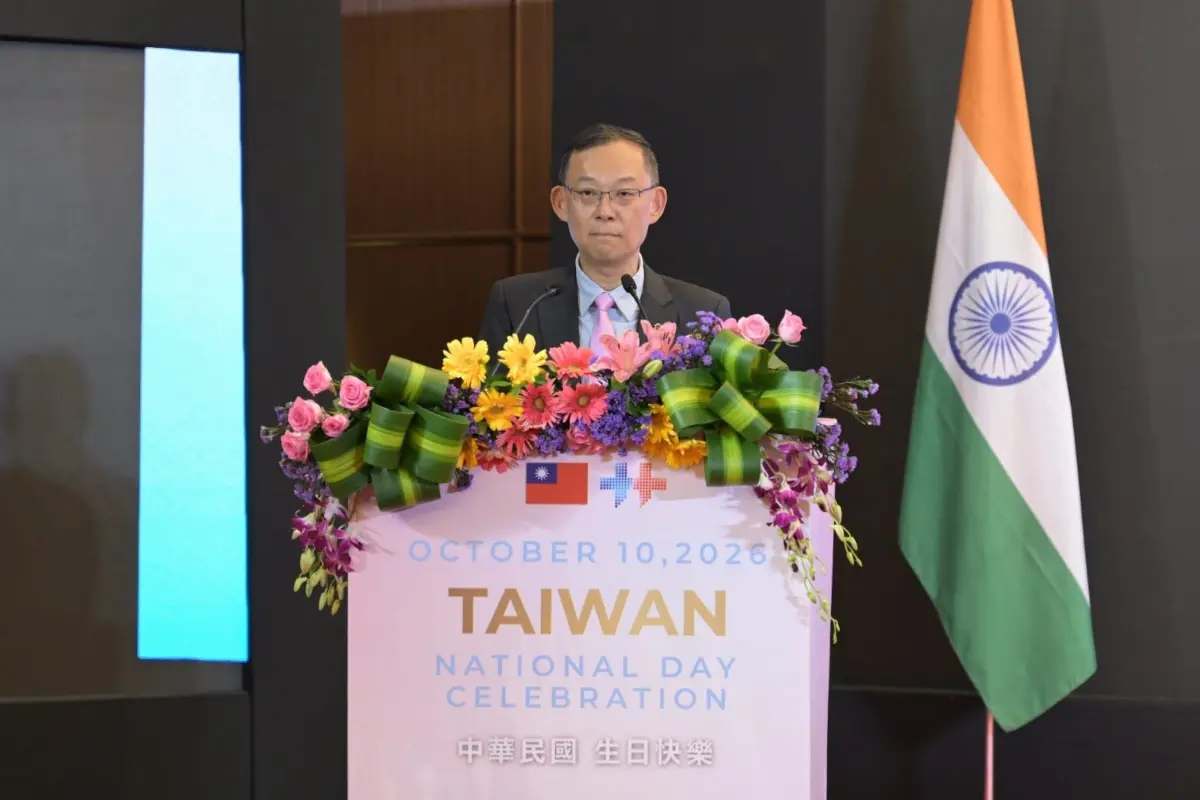
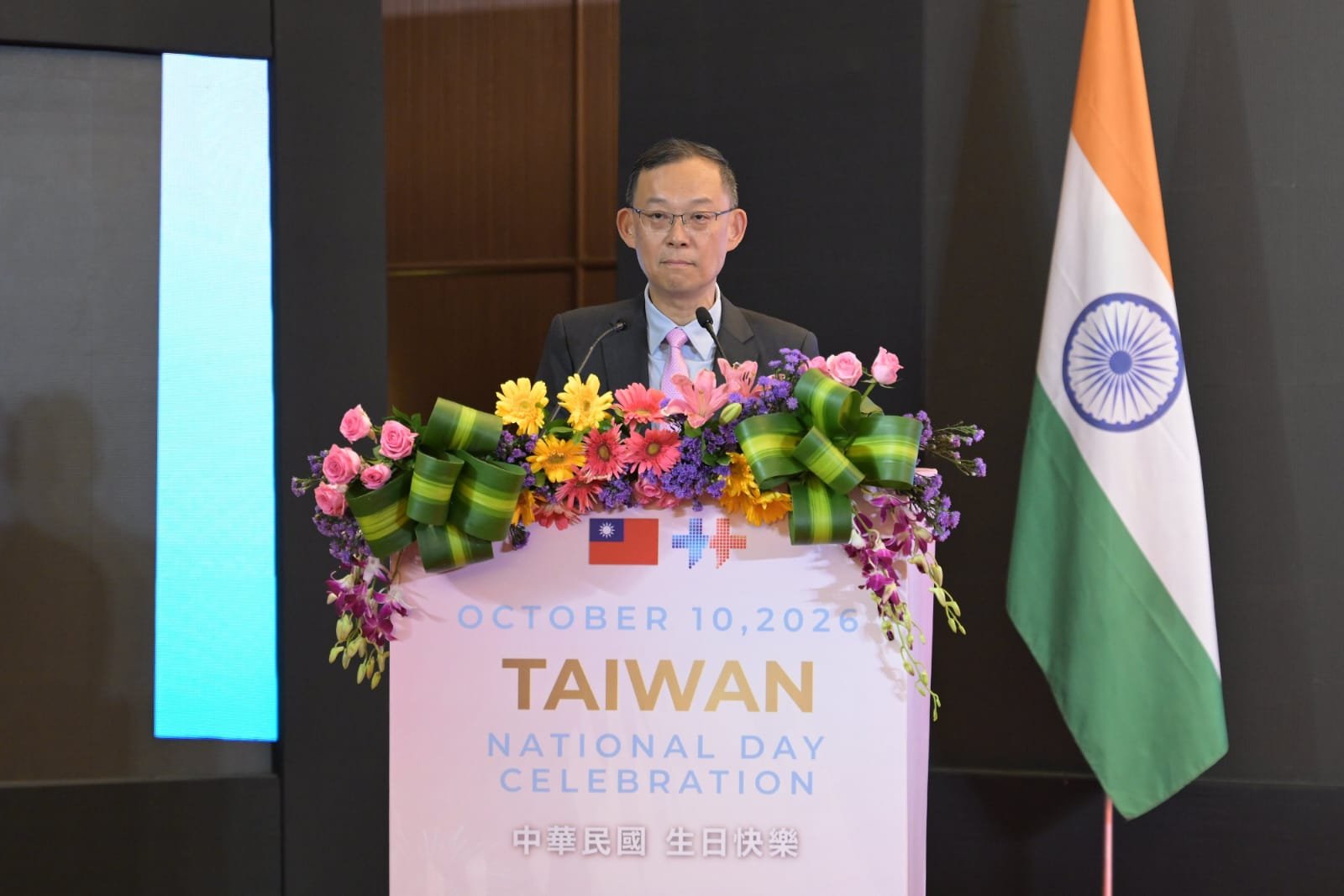
NEW DELHI — Despite being separated by approximately 4,000 kilometers of land and sea, Taiwan and India are finding themselves drawn closer together through an expanding matrix of technology, trade, education, and cultural exchange. This was the resounding message delivered by Dr Mumin Chen, Representative of the Taipei Economic and Cultural Centre in India, during his keynote address at Taiwan’s 115th National Day reception held in New Delhi.
The high-profile gathering brought together a diverse assembly of Indian government officials, members of the diplomatic corps, business leaders, and representatives of the local Taiwanese community. The evening served not only as a commemoration of Taiwan’s national milestones but also as a vibrant showcase of bilateral amity. Cultural performances highlighted the night, featuring a Taiwanese troupe performing a creative piece inspired by the ancient Indian epic, the Ramayana, alongside Indian university students who delighted the audience by singing traditional Taiwanese songs in Mandarin. For attendees, the artistic showcase offered a fitting backdrop, underscoring the vital role that grassroots cultural engagement plays in fostering deeper mutual understanding between the two societies.
Welcoming the distinguished guests to the celebration, Dr Chen drew direct parallels between the foundational ethos of both nations. Pointing to their shared societal characteristics, he noted that both populations take immense pride in their unique cultural heritages while operating as vibrant, energetic democracies driven by entrepreneurial spirit.
A Milestone Year for Democracy and Economic Resilience
Dr Chen’s remarks resonated against the backdrop of a deeply significant anniversary for Taiwan, marking thirty years since the island nation held its first direct presidential election in 1996. Reflecting on this historic political milestone, Dr Chen reminded the audience of how the people of Taiwan resolutely chose the path of democracy in the face of considerable military pressure and external challenges. Over the three decades since that pivotal vote, Taiwan has witnessed multiple peaceful transitions of power between governing parties, cementing the maturation and consolidation of its democratic institutions.
He underscored that the foundational pillars of freedom, democracy, and human rights remain non-negotiable tenets of Taiwanese society. This sentiment has been echoed by President Lai Ching-te, who has frequently characterized the anniversary as a crucial benchmark in Taiwan’s democratic evolution, highlighting both the resilience of its institutions and the unwavering determination of its citizenry to safeguard their democratic way of life.
Yet, as Dr Chen articulated, Taiwan’s contemporary narrative extends far beyond its political evolution. It is equally a story of remarkable economic transformation, cutting-edge technological innovation, and deep integration into complex global supply chains.
Detailing the island’s strong economic performance, Dr Chen reported that Taiwan’s GDP per capita reached approximately US$39,000 in the previous year. This upward trajectory continued unabated into the first half of 2026, propelled heavily by sustained global demand for information technology hardware and Taiwan’s indispensable positioning within international manufacturing networks. Official economic statistics recorded a year-on-year GDP growth rate of 14.55 percent in the first quarter, followed by an impressive 12.93 percent expansion in the second quarter.
"Technology is always at the heart of this transformation," Dr Chen observed, pointing to the semiconductor industry, advanced machinery, information and communications technology (ICT), and sophisticated electronic manufacturing capabilities that anchor Taiwan’s standing in the global tech ecosystem.
This strategic role has grown exponentially as the world accelerates its demand for artificial intelligence infrastructure and advanced computing solutions. Highlighting this trend, Taiwan Semiconductor Manufacturing Company (TSMC), the world’s leading contract chipmaker, announced record-breaking third-quarter revenue figures, mirroring the insatiable global appetite for AI-driven applications.
However, Dr Chen cautioned that this technological success must be viewed through the lens of an increasingly complex and volatile geopolitical landscape. Intensifying global tensions and mounting challenges to the rules-based international order have reinforced the critical necessity of forging robust partnerships among like-minded economies, alongside building unbreakable resilience within critical supply chains.
India Emerges as a Strategic Pillar
Within this evolving global framework, India is rapidly emerging as an indispensable partner for Taiwan. The momentum of this bilateral relationship was visibly demonstrated by several major announcements made during the National Day reception.
Chief among these diplomatic developments was the official revival of the Taiwan–India Parliamentary Friendship Association, which has successfully secured the participation of 23 Indian parliamentarians. Dr Chen lauded legislative exchanges as a vital channel for cultivating mutual understanding and bridging political discourse between the two societies, an initiative that has similarly garnered significant attention from Taiwan’s Central News Agency.
Economic and commercial engagement continues to serve as the bedrock of the bilateral relationship. According to Dr Chen, bilateral trade between Taiwan and India scaled a record-breaking peak of US$12.5 billion in 2025. The upward momentum has only accelerated in the current year; during the first eight months of 2026 alone, bilateral trade volume reached US$12.9 billion, marking a staggering 60 percent increase compared to the corresponding period from the previous year.
Furthermore, Dr Chen cited figures indicating that nearly 400 Taiwanese companies are actively operating across India. Their cumulative investment in the country now approaches US$7.5 billion, collectively supporting and generating employment for more than 200,000 workers.
Taiwanese enterprises bring world-class expertise in semiconductors, electronic manufacturing, precision machinery, industrial automation, and advanced manufacturing processes. Conversely, India—with its rapidly expanding domestic manufacturing base, massive consumer market, and thriving innovation ecosystem—offers fertile ground for deeper industrial synergy. Prominent Taiwanese technology brands, including ASUS, maintained a visible presence at the reception, serving as tangible proof of the deepening commercial bridges already linking the two regional markets.
Innovation-driven collaborations are also branching out into unexpected sectors. Dr Chen highlighted an emerging partnership centered on the tea industry, which successfully combines the cultivation of high-quality tea leaves from India’s Meghalaya region with advanced Taiwanese machinery and processing technology. Such niche initiatives illustrate how bilateral cooperation extends well beyond heavy industrial investments into specialized agricultural and processing sectors, unlocking fresh avenues for innovation and value addition.
Expanding Horizons in Science, Education, and Connectivity
Scientific and technological research cooperation has maintained a steady upward trajectory since institutional frameworks were established. Dr Chen noted that since 2009, Taiwan and India have jointly supported approximately 180 collaborative research projects spanning renewable energy, biomedical technology, and nanotechnology. Newer frontiers of engagement now include cutting-edge domains such as semiconductors, artificial intelligence, quantum computing, sustainable development, and the social sciences.
Additionally, Dr Chen pointed to Taiwan’s ongoing knowledge-sharing initiatives focused on critical public concerns such as air pollution management, alongside planned workshops dedicated to cybersecurity and science education. These practical exchanges provide researchers, academics, and institutional leaders with actionable platforms to tackle shared societal challenges.
Education and people-to-people connections remain foundational pillars of the relationship. Dr Chen revealed that more than 3,500 Indian students are currently pursuing their higher education in Taiwan, while roughly 600 young Indian professionals and students are gaining hands-on experience through internships on the island. A network of Taiwan Education Centres spread across India continues to promote Mandarin language proficiency while offering students avenues to explore Taiwanese culture and society.
Demonstrating a commitment to expanding these academic bridges, Dr Chen announced that Taiwan has awarded 95 distinct scholarships to Indian students for the year, divided between 47 degree scholarships and 48 language scholarships. This academic expansion is further underscored by the recent renewal of nine memoranda of understanding and the execution of an additional cooperative agreement with an Indian university. Looking forward, both sides have expressed a keen interest in broadening academic cooperation to target semiconductors, artificial intelligence, green technology, and biotechnology, with a particular emphasis on strengthening industry-academia partnerships.
Geographical distance is set to shrink further with a major boost in direct logistical connectivity. EVA Air is scheduled to inaugurate a nonstop flight service connecting Taipei and Delhi starting December 1, operating five flights per week. The new aviation route is widely expected to ease travel constraints for business leaders, academics, students, and tourists, thereby cementing the practical foundations of bilateral economic and educational exchanges.
Cultural diplomacy continues to run parallel to commercial and academic pursuits, broadening Indian public awareness of Taiwan’s artistic landscape. Dr Chen referenced recent visits by Taiwanese artists and writers, as well as concrete plans to host forthcoming film festivals and cultural programs in major urban centers like New Delhi and Mumbai. These initiatives give citizens from both nations direct opportunities to appreciate each other’s languages, historical traditions, and contemporary creative expressions.
Concluding his address, Dr Chen reaffirmed Taiwan’s unwavering commitment to expanding international cooperation across vital sectors, including public health, disaster relief, agricultural technology, digital governance, the global net-zero transition, and broader humanitarian assistance.
"Taiwan is a vital partner in this journey," Dr Chen said, expressing his deep appreciation for the enduring friendship and robust support extended by the people of India.