Every data professional knows the sinking feeling: a dashboard displays a metric that defies all logic, a regulator drops an unexpected inquiry demanding the exact provenance of a sensitive data point, or a mission-critical pipeline silently shatters in the dead of night. In virtually every instance, these high-stakes operational crises culminate in the exact same frantic question: where did this data actually come from, and how did it get here?
As modern enterprises grapple with increasingly complex, multi-cloud architectures, answering that foundational question has evolved from a routine administrative task into a formidable engineering challenge. Organizations now route information across sprawling ecosystems—spanning object storage, cloud data warehouses, transformation tools, business intelligence dashboards, and external orchestration engines. Tracing a single metric often requires traversing a labyrinth of disparate systems, each operating in its own isolated silo.
To address this growing complexity, the Precisely Data Integrity Suite has introduced an automated approach to data lineage that seeks to bridge the persistent gap between architectural intent and operational reality. By combining two distinct methodologies—static lineage derived from metadata and operational lineage captured directly from runtime execution—the platform automatically maps how information flows, transforms, and is consumed across the entire enterprise ecosystem.
Static Lineage: Mapping the Blueprint from Metadata
Some structural questions about data movement can be answered by examining definitions alone. Modern data stack components inherently understand their immediate environments; business intelligence tools like Tableau are explicitly aware of the underlying tables feeding their visualizations, and workflow orchestrators like Azure Data Factory maintain records of the specific pipelines they read from and write to. Static lineage captures these foundational relationships by connecting directly to data sources and extracting built-in metadata definitions.
When an enterprise catalogs a new connection, the Data Integrity Suite systematically queries the source system, ingests its schema definitions and transformation logic, and translates those relationships into a normalized lineage graph. A significant advantage of this metadata-driven approach is its independence from active runtime workloads. Static lineage can successfully capture architectural relationships from legacy or static sources that were never originally configured with runtime observability tools.
Yet, relying solely on static definitions leaves critical blind spots in modern analytics environments. While a metadata catalog can reveal how a pipeline was designed to function on paper, it often fails to capture the dynamic, fluid nature of modern data transformations happening in production.
Operational Lineage: Capturing the Reality of Execution
To achieve a complete and accurate picture of data movement, organizations must look beyond static blueprints and observe what is actually happening during execution. Certain transformations cannot be anticipated by looking at static definitions alone. For instance, when transformation tools execute complex models within cloud data warehouses like Snowflake, the system executes dynamic queries that may not be fully captured by static schema definitions.

To solve this, operational lineage extracts real-time execution data directly from system audit logs and execution views, such as Snowflake’s internal ACCESS_HISTORY view and Databricks system access tables. These system records update continuously as queries run in production, providing an empirical record of which assets were accessed, modified, or joined during a specific job execution.
Furthermore, operational lineage extends its reach through integration with open standards like OpenLineage. By ingesting runtime events emitted by external workflow orchestrators, the Data Integrity Suite can track reads and writes across virtually any custom or third-party tool participating in the data pipeline.
Crucially, both static and operational lineage within the platform operate at the granular level of individual fields and columns, rather than simply mapping entire tables or datasets together. Understanding that a specific output metric in an executive report traces back to a precise source column provides data engineering and compliance teams with the actionable precision required for rapid troubleshooting.
Stitching the Fragmented Landscape into a Unified Map
Building a comprehensive data lineage map across a modern enterprise is rarely a single-step operation. When organizations first begin cataloging their assets within the Data Integrity Suite, lineage typically exists as a series of isolated fragments. A Tableau workbook maintains visibility over its immediate data sources, and a cloud data warehouse retains its local query history, but initially, neither system has native awareness of the other.
To bridge these disparate islands, the platform employs an intelligent reference resolution mechanism. When the Data Integrity Suite encounters a reference to a data asset that has not yet been cataloged, it automatically generates a temporary placeholder, keeping the broader lineage relationship open and intact. Once the missing asset is eventually cataloged and integrated into the system, the placeholder resolves, connecting the previously isolated fragments and seamlessly expanding the enterprise lineage graph.
As more sources, databases, and reporting tools are systematically cataloged, these individual connections compound. What begins as fragmented pockets of metadata transforms into a continuous, end-to-end lineage map. Organizations can trace information seamlessly from raw storage buckets through cloud warehouses and transformation layers all the way to final business intelligence dashboards. This unified perspective is generated automatically, eliminating the need for manual documentation and ensuring that the map remains perpetually synchronized with underlying environmental changes.
Connecting Lineage Across the Enterprise Ecosystem
The true utility of automated data lineage extends far beyond simple visualization; its real power emerges when it is tightly integrated with the broader capabilities of a governance and data integrity platform.
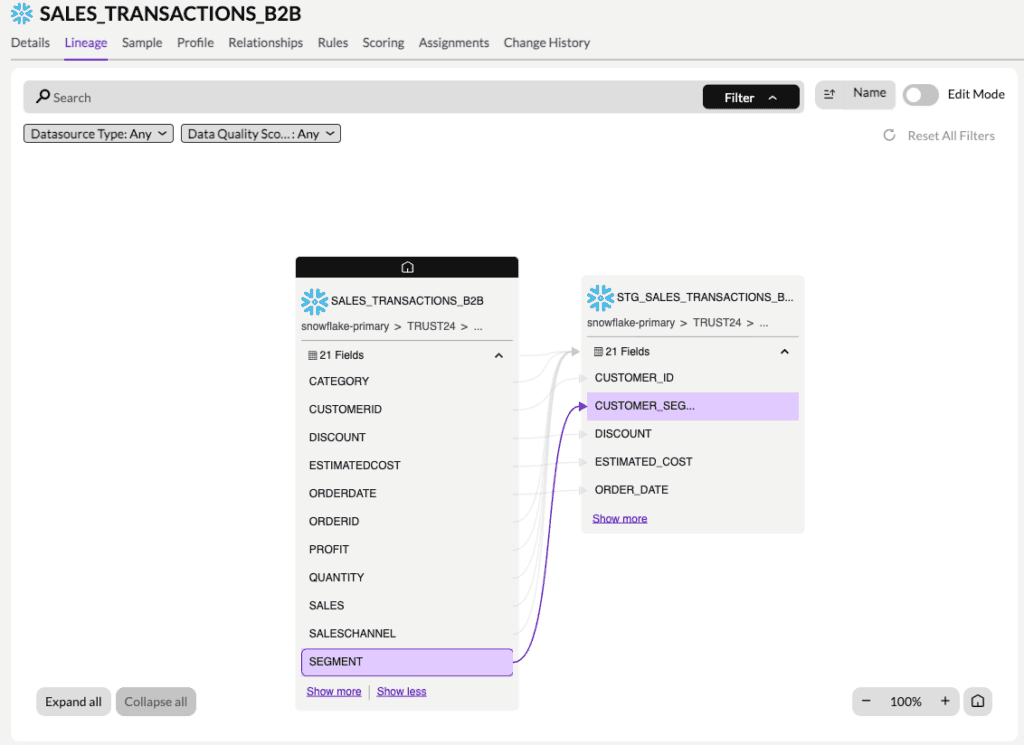
When a data quality validation rule unexpectedly fails in production, operational lineage allows data engineering teams to instantly trace the anomaly upstream. By following the lineage graph backward from the failing column, teams can pinpoint the exact source system or errant pipeline that introduced the corrupt data, drastically reducing mean time to resolution. Conversely, before executing upstream schema modifications or deprecating legacy tables, administrators can perform comprehensive impact analyses using the same lineage graph to definitively answer what will break if a change is made.
Data governance initiatives also rely heavily on this level of traceability to give meaning to business definitions. A Business Glossary may formally define critical organizational concepts such as net revenue or active customers, but these terms carry little operational weight unless they are explicitly tethered to physical data. Lineage bridges this gap, allowing governance teams to trace abstract business terms all down to the physical columns responsible for generating them.
A parallel capability applies to data privacy and regulatory compliance. When a specific data column is classified as sensitive or personally identifiable at its origin, lineage tracking allows compliance officers to trace that classification forward through every transformation, intermediate view, and downstream dashboard that inherits the data. This end-to-end visibility provides financial institutions, healthcare providers, and other regulated entities with the verifiable audit trails required to demonstrate compliance with stringent data protection mandates.
The Foundation of Enterprise Trust
As data ecosystems grow increasingly complex, organizations can no longer afford to rely on manual investigations and tribal knowledge every time an anomaly disrupts operations or an audit requires proof of data provenance. Automating this discovery process across disparate business intelligence tools, extraction pipelines, databases, and cloud platforms ensures that governance remains resilient in the face of constant change.
By fusing static metadata definitions with runtime operational execution at the column level, modern data integrity platforms successfully close the persistent gap between architectural intent and operational reality. When deep traceability is actively connected to automated data quality checks, business glossaries, and privacy classifications, data lineage ceases to be a static catalog artifact. Instead, it becomes the foundational layer upon which enterprise governance, operational reliability, and institutional trust are built.