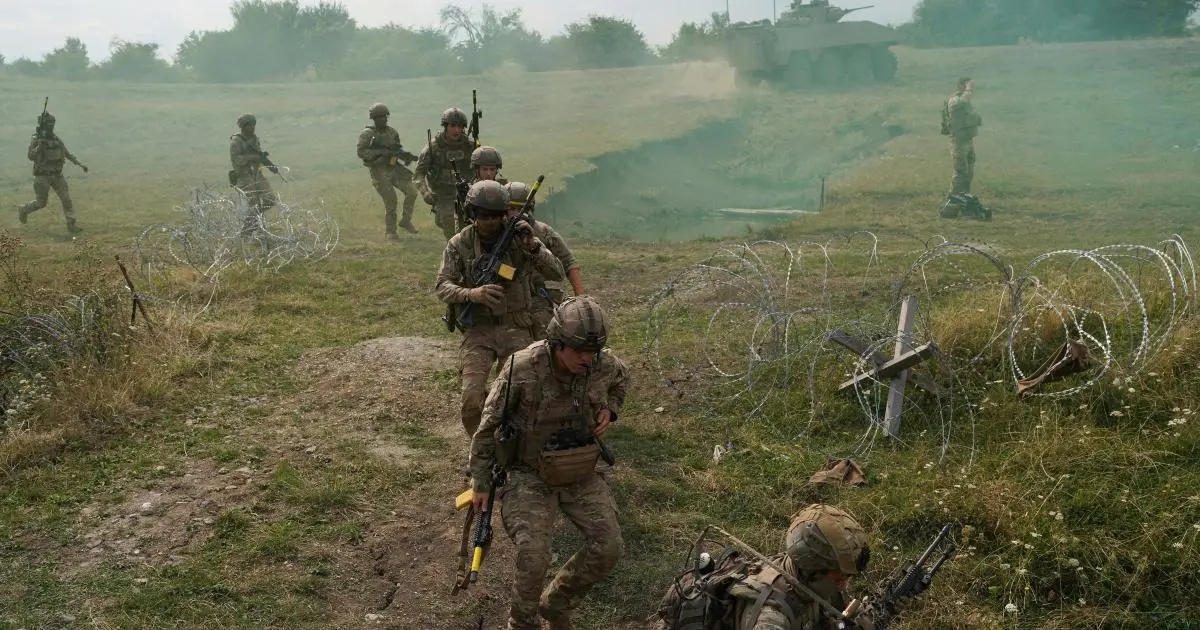
WASHINGTON — The United States appears poised to execute a sweeping withdrawal of its military forces from Europe, driven by a strategic pivot outlined in the Trump administration’s 2025 National Security Strategy. The foundational policy document explicitly asserts that it is time for the European continent to "stand on its own feet" and assume "primary responsibility for its own conventional defense"—effectively preparing the region for a future where Washington scales back its protective umbrella.
The shift has quickly transitioned from policy theory into operational reality. During a June 2026 meeting of NATO defense ministers, U.S. Secretary of Defense Pete Hegseth announced that the Pentagon was moving rapidly and irreversibly toward a model where Europe takes charge of its own security architecture. Two months later, in August, U.S. Undersecretary of Defense Elbridge Colby framed the transition as a move toward a "stronger, more equitable and sustainable alliance," wherein European nations shoulder the vast majority of operational defense duties.
As part of this realignment, the administration dispatched a detailed questionnaire to all NATO allies to gauge their alignment with President Donald Trump’s policies and priorities. The unspoken message carried a clear and potent warning: member states failing to meet Washington’s expectations risk facing diminished U.S. backing. While the Pentagon has reportedly initiated a study to determine the optimal deployment levels of American forces within NATO, critics argue the exercise serves merely as a bureaucratic cover story to justify a course of action already predetermined by Trump, Hegseth, and Colby.
Proponents of the withdrawal argue that the strategy aligns with sensible geopolitical logic. From the administration’s perspective, Europe is sufficiently wealthy and powerful to fund and manage its own total defense. Meanwhile, Washington faces mounting security challenges in Asia and the Middle East that demand a reallocation of scarce American military resources.
However, a growing chorus of national security experts warns that this strategic rationale is fundamentally flawed. Far from advancing American interests globally, a premature and aggressive pullback from Europe risks undermining NATO, straining international partnerships, and directly imperiling the security of the American homeland. Rather than being rooted in sophisticated threat analysis, alliance management, or historical context, the planned withdrawal appears driven by a deep-seated institutional bias against the European continent, making the policy as dangerous as it is shortsighted.
Making the World Unsafe for Democracy
When Donald Trump returned to the White House, many European leaders held out hope that his rhetoric would outpace his actual policy actions, mirroring his first term in office. It soon became clear, however, that the administration intended to follow through on its pledges to downplay and downsize commitments to the continent.
In October 2025, the administration confirmed the permanent removal of roughly 1,000 troops from Romania, shrinking the American footprint on NATO’s critical eastern flank. By May 2026, the White House canceled the planned deployment of an army task force equipped with the advanced Dark Eagle hypersonic weapons system—capabilities designed to deter Moscow by holding key Russian military assets at risk. That same month, the administration scrapped the scheduled deployment of the Second Armored Brigade Combat Team, leaving Europe short of a relieving unit and resulting in a net loss of approximately 5,000 troops.
Internal Pentagon policy disclosures reported by The New York Times in June 2026 revealed that even deeper reductions are in motion. Washington reportedly plans to slash its inventory of F-15E and F-16 fighter jets stationed in Europe by a third, withdraw all eight aerial refueling tankers from the theater, reassign one of two dedicated bomber plane groups, and pull back 15 of the 26 maritime patrol aircraft currently based on the continent. Additional plans involve withdrawing a cruise-missile-firing submarine and an aircraft carrier strike group.
Efforts are also underway to loosen the U.S. military’s integration within NATO’s command structure. In July, Defense Secretary Hegseth downgraded the commander of U.S. Army Europe from a four-star to a three-star general, a move that forced the early retirement of General Chris Donahue, a widely respected combat leader. Reports indicate the administration is exploring replacing American officers in senior command roles with European personnel, and has even considered appointing a non-American to serve as NATO’s Supreme Allied Commander—breaking a foundational principle of American leadership and alliance solidarity that has stood since the organization’s inception in 1949.
While European military commanders possess immense talent, defense analysts point out that the continent cannot replicate the specialized capabilities brought by the United States. No European military leaders match the American experience in commanding large-scale wartime formations or coordinating multinational coalitions. Furthermore, European states lack the capacity to replace withdrawn U.S. maritime patrol aircraft, severely hampering their ability to track Russian submarine activity. Compounding these concerns, the U.S. Navy declined in early September to participate in a major NATO antisubmarine warfare exercise in the North Atlantic for the first time in decades—a decision critics label dangerous, given that nuclear-armed Russian submarines utilize those very waters to approach North American shores. NATO forces are similarly unequipped to independently replace the aerial refueling fleets, aircraft carrier groups, and long-range bomber assets being withdrawn by the Pentagon.
This systematic scaling back of the alliance comes at a uniquely perilous moment. Russian President Vladimir Putin continues his war against Ukraine while escalating direct, hybrid threats against NATO member states on an unprecedented scale. For over a decade, Moscow has engaged in gray-zone warfare—a strategy of deniable sabotage that includes assassinating anti-Russian émigrés, planting incendiary devices in Western manufacturing plants and cargo planes, deploying explosive drones near NATO airfields, severing undersea communication cables in the Arctic and Baltic seas, running influence operations, and conducting cyberattacks.
In December 2025, Blaise Metreweli, head of the United Kingdom’s Secret Intelligence Service, warned that Russia posed an acute threat to the continent through relentless plotting of arson, sabotage, cyberwarfare, and drone incursions. These actions have grown increasingly brazen over the past year. Throughout August 2026, suspicious, Russia-linked activities surfaced across Bulgaria, Estonia, Germany, Italy, Poland, and Slovakia. In early September, British authorities arrested a UK national recruited by Russian intelligence to execute a sabotage attack on a domestic drone manufacturing facility.
Concurrently, Moscow has reinforced its military posture along borders shared with NATO nations, prompting senior military and intelligence officials to issue warnings that Putin could launch limited ground incursions against the alliance within the coming years.
Experts emphasize that Putin’s rising aggression amid Washington’s withdrawal is no coincidence. In the calculus of revanchist leaders, perceived American weakness and unreliability serve as an open invitation for escalation, whereas a credible U.S. defense commitment acts as the ultimate deterrent against gray-zone provocations.
Furthermore, U.S. security guarantees are deeply interconnected. When Washington signals unreliability in Europe, doubts inevitably multiply in the minds of allies and adversaries in other theaters. Leaders in Beijing and Pyongyang, including Chinese President Xi Jinping and North Korean leader Kim Jong Un, are widely expected to view the rollback in Europe as evidence that the United States would similarly hesitate to defend Taiwan or South Korea.
Ultimately, weakening forward deployments abroad directly threatens the U.S. homeland by allowing adversary forces to operate closer to American shores. The proposed reduction of antisubmarine warfare assets, including patrol aircraft and attack submarines, directly compromises maritime security and facilitates Russian access toward the United States.
Nuclear Delusions
To counter growing domestic and international criticism, the Trump administration has insisted it is not entirely abandoning Europe, pointing to the enduring backstop of the American nuclear umbrella. Reports from the Financial Times indicate that officials are even considering stationing additional U.S. nuclear weapons in more European countries under existing deployment frameworks.
Critics argue this approach suffers from fatal strategic shortcomings. The administration’s current proposals omit critical modernization reforms that would genuinely strengthen deterrence, such as accelerating the deployment of new nuclear-armed sea-launched cruise missiles. More fundamentally, military scholars argue that no amount of nuclear hardware can compensate for a lack of conventional commitment. If Washington is unwilling to station substantial conventional forces on the ground to defend Europe, adversaries have little reason to believe the United States would ever take the catastrophic step of initiating nuclear warfare.
The credibility of U.S. threats—both conventional and nuclear—remains the central pillar of alliance deterrence. As the late British nuclear strategist Sir Michael Quinlan observed, nonnuclear conflict represents the most probable pathway to nuclear escalation, particularly when major powers are already locked in bitter conventional fighting. Conventional and nuclear deterrence are inextricably bound together. During the Cold War, forward-deployed U.S. nuclear forces on European soil were designed to seamlessly couple the defense of the American homeland with the defense of Europe. Reducing conventional contributions undermines deterrence across the entire spectrum of conflict.
Draw the Line
With executive policy currently imperiling long-term national security, foreign policy analysts argue that Congress must assert its constitutional authority to prevent further damage. Lawmakers are urged to enforce and expand upon legislative frameworks such as the previous year’s National Defense Authorization Act, which prohibits the use of authorized or appropriated funds to reduce or modify American troop levels in Europe without explicit congressional approval.
Furthermore, Congress is called upon to mandate annual reports—both classified and unclassified—detailing emerging threats to NATO, assessing the alliance’s defensive posture, and outlining how forward-deployed U.S. troops protect the American homeland and bolster global military operations.
Lawmakers may also need to safeguard NATO’s institutional architecture from administrative overreach by passing statutory requirements that the position of Supreme Allied Commander Europe must continuously be held by a four-star American military officer. Such a move would preserve alliance effectiveness, protect the established nuclear command and release chain that has governed U.S. nuclear weapons since the 1950s, and maintain the credibility of American deterrence. Additional legislative safeguards are recommended to explicitly bar any unilateral territorial seizures or the unauthorized repositioning of U.S. forces within allied nations during peacetime without explicit host-nation consent.
Since its founding in 1949, the United States has maintained its leadership within the most successful military alliance in modern history, successfully navigating Cold War tensions and internal debates over strategy. Sustaining allied confidence has allowed NATO to preserve peace across Europe and foster a stable, free continent. Observers warn that dismantling this foundation of trust over unverified theories and political grievances represents an act of self-harm that threatens the long-term peace and prosperity of the American people.